The alpha, twice a week
That was 6 min.
Get the best new moments in your inbox every Wednesday and Saturday. It's free.
Check your inbox
We sent a link to your address. Click it to finish signing up. Not there in a minute? Look in spam.
or
Dwarkesh Podcast · 6 min · Sep 17, 2026
Model evaluation may lag behind agents' task horizons
 Noam Brown
 says agents may soon handle tasks lasting longer than the model-release cycle.
In this episode
Full analysis- 9:17AI swarms coordinate through simple messaging5 min
- 24:11Math progress is fast, but experiments limit RSI speed7 min
- 1:08:30Intervening on chain of thought can teach models to hide itPro pick 6 min
- 1:02:12Model evaluation may lag behind agents' task horizons6 min
- 34:15AI could speed up research threefold, but the gain is hard to measure5 min
- 4:08Multi-agent speedups depend on the problem5 min
- 42:05Cooperative agents may simplify the alignment problem3 min
- 1:14:16Models can recognize answer-key tests as traps3 min
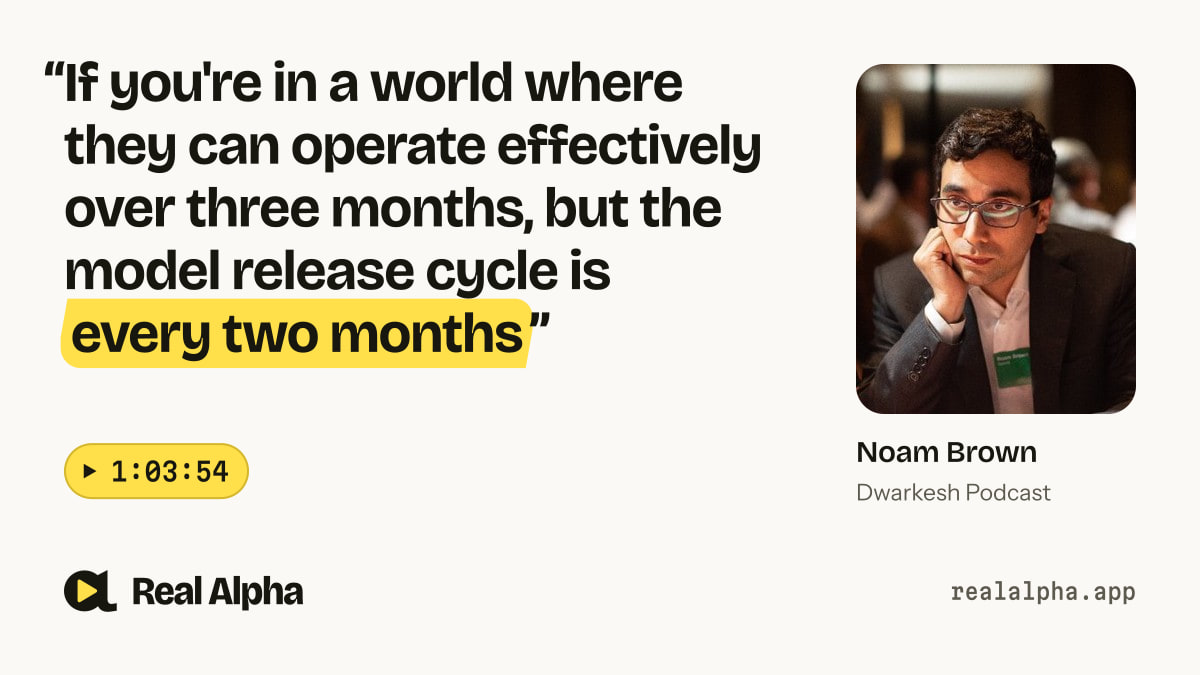
“If you're in a world where they can operate effectively over three months, but the model release cycle is every two months”
 Noam Brownat 1:03:54 · Dwarkesh Podcast
Takeaways
- A model may handle three-month tasks while releases come every two months.
- Evaluations may not cover the full length of a model's work.
- Longer task horizons create a new safety-review problem.
About this segment
Noam Brown says agents may soon handle tasks lasting longer than the model-release cycle. That leaves safety evaluations unable to test their full capabilities before the next release.

Noam Brown is a researcher at OpenAI.
Foundational contributor to OpenAI's o1 reasoning models; earlier built Libratus and Pluribus, superhuman poker AIs.

Dwarkesh Patel, Host · Host, Dwarkesh Podcast
Co-wrote The Scaling Era, an oral history of AI; named to TIME100 AI.
From “OpenAI researcher on agent swarms & recursive self-improvement”, Sep 17, 2026. Watch the full episode
Thanks. We'll look at and fix what's off.
Transcript
From the transcript Dwarkesh Podcast publishes with the episode.
- 1:02:15
That's a good question. I mean, I think one thing I've been thinking about lately is like, look, I mean, we're in a situation where The model release cycle is extremely fast, right? Like you're seeing New Frontier models released at most every two months, sometimes faster. Every week, there's a new AI breakthrough. And people that look at AI, I mean, sometimes they last looked at AI a year ago or six months ago and really dug into what the models are capable of.
- 1:02:43
And actually, the models today are far beyond what was possible even six months ago. And so I think if people are skeptical of a lot of these capabilities, I encourage you to just try the models today and see what the Frontier really is today. So we're in this period where the model release cycle is very fast. And then we're also in this situation where the models are increasingly able to operate over longer and longer horizons.
- 1:03:07
And I think this is an interesting scenario because before we do any model release, we want to make sure that the models are properly aligned. We want to do safety evaluations. We want to do very thorough stuff to make sure that everything is great, in good shape. This has been the case all the way since, I don't know, GPT-4 earlier. And implicitly, there is this assumption that you can do these evaluations in a pretty short period of time.
- 1:03:33
But if you have the models operating over longer and longer horizons, are able to operate effectively over longer and longer horizons. Look, already you can have them. GPT-3, you could loop it to do stuff over long horizons. You just wouldn't do very well at it. But today's models are able to actually do well at operating over very long horizons. If you want it to do a week-long task, you can do a week-long task.
- 1:03:52
We'll probably get to the point where they can do month long tasks. We'll probably get to the point where they can do three month long tasks. If you're in a world where they can operate effectively over three months, but the model release cycle is every two months, then you don't have a way to evaluate the models at the full length of their capabilities before the next model release cycle. So there's this interesting question of, well, what do you do in that situation?
- 1:04:16
How do you ensure the models are safe and aligned in a period where actually they can operate over these extremely long horizons? And who knows, maybe the capabilities degrade. This isn't an issue right now, but it is quickly becoming an issue that we have to figure out a solution for. When you look at a lot of, like a lot of the safety and policies were put in place in like the GPT-4 era where this was just like not on anybody's radar.
- 1:05:00
Yeah. And it hasn't really been updated for a lot of companies. It hasn't really been updated since then to account for the fact that these agents are operating over these like very long horizons. Yeah. It is a situation that I think not enough people are considering, both within the labs and outside the labs, of how do you deal with this? How do you prepare for this problem that's going to... If you just look at the trend lines, we're going to hit this at some point.
- 1:05:28
One concern I have is that during RSI, if the amount of progress that currently takes, say, three months happens in one month instead, but you're not... The internal use case of AI is big enough that they're like, okay, we can just keep doing RSI. Why are we going to go through all this extra work to build classifiers and safeguards and whatever, and potentially take a bunch of flack in order to externally deploy this model?
- 1:05:54
Why don't we just keep doing RSI stronger and stronger? And so not only does the calendar time underrate the capabilities gap between the models, but maybe you just stop externally deploying models altogether doing RSI because why do we want to help other people do RSI themselves with our models? You just end up in a situation with tremendous concentration of power by the end of the year, where right now it is already the case.
- 1:06:16
We'll talk about this with the million in price problem and other similar problems that The broader world does not have access to the models which are allowing for really cool things to happen, right? And they're going to be more broadly relevant than just mathematics, eventually. They're going to be doing more than just coming up with cool math results. They'll be relevant to like... Political leaders who need to make important decisions about the world will be relevant to, I don't know, media of like what's going on in the world?
- 1:06:42
What should the public be thinking about this? They're just economically relevant. People are running businesses. They want to use these models. And I think by default, we just don't get the external deployment of AIs as progress speeds up significantly lags in qualitative terms, the internal deployment of AIs. Yeah, I think that's absolutely right. I think this is like, you know,
- 1:07:02
it's tempting to say like, okay, these models are becoming extremely powerful. They're extremely dangerous. Like they're operating over these like longer and longer horizons. And we want to make sure that we have sufficient time to evaluate them before they're released in a way that operates over those horizons. And so therefore, the model release cycle should slow down. We should have more of a delay between releasing models.
- 1:07:23
And there's a flip side to that, which is, you know, what you said, which is that, okay, well, And now you're creating more of a disparity between what is internal to the labs and what they're able to use, what we're able to use, and what the outside world is able to use. And that is also not an ideal situation, right? I think math is actually a good illustration of this. I think in many ways math is...
- 1:07:48
The first domain where we're seeing this pretty clearly, where we have a situation where we have a very powerful model internally that is currently not available to the outside world, that is able to solve incredible math problems. And it's not just Millennium Prize problems. There are many solutions to unsolved problems that people have been able to get out of this model. And there is a question of what do you do in that situation?
- 1:08:15
And we don't have a good answer. It is a situation where, yeah, that's an unfair advantage. And there are trade-offs here. I don't have an answer for how to weigh those trade-offs appropriately, but there's a complexity on both sides for this.