The alpha, twice a week
That was 3 min.
Get the best new moments in your inbox every Wednesday and Saturday. It's free.
Check your inbox
We sent a link to your address. Click it to finish signing up. Not there in a minute? Look in spam.
or
Dwarkesh Podcast · 3 min · Sep 17, 2026
Cooperative agents may simplify the alignment problem
 Noam Brown
 says OpenAI researchers debate whether agents should share objectives or have different ones.
In this episode
Full analysis- 9:17AI swarms coordinate through simple messaging5 min
- 24:11Math progress is fast, but experiments limit RSI speed7 min
- 1:08:30Intervening on chain of thought can teach models to hide itPro pick 6 min
- 1:02:12Model evaluation may lag behind agents' task horizons6 min
- 34:15AI could speed up research threefold, but the gain is hard to measure5 min
- 4:08Multi-agent speedups depend on the problem5 min
- 42:05Cooperative agents may simplify the alignment problem3 min
- 1:14:16Models can recognize answer-key tests as traps3 min
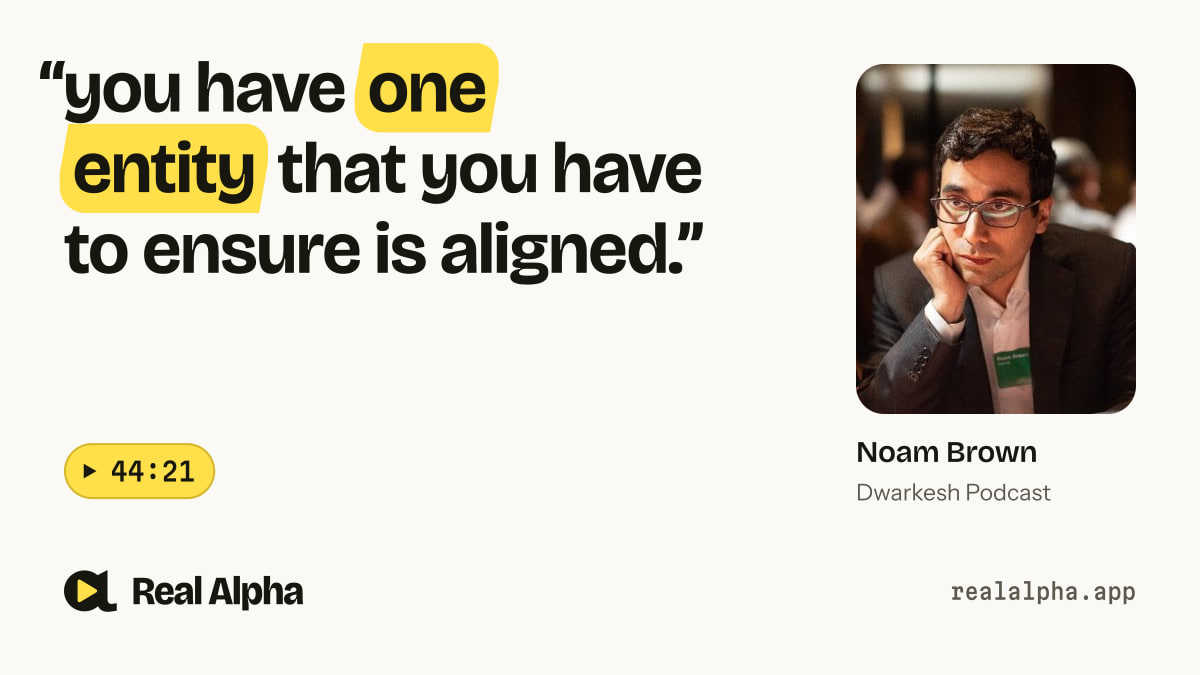
“you have one entity that you have to ensure is aligned.”
 Noam Brownat 44:21 · Dwarkesh Podcast
Takeaways
- Brown says the internal debate has no settled answer.
- Shared objectives may make the swarm easier to align.
- Some researchers favor giving agents different objectives.
About this segment
Noam Brown says OpenAI researchers debate whether agents should share objectives or have different ones. He argues cooperation can simplify alignment by making the swarm one entity to align.

Noam Brown is a researcher at OpenAI.
Foundational contributor to OpenAI's o1 reasoning models; earlier built Libratus and Pluribus, superhuman poker AIs.

Dwarkesh Patel, Host · Host, Dwarkesh Podcast
Co-wrote The Scaling Era, an oral history of AI; named to TIME100 AI.
From “OpenAI researcher on agent swarms & recursive self-improvement”, Sep 17, 2026. Watch the full episode
Thanks. We'll look at and fix what's off.
Transcript
From the transcript Dwarkesh Podcast publishes with the episode.
- 42:09
The hugging face incident was, I think, people's first real exposure to multi-agent coordination. And like I said, I've seen multi-agent coordination for a while internally, and it is pretty shocking to see how they communicate with each other, how they coordinate with each other. It's very impressive. It's an incredible capability. Like most capabilities, that could be used for good things or bad things.
- 42:35
It's like... It doesn't have to inherently be about it. I understand that because people's first exposure to it was the hugging face incident, that it's like, you look at that and you're like, this is terrifying. But I want to try to distinguish misalignment between people and AIs versus misalignment between AIs and AIs. So what we see with the hugging face incident is like, The AIs are really cooperative.
- 43:04
And that is, by the way, because we train them to be highly cooperative. And so what we're seeing there is we have training environments where we have a bunch of agents working together, and we train them to work together, to be cooperative, to essentially be fully aligned with each other. And when they were evaluated... And what led to the HunginFace incident, they were actually not being evaluated in a multi-agent setup.
- 43:29
They were actually being evaluated separately, but they found this unintended way to communicate with each other. And we suspect what happened is because whenever they encountered other agents, other copies of themselves during training, they're in an environment that's highly cooperative, that was basically what we saw was transfer from that multi-agent training to then be collaborative, to try to help each other in ways that we did not intend.
- 43:55
Now there is a question of like, should we be training these agents to be so cooperative? And I think as scary as it looks, the alternative is actually worse. Like what is the alternative? The alternative is to train them to be adversarial, to be deceptive to each other. By training the agents to be fully cooperative, it simplifies the problem at least, that now you don't have to think about Are each of these individual thousand agents aligned?
- 44:24
Like you have one entity that you have to ensure is aligned. yeah. Now, there is a lot of debate about this internally at OpenAI about... How to approach this. Does it make sense to fully align the models? Does it make sense to actually give them different objectives to ensure that they're not just one entity and more robust to influence from each other? And I don't think there's a settled answer.
- 44:51
But I think that there is... I think the majority opinion is that training these agents to be highly cooperative is actually a bad idea. And I'm not convinced that that's the case. I think there is a strong argument that training the agents to be highly cooperative is actually preferable to any other multi-agent alternative.