The alpha, twice a week
That was 3 min.
Get the best new moments in your inbox every Wednesday and Saturday. It's free.
Check your inbox
We sent a link to your address. Click it to finish signing up. Not there in a minute? Look in spam.
or
Sourcery · 3 min · Oct 2, 2026
AI training has shifted from tests to real work
 Jonathan Siddharth
 says data work has moved from expert-scored benchmarks to simulated environments modeled on real workflows.
In this episode
Full analysis- 22:28Reward systems must account for models gaming the testPro pick 5 min
- 27:36Enterprises can improve agents through their own learning loopsPro pick 5 min
- 32:16Open models let enterprises retain control of core workflows5 min
- 1:29AI training has shifted from tests to real work3 min
- 16:34RL environments should yield 20–40% agent success4 min
- 42:10Compute, energy and data benefit whoever wins the AI race3 min
- 55:01AI will improve steadily, but enterprise adoption will take time3 min
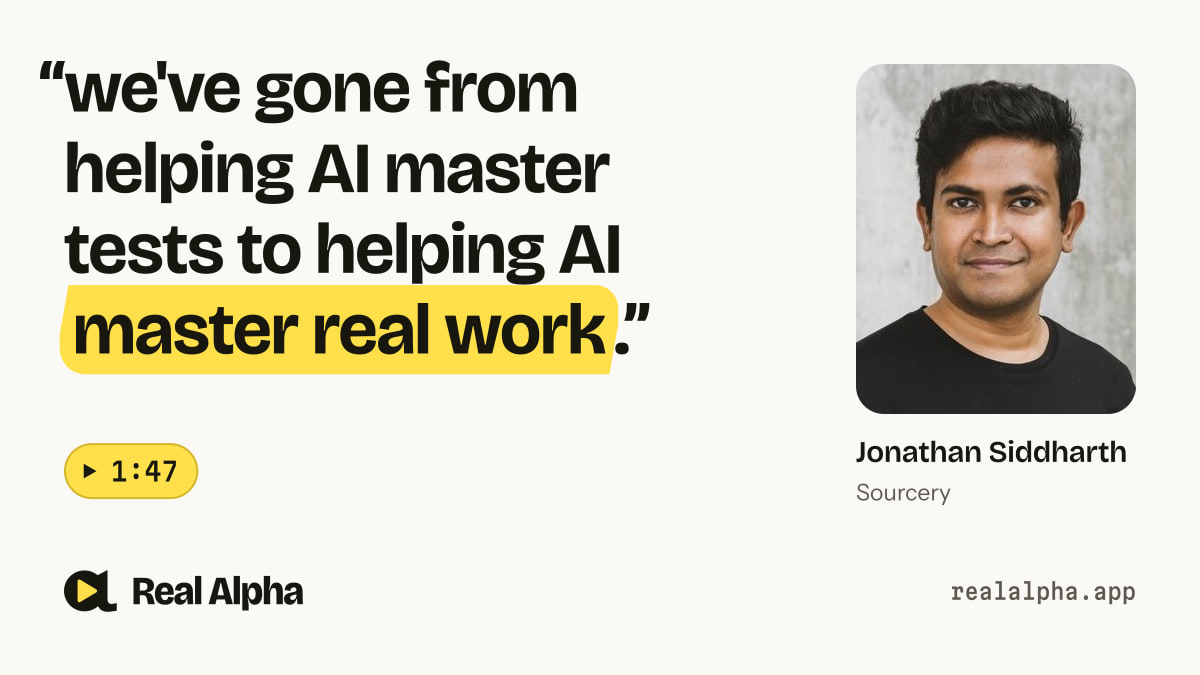
“we've gone from helping AI master tests to helping AI master real work.”
 Jonathan Siddharthat 1:47 · Sourcery
Takeaways
- Earlier training transferred expert knowledge through dialogue and evaluation.
- Current RL training uses simulations modeled on real workflows.
- Enterprise deployments can reveal how professionals actually work.
About this segment
Jonathan Siddharth says data work has moved from expert-scored benchmarks to simulated environments modeled on real workflows. That shifts the need toward realistic prompts, verifiers and seed data.

Jonathan Siddharth is co-founder and CEO of Turing.
Co-founded Turing, which now powers nearly every frontier AI lab, including OpenAI, Anthropic and Google.

Molly O'Shea, Host · Founder, Sourcery
Ex-Upfront Ventures investor; has interviewed Alex Karp and Palmer Luckey.
From “If an AI Model Can Cheat, It Will | Turing CEO on Reward Hacking”, Oct 2, 2026. Watch the full episode
Thanks. We'll look at and fix what's off.
Transcript
Transcribed by machine (Whisper) from the episode’s audio, so a word may be off here and there.
- 1:34
A lot has changed, right? Even by AI standards, there's a lot of stuff that has happened in the last few months. The data landscape has completely shifted in 2026, from my vantage point. The biggest observation I have is that we've gone from helping AI master tests to helping AI master real work. Back in the era of helping AI master tests, like when we were happy that AI is passing the SATs, passing the bar, winning a gold medal in the Math Olympiad, the paradigm, the game was different.
- 2:14
It was about finding experts in every different domain. The question was about, like, how many experts can you find? And extracting knowledge from their heads by having them have a dialogue with the model, having them evaluate model outputs. It was about transferring knowledge from the minds of experts into the models. I used to think of it like distilling human knowledge and skills into LLMs. Now, in the era of having AI master real work, it's less about finding experts.
- 2:48
It's more about how close to reality can you engineer these simulated environments. It's all about these simulated RL environments. And inside these environments, these agents train. And you still need experts to make sure the environment that we build is as close to reality. and you want experts to help you come up with the right prompts, the right verifiers, the right seed data, I think of it a little bit like the matrix.
- 3:20
Like, can you recreate a rich enough simulation of the world so that when the agents train in that, they end up being good in the real world as well? At Turing, this has been super fun because we have this unique advantage where we don't just help all the Frontier Labs improve their models in coding and knowledge work. We have an entire division dedicated to deploying agentic systems into the enterprise.
- 3:49
And because we deploy, we get to see real process workflows. We get to see how real professionals work with these agentic systems. They define real verifiers, and that helps us build these simulated environments that are very close to reality to automate knowledge work.