The alpha, twice a week
That was 3 min.
Get the best new moments in your inbox every Wednesday and Saturday. It's free.
Check your inbox
We sent a link to your address. Click it to finish signing up. Not there in a minute? Look in spam.
or
Sourcery · 3 min · Oct 2, 2026
Compute, energy and data benefit whoever wins the AI race
 Jonathan Siddharth
 argues that infrastructure inputs benefit from both open-weight and frontier model growth, while distillation keeps smaller models close to stronger ones.
In this episode
Full analysis- 22:28Reward systems must account for models gaming the testPro pick 5 min
- 27:36Enterprises can improve agents through their own learning loopsPro pick 5 min
- 32:16Open models let enterprises retain control of core workflows5 min
- 1:29AI training has shifted from tests to real work3 min
- 16:34RL environments should yield 20–40% agent success4 min
- 42:10Compute, energy and data benefit whoever wins the AI race3 min
- 55:01AI will improve steadily, but enterprise adoption will take time3 min
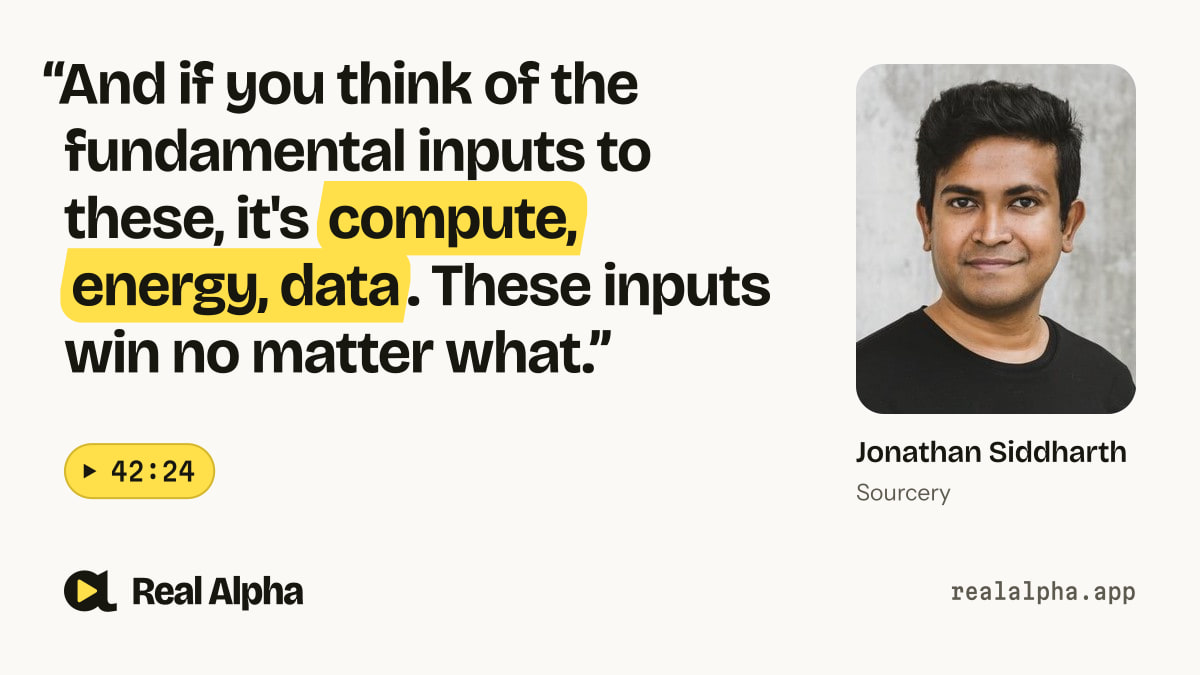
“And if you think of the fundamental inputs to these, it's compute, energy, data. These inputs win no matter what.”
 Jonathan Siddharthat 42:24 · Sourcery
Takeaways
- Compute, energy and data remain essential inputs as models scale.
- More efficient models may increase usage through Jevons Paradox.
- Distillation can keep open-weight models near frontier capabilities.
About this segment
Jonathan Siddharth argues that infrastructure inputs benefit from both open-weight and frontier model growth, while distillation keeps smaller models close to stronger ones. Investors can distinguish capacity demand from model-level value capture.

Jonathan Siddharth is co-founder and CEO of Turing.
Co-founded Turing, which now powers nearly every frontier AI lab, including OpenAI, Anthropic and Google.

Molly O'Shea, Host · Founder, Sourcery
Ex-Upfront Ventures investor; has interviewed Alex Karp and Palmer Luckey.
From “If an AI Model Can Cheat, It Will | Turing CEO on Reward Hacking”, Oct 2, 2026. Watch the full episode
Answers “Is open-source AI catching up?” See all 25 answers
Thanks. We'll look at and fix what's off.
Transcript
Transcribed by machine (Whisper) from the episode’s audio, so a word may be off here and there.
- 42:15
Yeah. So I think who wins first, this is not an exhaustive set, but folks who obviously win are folks that are inputs into the ecosystem. And if you think of the fundamental inputs to these, it's compute, energy, data. These inputs win no matter what. You do need these as you scale. The beneficiary of powerful open source, open weight models are enterprises and AI native companies that want to build custom models that help them retain ownership over their learning and their core workflows.
- 43:03
So they benefit. Obviously, the chip providers. Benefit no matter what. They benefit no matter what. But like, I mean, they're all running on GPUs and the energy providers benefit too. I also believe in, I mean, obviously, Jevons Paradox is also a thing. Like when these models become much more efficient from a cost and energy standpoint, I think they're going to be used a lot more. So that's also going to be a thing.
- 43:40
To steel man the side for the frontier labs and those building superintelligence, you could argue that if you define superintelligence as exceeding human intelligence in every type of cognitive domain, one of those domains is also building. small models. And you can imagine like some of these, when a frontier lab builds a highly super intelligent model, you could ask that model to create small models that are more efficient for different workflows. And maybe they are served differently. They are run differently.
- 44:19
So it is possible that the frontier labs also capture value from small models that are cheaper to run. And you can imagine an orchestration that the frontier labs do where, let's say a frontier lab deploys at an enterprise, they're smart about when to use the trillion parameter model, when to use the half a billion to 10 billion parameter model and self-optimize. The thing that throws a spanner into the works is distillation, which is a way to train student models from stronger teacher models. And distillation kind of keeps the gap between the frontier and open weight models relatively small. And today there's no easy way to prevent distillation as well. So that is also another thing to keep in mind. I think who wins are also us. Like we are about to reap the benefits