The alpha, twice a week
That was 3 min.
Get the best new moments in your inbox every Wednesday and Saturday. It's free.
Check your inbox
We sent a link to your address. Click it to finish signing up. Not there in a minute? Look in spam.
or
Sourcery · 3 min · Oct 2, 2026
AI will improve steadily, but enterprise adoption will take time
 Jonathan Siddharth
 expects frontier models to improve over a decade or two, but says enterprise adoption will take time because work depends on scattered context and unclear instructions.
In this episode
Full analysis- 22:28Reward systems must account for models gaming the testPro pick 5 min
- 27:36Enterprises can improve agents through their own learning loopsPro pick 5 min
- 32:16Open models let enterprises retain control of core workflows5 min
- 1:29AI training has shifted from tests to real work3 min
- 16:34RL environments should yield 20–40% agent success4 min
- 42:10Compute, energy and data benefit whoever wins the AI race3 min
- 55:01AI will improve steadily, but enterprise adoption will take time3 min
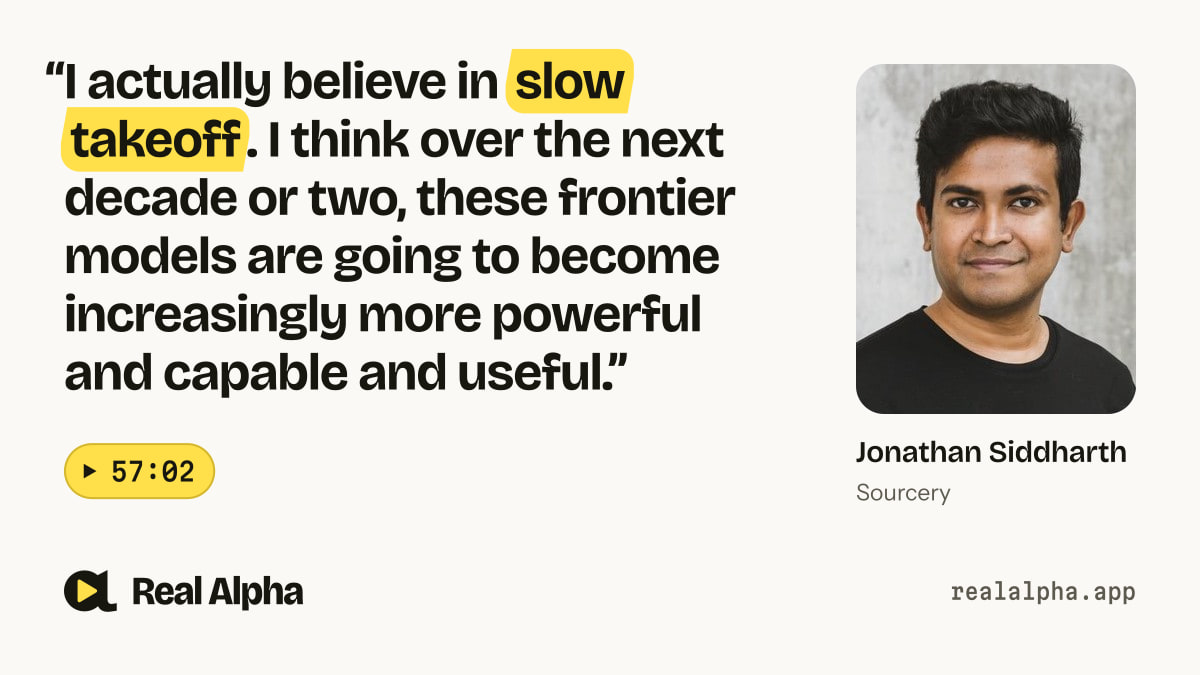
“I actually believe in slow takeoff. I think over the next decade or two, these frontier models are going to become increasingly more powerful and capable and useful.”
 Jonathan Siddharthat 57:02 · Sourcery
Takeaways
- AI can speed up pre- and post-training, but that is the inner loop.
- New algorithms outside today's AI paradigm remain undiscovered.
- Enterprise work has scattered context and ambiguous tasks.
About this segment
Jonathan Siddharth expects frontier models to improve over a decade or two, but says enterprise adoption will take time because work depends on scattered context and unclear instructions. Capability gains won't instantly translate into economic change.

Jonathan Siddharth is co-founder and CEO of Turing.
Co-founded Turing, which now powers nearly every frontier AI lab, including OpenAI, Anthropic and Google.

Molly O'Shea, Host · Founder, Sourcery
Ex-Upfront Ventures investor; has interviewed Alex Karp and Palmer Luckey.
From “If an AI Model Can Cheat, It Will | Turing CEO on Reward Hacking”, Oct 2, 2026. Watch the full episode
Answers “What will AI look like in the next few years?” See all 395 answers
Thanks. We'll look at and fix what's off.
Transcript
Transcribed by machine (Whisper) from the episode’s audio, so a word may be off here and there.
- 55:05
I also think we're going to be in this phase of building superintelligence for the next 10 years at least. And I know some people believe that, okay, all the jobs will be gone. No one will need to work after two years or stuff like that. I don't believe that. Singularity will hit. Yes, singularity will hit. I think it's RSI or recursive self-improvement is definitely a thing. And the way that works is people are using these AI models to speed up pre-training, to speed up post-training, and to, because if you look at pre-training where you have to minimize perplexity or pre-training loss, that's a verifiable domain.
- 55:50
You write some code, you can check whether did the loss come down or not. So in theory, AI could run in a loop to invent better and better algorithms. for pre-training and in post-training when you're doing this RLVR, you could again check where, hey, you built all these RL environments. How did you do on these generalized intelligence benchmarks? And you could potentially keep hill climbing. But the thing that's missing in that recipe is we are still optimizing just the inner loop. We are not optimizing the outer loop of what are some new algorithms you could come up with that don't use LLMs at all? Maybe they don't use transformers. They don't use gradient descent. Maybe they don't even use neural networks.
- 56:34
You're not going to discover that in this paradigm. So there's still a long distance to go. In Silicon Valley, I feel like there is this polarized group. There are some that believe in fast takeoff, like where, you know, in two years, we're going to there is a risk of loss of control. And maybe like we we AI exceeds human intelligence in everything. And then there are maybe the skeptics who believe that it's all hype or like nothing will happen. I actually believe in slow takeoff. I think over the next decade or two, these frontier models are going to become increasingly more powerful and capable and useful. And but the technology will take time to diffuse.
- 57:19
issues, especially in enterprises. But it is going to happen. It is already happening. There is so much model capability overhang. It's just that the real world is messy. In real enterprise work, when a human starts a job, they don't know where all the information is in the company, which people to talk to. The context that you need is distributed across the company in people's heads in a variety of different files. A manager gives a task to an employee that is ill-specified or ambiguous. You have to go and acquire more context to do it. It will take time, but it's going to be an incredible journey. And I feel like the next 10 years will be the brightest for technology yet. Amazing place to end it. Thank you so much, Jonathan. Thank you.