The alpha, twice a week
That was 4 min.
Get the best new moments in your inbox every Wednesday and Saturday. It's free.
Check your inbox
We sent a link to your address. Click it to finish signing up. Not there in a minute? Look in spam.
or
Silicon Valley Girl · 4 min · Nov 24, 2026
AI’s next opportunities will extend beyond software engineering
 Vlad Tenev
 points to healthcare and robotics as sectors AI has barely reached, arguing software was simply easier to automate first.
In this episode
Full analysis- 15:15Generic AI trading prompts are unlikely to produce alphaPro pick 5 min
- 40:00Measure AI productivity by output, quality, and speed4 min
- 43:28A CEO can reverse course without defending past decisions4 min
- 3:02More AI-company growth is shifting to private markets4 min
- 30:11AI’s next opportunities will extend beyond software engineering4 min
- 34:30Robinhood’s AI adoption has more than doubled its product pace4 min
- 47:04Benioff connects company values to budgets and headcount3 min
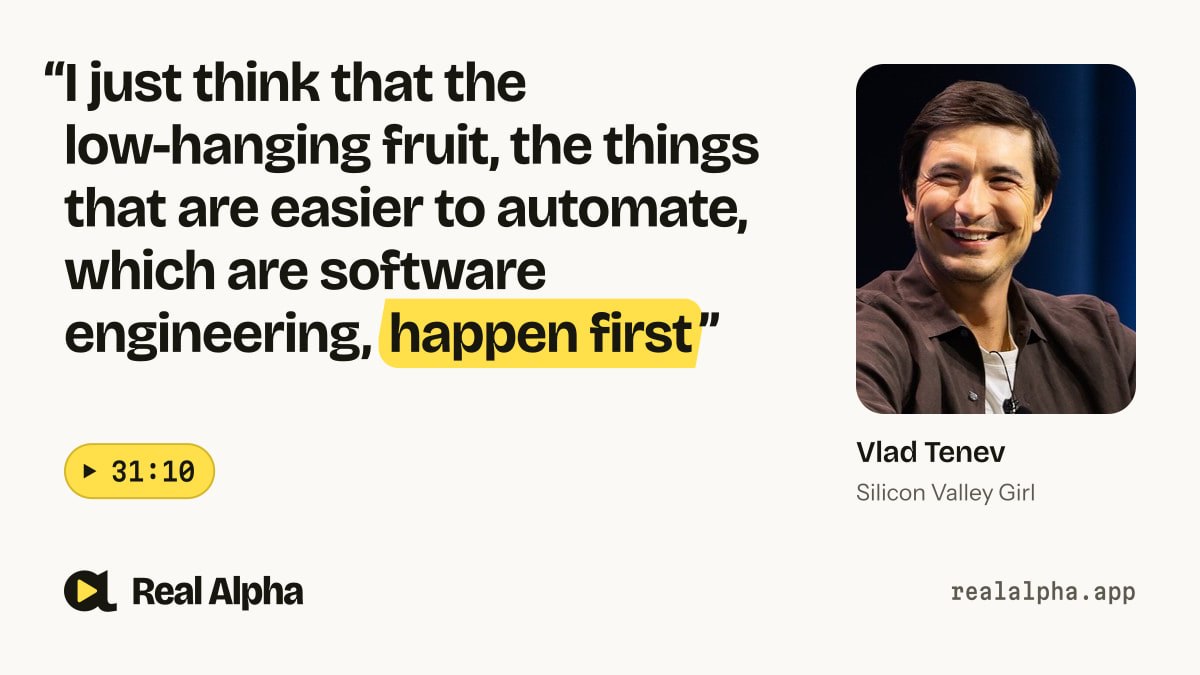
“I just think that the low-hanging fruit, the things that are easier to automate, which are software engineering, happen first”
 Vlad Tenevat 31:10 · Silicon Valley Girl
Takeaways
- Healthcare services and robotics remain largely untouched by AI.
- Software engineering was an early target because it was easier to automate.
- Finding a real human need is still part of building a product.
About this segment
Vlad Tenev points to healthcare and robotics as sectors AI has barely reached, arguing software was simply easier to automate first. He also says founders need to automate software development while staying focused on human needs.

Vlad Tenev is cofounder and CEO of Robinhood.
Co-founded Robinhood in 2013, then steered it from a $500M loss in 2023 to a $1.1B profit.

Marina Mogilko, Host · Host, Silicon Valley Girl
Co-founded LinguaTrip and built Linguamarina, an English-learning YouTube channel with almost 9M subscribers.
From “Robinhood CEO: How to Build Wealth in the AI Era (Before It's Too Late)”, Nov 24, 2026. Watch the full episode
Thanks. We'll look at and fix what's off.
Transcript
Transcribed by machine (Whisper) from the episode’s audio, so a word may be off here and there.
- 30:23
And you mentioned in Vanity Fair that you want hundreds of thousands of single-person unicorns. Yeah. So if you were to start today with, I don't know, $5,000 and AI agents, what would you build? I think that there's a lot of areas that AI intelligence still hasn't touched very deeply that are very, very important. I mean, let's look at health care, for instance. right uh we have so much intelligence so much progress has been made in coding and making it easier to create software but the uh experience of getting health services you know end-to-end whether you're going to a hospital paying insurance or doing like direct-to-consumer healthcare hasn't really been touched. And I don't think there's anything inherent in that that makes it difficult to reimagine with AI. I just think that the low-hanging fruit,
- 31:26
the things that are easier to automate, which are software engineering, happen first, but then you'll see diffusion through all the sectors of the economy. So think about healthcare is one, but it's not the only one. I mean, anything physical and robotics, there's very little that's actually happened in robotics. I mean, there's a lot of prototypes, but you're not seeing robots building our houses or doing construction. And I think the next 10 years will be how can we take this intelligence that we've built and that's predominantly digital and apply it to all of these domains that haven't been touched by it yet.
- 32:09
What would be your advice to founders today? I'm talking to a lot of builders, and what I'm seeing is that compared to even like five years ago, you have to run so much faster. I remember somebody said to me, it's not soil, it's lava they're running on. But if you run fast enough, like you can make it. Well, I think that for a while with any new technology, speed is an advantage. I mean, AI as a technology will make you move faster because basically it's free to create code now.
- 32:43
And so much of the actual underlying substrate between creating a company in Silicon Valley has been how quickly can you get software out and can you produce it in a way that works and deliver it to customers. The production of software has gotten cheaper. And I'd say if you're not thinking about how to automate your entire software development lifecycle, you're probably not going to make it in this new era.
- 33:10
I mean, if you're writing code by hand, it's probably going to be very, very difficult. Not impossible. I think that there's some part of building a successful product that's actually identifying a human need and making sure that you actually solve that human need. And I don't think that has been automated yet, the discovery of that process and the customer. But I think it's going to be much more difficult than it needs to be if you're writing code by hand.