The alpha, twice a week
That was 4 min.
Get the best new moments in your inbox every Wednesday and Saturday. It's free.
Check your inbox
We sent a link to your address. Click it to finish signing up. Not there in a minute? Look in spam.
or
Silicon Valley Girl · 4 min · Nov 24, 2026
More AI-company growth is shifting to private markets
 Vlad Tenev
 contrasts Home Depot’s early valuation with trillion-dollar AI listings, then argues more growth is moving into private markets.
In this episode
Full analysis- 15:15Generic AI trading prompts are unlikely to produce alphaPro pick 5 min
- 40:00Measure AI productivity by output, quality, and speed4 min
- 43:28A CEO can reverse course without defending past decisions4 min
- 3:02More AI-company growth is shifting to private markets4 min
- 30:11AI’s next opportunities will extend beyond software engineering4 min
- 34:30Robinhood’s AI adoption has more than doubled its product pace4 min
- 47:04Benioff connects company values to budgets and headcount3 min
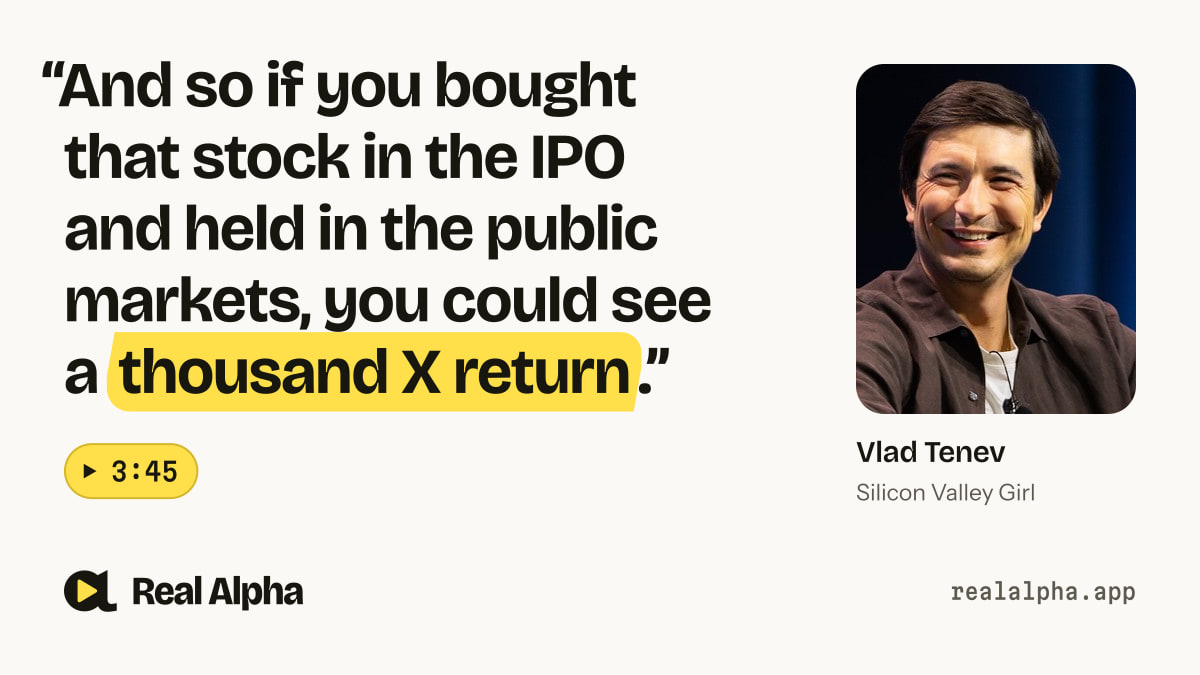
“And so if you bought that stock in the IPO and held in the public markets, you could see a thousand X return.”
 Vlad Tenevat 3:45 · Silicon Valley Girl
Takeaways
- A 1,000× return from a $1T IPO valuation implies a $1 quadrillion company.
- Vlad says more company growth is increasingly happening in private markets.
- Robinhood Ventures aims to offer retail investors private-company exposure.
About this segment
Vlad Tenev contrasts Home Depot’s early valuation with trillion-dollar AI listings, then argues more growth is moving into private markets. It explains why access before IPO matters and what Robinhood Ventures aims to offer.

Vlad Tenev is cofounder and CEO of Robinhood.
Co-founded Robinhood in 2013, then steered it from a $500M loss in 2023 to a $1.1B profit.

Marina Mogilko, Host · Host, Silicon Valley Girl
Co-founded LinguaTrip and built Linguamarina, an English-learning YouTube channel with almost 9M subscribers.
From “Robinhood CEO: How to Build Wealth in the AI Era (Before It's Too Late)”, Nov 24, 2026. Watch the full episode
Thanks. We'll look at and fix what's off.
Transcript
Transcribed by machine (Whisper) from the episode’s audio, so a word may be off here and there.
- 3:15
conversation because I feel like people, they don't understand what's going on. These companies are going public at a $1 trillion valuation. We saw SpaceX, which is actually down from being up 19 percent on their first day now it's only about 5% over their IPO price. Do you think there's way more potential to grow? I think your point is definitely a good one. I mean, you look back at Apple or Amazon or Microsoft.
- 3:41
I mean, you had these companies that went public at valuations of hundreds of millions, right? I was just listening to a podcast on Home Depot. Home Depot went public in the early 80s at a valuation of, I want to say, 50 million, right? And so if you bought that stock in the IPO and held in the public markets, you could see a thousand X return. And obviously, if a company goes public at a valuation of one trillion, to get that thousand X return in the public markets, it would have to reach a valuation of one quadrillion, which may be, I'm not going to say it's impossible, but you're starting to get into the aggregate size of the entire global economy at those scales.
- 4:27
So those are some big numbers. There's obviously still growth in public markets. You can find it, but a lot of the growth is increasingly in private markets, which is one of the reasons why we're working to solve this problem with Robinhood Ventures, which gives exposure to high-quality private companies, to individual retail investors on Robinhood before they go public. That's kind of one of my big crusades, one of the things I'm very passionate about.
- 4:55
I mean, Robinhood's real origin is to take what the wealthy have enjoyed and have benefited from for a long time and democratize that and make that available to the general public. And it started out with stocks and access to options and just easy access to these asset classes. But increasingly, the wealthy always find ways to get better and newer things, and they're very innovative, really, as a class of people, which means our mission really is never done.
- 5:30
There's always new stuff. Increasingly, that's private markets, and so one of my crusades is to democratize private markets, which Robinhood Ventures is the first step in doing. I think we're basically the only ones that are trying to tackle that challenge and come up with a real solution in the U.S. And I think it really addresses the problem where there's so much fear around AI because people can't participate in it.
- 5:51
They see all the headlines, AI is taking my job, AI is changing everything, and you see all the billionaires that emerge because of AI, and they're like, how can I participate? So for me, the solution was I just buy Google stock because it's easy, it's on the market, and they own part of Entropic, they invested in SpaceX. What would be your advice to people who are trying to participate in this? I mean, I think that there is not a great solution up until Robinhood Ventures, but I'll put Robinhood Ventures aside because I don't want to be talking my book. That's what we're trying to solve with it, right? So many of the innovative AI companies are still private.
- 6:31
And you have this revolution, which really started in 2022. So it hasn't been going for that long. It's about four years since ChatGPT came out and it kind of ushered in this new renaissance in AI. You know, four years, a very short period of time to go public. So if we don't find a solution to this and if more people don't start doing what we're doing and kind of innovating in the private markets frontier, there's a good chance that an entire generation could be left behind of these gains.