The alpha, twice a week
That was 5 min.
Get the best new moments in your inbox every Wednesday and Saturday. It's free.
Check your inbox
We sent a link to your address. Click it to finish signing up. Not there in a minute? Look in spam.
or
Sources · 5 min · Nov 10, 2026
AWS expects capacity shortages and stages its spending
 Matt Garman
 says customer commitments help AWS forecast demand, while staged purchases let it delay some spending until needs are clearer.
In this episode
Full analysis- 41:38Mathematical proofs could make AI agents safer4 min
- 14:07Compute boom risks depend on how providers finance and sell capacity3 min
- 2:21AI is accelerating the move of core workloads to the cloud3 min
- 38:02AWS reserves compute for startups not yet formed2 min
- 16:59A 50% drop in inference costs can drive tenfold usage3 min
- 9:29AWS expects capacity shortages and stages its spending5 min
- 19:59AWS says local benefits are key to data center support5 min
- 28:22Garman sees deserts as likelier data center sites than space3 min
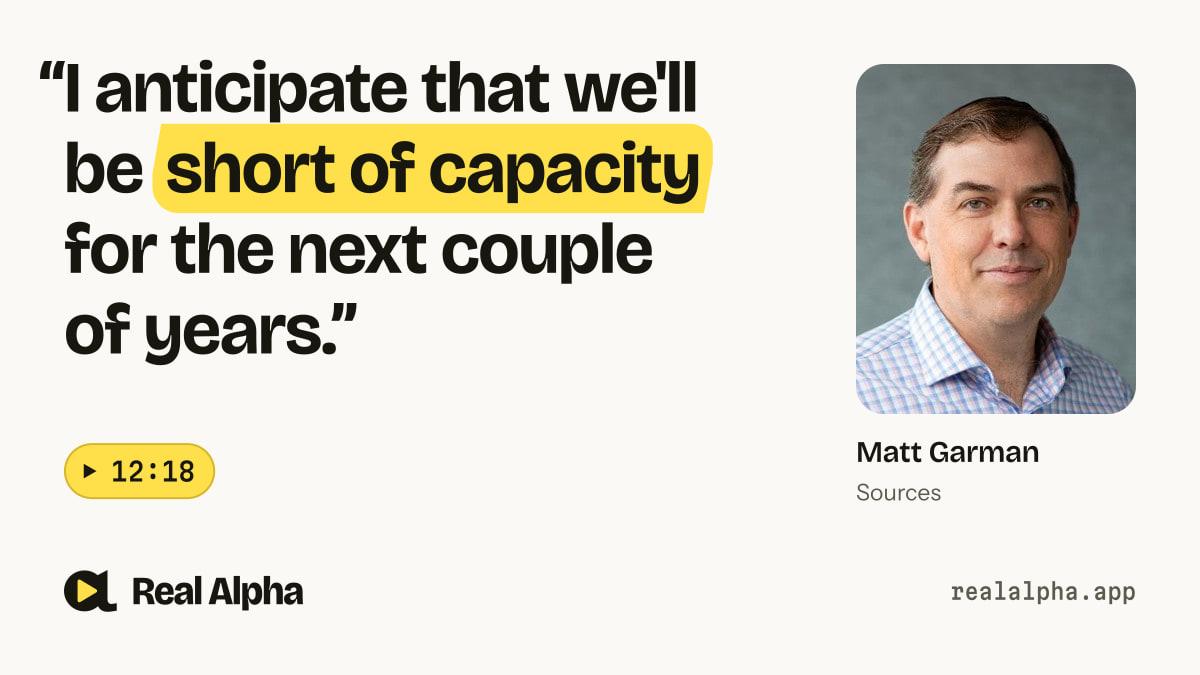
“I anticipate that we'll be short of capacity for the next couple of years.”
 Matt Garmanat 12:18 · Sources
Takeaways
- AWS offers customers controls such as spend caps and model-cost adjustments.
- Customer commitments help establish a baseline for demand forecasts.
- AWS can buy land and power early, then delay server purchases.
About this segment
Matt Garman says customer commitments help AWS forecast demand, while staged purchases let it delay some spending until needs are clearer. Even so, he expects demand to exceed supply for a couple more years.

Matt Garman is CEO of AWS.

Alex Heath, Host · Founder & host, Sources
Left The Verge to start Sources in 2025; it has made over $1M since, mostly from sponsors.
From “AWS CEO Matt Garman on building a $1 trillion business”, Nov 10, 2026. Watch the full episode
Thanks. We'll look at and fix what's off.
Transcript
Transcribed by machine (Whisper) from the episode’s audio, so a word may be off here and there.
- 9:33
Something that does feel new though about this moment, I agree with you, but when you scale right now, especially if you're AI heavy and you're doing a lot of inference, you can, I think it's Linux fireworks, but I've heard the concept of like, you can scale into bankruptcy. There's a sense of like, you know, you can't scale because of the compute, which you have most of. So I'm curious how you think about that and how you advise, you know, companies and startups you meet with that are facing that issue.
- 9:59
Because I think it's a really real issue. It is a very real issue. and actually we're thinking deeply and actually investing in more robust cost management tools for companies so that they can do exactly that. Customers want tools that on the range from, you know, shut my account down when it hits this dollar amount. Like, I don't care. It's okay. Like, I'll figure it out, but I don't want to spend more than this to alert me when I hit this dollar amount to, if it's an inference, maybe ratchet my usage from an expensive model to a cheaper model And we're trying to think about what are all of the tools and controls that we can give customers so that they can actually feel confident about that cost management.
- 10:40
Even larger customers, by the way, it's not necessarily the small customers that are worried about spending $10,000 and not being able to afford it. But even large companies are saying, you know what, I may want this particular person to be able to spend largely uncontrolled. But, you know, Alex, on your personal account, you know, it's $100 and then I shut it down or whatever it is. And so really giving those fine-grained controls so that companies of all sizes have that, I think, is incredibly important.
- 11:07
I think from a capacity point of view, it is a real concern. And it's part of why we're spending so much on CapEx and investing in this infrastructure. We're of this fortunate position. I think a lot of people are worried about things like concentration risk when you're spending capital and things like that. for us, we spread that usage across, you know, we have tens of hundreds of thousands, millions of customers that are all using AWS. And so when I see all of, you know, a lot of that comes from a broad swath of companies, that's where we feel confident that we can go and put down a lot of capital and really grow the amount of compute that's available for customers, because we get really good signals as to where they're all growing, what it looks like, what demand is going to look like next year, what it's going to look like the year after that. And we have good
- 11:49
signals and many of our larger customers will commit to five, sometimes even eight, nine, 10 year commitments on their spend with us. But most of them are in the kind of, you know, three, four or five, six year commitments, but that gives us really good visibility as to what their growth is going to look like. And oftentimes those customers, frankly, will outspend their commitments, but it's more a baseline, but it gives us a good sense of where that growth is going to be.
- 12:11
And unfortunately, you know, well, fortunately or unfortunately, but right now the demand is far out stripping the supply. And so even spending as much capex as we are investing as much as we are ahead in capacity, I anticipate that we'll be short of capacity for the next couple of years. Can you see into 2030? Some, you know, I think you can see trends. I can't personally, otherwise, you know, you're an alchemist.
- 12:33
Yeah. I'll do some sports betting or something, but we get signals, right? And there's, you know, how we think about it. Actually, it a little bit goes back to the kind of the supply chain roots of Amazon, where we really think about how do we manage our full supply chain? And then at AWS, we really think about how do I spend money at the last possible minute so that I have as much possible information as I have while giving myself option value to hit the upside, right? Because I'd like to, the optimal is I would have exactly as much capacity as I need.
- 13:05
You're never going to be perfect. You don't want to overspend and you don't want to wildly underspend in that capex. And so what we do is you think about what are those long lead time components that you have to go spend on? You have to buy land, you have to acquire power contracts, you have to, you know, get permitting, things like that. Then as you get closer to like landing a data center, you might have to buy networking equipment, you might have to buy generators, you might have to buy some of those other pieces. So if you're going all the way up to 2030, I might be buying lands today that I plan to use in 2030. We're not buying servers, you know, we're not buying all of those things. And so I can wait for a lot of the capex expenses that I would need to support my 2030 proposed growth until much closer to 2030. And so I don't have
- 13:45
to have perfect views into 2030. You can have directions on where they go. And if we're wrong, probably resell land. And it's, you know, worst case you lost a little bit on appreciation or not, but mostly it's a durable asset that you can resell. And so we think about our investments kind of staged that way. And it takes some of the risk out of there as we think about it, but it requires a lot of long-term planning and thinking and watching kind of the various variables that you have in there.