The alpha, twice a week
That was 3 min.
Get the best new moments in your inbox every Wednesday and Saturday. It's free.
Check your inbox
We sent a link to your address. Click it to finish signing up. Not there in a minute? Look in spam.
or
Sources · 3 min · Nov 10, 2026
Garman sees deserts as likelier data center sites than space
 Matt Garman
He sees space as impractical for at least a decade or two, citing launch, heat and servicing constraints, and finds oceans difficult too.
In this episode
Full analysis- 41:38Mathematical proofs could make AI agents safer4 min
- 14:07Compute boom risks depend on how providers finance and sell capacity3 min
- 2:21AI is accelerating the move of core workloads to the cloud3 min
- 38:02AWS reserves compute for startups not yet formed2 min
- 16:59A 50% drop in inference costs can drive tenfold usage3 min
- 9:29AWS expects capacity shortages and stages its spending5 min
- 19:59AWS says local benefits are key to data center support5 min
- 28:22Garman sees deserts as likelier data center sites than space3 min
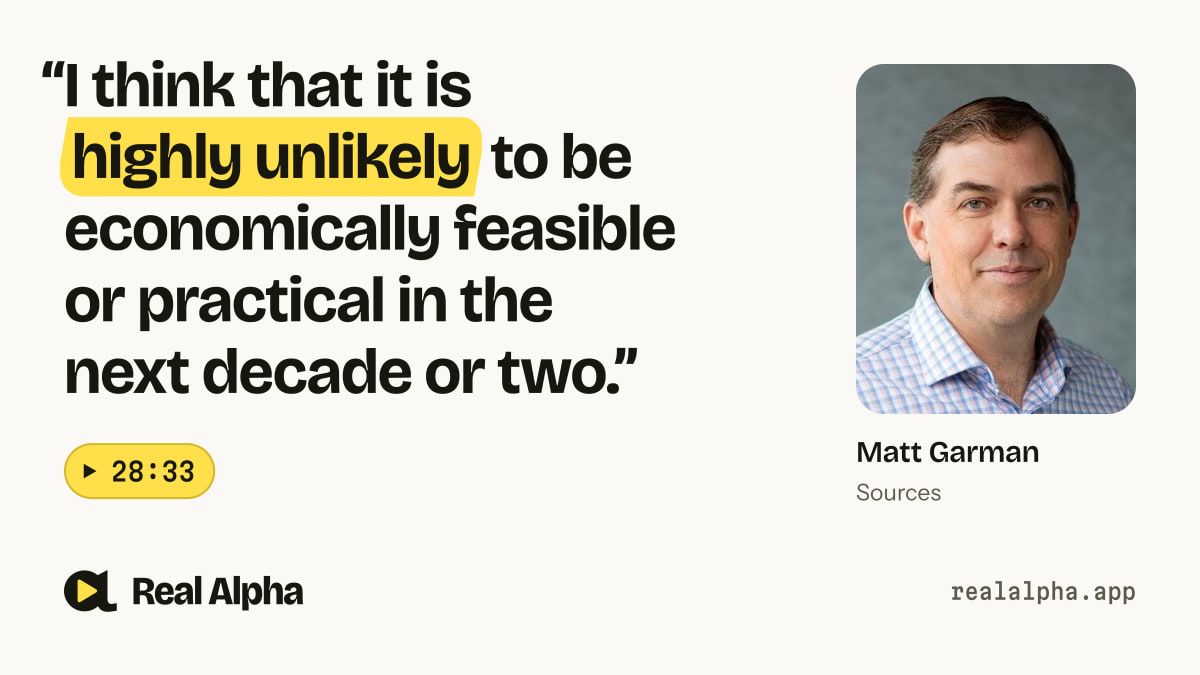
“I think that it is highly unlikely to be economically feasible or practical in the next decade or two.”
 Matt Garmanat 28:33 · Sources
Takeaways
- He sees orbital data centers as impractical for at least 10–20 years.
- Launch capacity and heat removal are major obstacles in space.
- Deserts offer solar access and room for cooling infrastructure.
About this segment
He sees space as impractical for at least a decade or two, citing launch, heat and servicing constraints, and finds oceans difficult too. Deserts look likelier because they offer solar access, room and cooling options.

Matt Garman is CEO of AWS.

Alex Heath, Host · Founder & host, Sources
Left The Verge to start Sources in 2025; it has made over $1M since, mostly from sponsors.
From “AWS CEO Matt Garman on building a $1 trillion business”, Nov 10, 2026. Watch the full episode
Thanks. We'll look at and fix what's off.
Transcript
Transcribed by machine (Whisper) from the episode’s audio, so a word may be off here and there.
- 28:25
right now. So, there's space, ocean, and desert. People are excited about these to varying degrees. Maybe we can start with space. What do you think about data centers in space? I think that it is highly unlikely to be economically feasible or practical in the next decade or two. Decade or two? Yeah. Okay. So, that's a no on space then. I mean, here's the thing is, it sounds good. You get free energy and it's up there somewhere.
- 28:53
there. That's great. Number one, launches are still relatively infrequent and expensive. You're always trying to fix that, but yes. Okay. Yeah. But to your point. Still waiting. Yeah. Like it's a great, I appreciate it. But one person's not going to fix it. And still, I don't know, there's, we as a world don't do one launch a day today, the whole world. And the data center, we're landing in a data center today, one GPU every 14 seconds.
- 29:23
Wow. So we don't do a launch a day for the world. And that's just us doing one GPU. You know, there's obviously like, so let's say one launch. And by the way, a rack of GPUs, you know, might weigh a ton. So I don't even know if you can stick that on a launch vehicle or how many you can get up there. You know, people talk about gigawatt data centers and megawatts of racks and whatever, like most solar panels and things drive kilowatts, not gigawatts.
- 29:47
So you need these gigantic things that are up there. They're still, they're really hot, And everyone's like, space is cold. Space also doesn't have air. Actually, dissipating heat in space is actually quite hard. And so that's actually, it's just a really hard environment. There's radiation everywhere, so you have to build things. It's going to be way more expensive to build servers. From a serviceability point of view, by the way, these are all technically solvable problems.
- 30:08
Yeah, it's going to take a while. And it's just going to take a while. Yeah. Like, I'm not saying any one of these things that I can highlight are not impossible. Yeah. And I just think that it's way far out. OK. Oceans, though? Oceans, there's some of those same problems. I think you get cooling, which is good. You have things floating in the water and moving. It's a little harder. So I find oceans to be also probably impractical.
- 30:32
I think deserts of those three that you mentioned are by far the most likely. You have relatively good environmental areas. You actually have heat sinks. You have solar areas that you can do it. I think deserts are very interesting and potentially. Also, when you go to liquid cooling, actually cooling the data center becomes actually a little bit of an easier problem in some dimensions with regards to energy usage at least. So I think ocean or deserts could be a interesting place particularly because, yeah, like you can also like lay a cable. Like it turns out that like actually the data transfer and stuff is pretty useful. And there's no people there, which may be good for the climate we're in. Well, yeah, I mean, look, yes, although then there's no one to benefit from kind of an increased tax base or anything like that too.
- 31:20
So like there are, it turns out people like living in towns. They like where they have high paying jobs. Like there's a bunch of things that like having those things nearby, it just means the high paying jobs aren't going to be in your town. The tax base is not going to be in your town. Like there's a lot of those things that are not great. Yeah. That people kind of say like, Ooh, actually that do want that. I'm really curious what you make of all of these inference providers that are popping up.