The alpha, twice a week
That was 2 min.
Get the best new moments in your inbox every Wednesday and Saturday. It's free.
Check your inbox
We sent a link to your address. Click it to finish signing up. Not there in a minute? Look in spam.
or
Sources · 2 min · Nov 10, 2026
AWS reserves compute for startups not yet formed
 Matt Garman
 says AWS deliberately leaves some future accelerator capacity uncommitted rather than selling it all to large customers.
In this episode
Full analysis- 41:38Mathematical proofs could make AI agents safer4 min
- 14:07Compute boom risks depend on how providers finance and sell capacity3 min
- 2:21AI is accelerating the move of core workloads to the cloud3 min
- 38:02AWS reserves compute for startups not yet formed2 min
- 16:59A 50% drop in inference costs can drive tenfold usage3 min
- 9:29AWS expects capacity shortages and stages its spending5 min
- 19:59AWS says local benefits are key to data center support5 min
- 28:22Garman sees deserts as likelier data center sites than space3 min
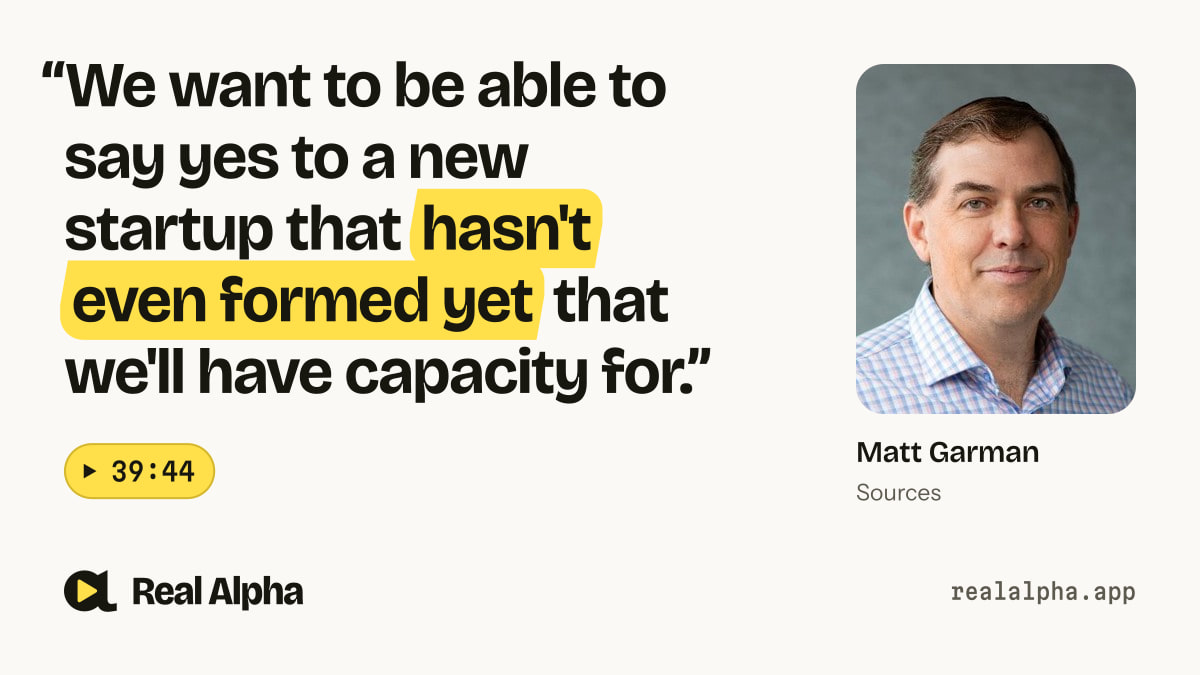
“We want to be able to say yes to a new startup that hasn't even formed yet that we'll have capacity for.”
 Matt Garmanat 39:44 · Sources
Takeaways
- AWS holds regular meetings to weigh demand against finite capacity.
- Some capacity stays available for startups and smaller enterprise requests.
- Customers may get compute later or in a different region.
About this segment
Matt Garman says AWS deliberately leaves some future accelerator capacity uncommitted rather than selling it all to large customers. That keeps room for enterprise requests and startups that have not yet formed.

Matt Garman is CEO of AWS.

Alex Heath, Host · Founder & host, Sources
Left The Verge to start Sources in 2025; it has made over $1M since, mostly from sponsors.
From “AWS CEO Matt Garman on building a $1 trillion business”, Nov 10, 2026. Watch the full episode
Thanks. We'll look at and fix what's off.
Transcript
Transcribed by machine (Whisper) from the episode’s audio, so a word may be off here and there.
- 38:06
And so it's one that we will be investing in and doing more and more over time. How do you decide compute allocation across the fleet now when you've got to deal with startups, the guys in the garage who want to build something, massive training clusters with huge equity partnerships you have with large labs? How do you balance that? It's hard. We spend a lot of time doing it. I wish I had some magic- Do you have daily allocation meetings?
- 38:31
It doesn't need to be daily, but we have regular allocation meetings where we actively debate how we think about where we can. I'd love to say yes to everyone, but yes, there's a finite amount of capacity. And as I said, we're adding a ton every day. So oftentimes we're able to say yes. Sometimes we have to go back to customers and say like, I know you want it in two weeks, but it's going to be in four weeks.
- 38:55
Or I know that you want it in the East Coast, but it's going to be in the West Coast. Or it's going to be internationally or it's going to be in India or wherever you have capability or wherever we have capacity. And sometimes they'll say, yes, that works for me. And sometimes no. And then you kind of go back and iterate on some of those. We're very intentional about making sure that we have a diverse customer base.
- 39:13
And so I don't want to sell out 100% of my capacity to just the large labs or the large technology companies. I want to be able to say yes if an enterprise comes along and says, hey, I need 10 GPUs. And I think that's part of the AWS value proposition. And so we very intentionally set aside, same for startups, by the way. There's going to be some startup. I could choose to sell out every single accelerator that I have that I know is landing in 2027 and just be done with it.
- 39:40
We choose not to do that for exactly these reasons. We want to make sure that I can say yes to a bunch of enterprises that come in. We want to be able to say yes to a new startup that hasn't even formed yet that we'll have capacity for. And so we do, we kind of have a portfolio where we, you know, we do commit a good chunk of our capacity well ahead and commit it for long term. And we keep some behind so that we can make sure that we can say yes to a bunch of those folks.
- 40:06
And then we, of course, save a bunch of capacity for Bedrock so that we can support as much of that as possible.