The alpha, twice a week
That was 5 min.
Get the best new moments in your inbox every Wednesday and Saturday. It's free.
Check your inbox
We sent a link to your address. Click it to finish signing up. Not there in a minute? Look in spam.
or
Sources · 5 min · Nov 10, 2026
AWS says local benefits are key to data center support
 Matt Garman
 cites power costs, jobs, tax benefits and a water-positive pledge as parts of AWS's community approach.
In this episode
Full analysis- 41:38Mathematical proofs could make AI agents safer4 min
- 14:07Compute boom risks depend on how providers finance and sell capacity3 min
- 2:21AI is accelerating the move of core workloads to the cloud3 min
- 38:02AWS reserves compute for startups not yet formed2 min
- 16:59A 50% drop in inference costs can drive tenfold usage3 min
- 9:29AWS expects capacity shortages and stages its spending5 min
- 19:59AWS says local benefits are key to data center support5 min
- 28:22Garman sees deserts as likelier data center sites than space3 min
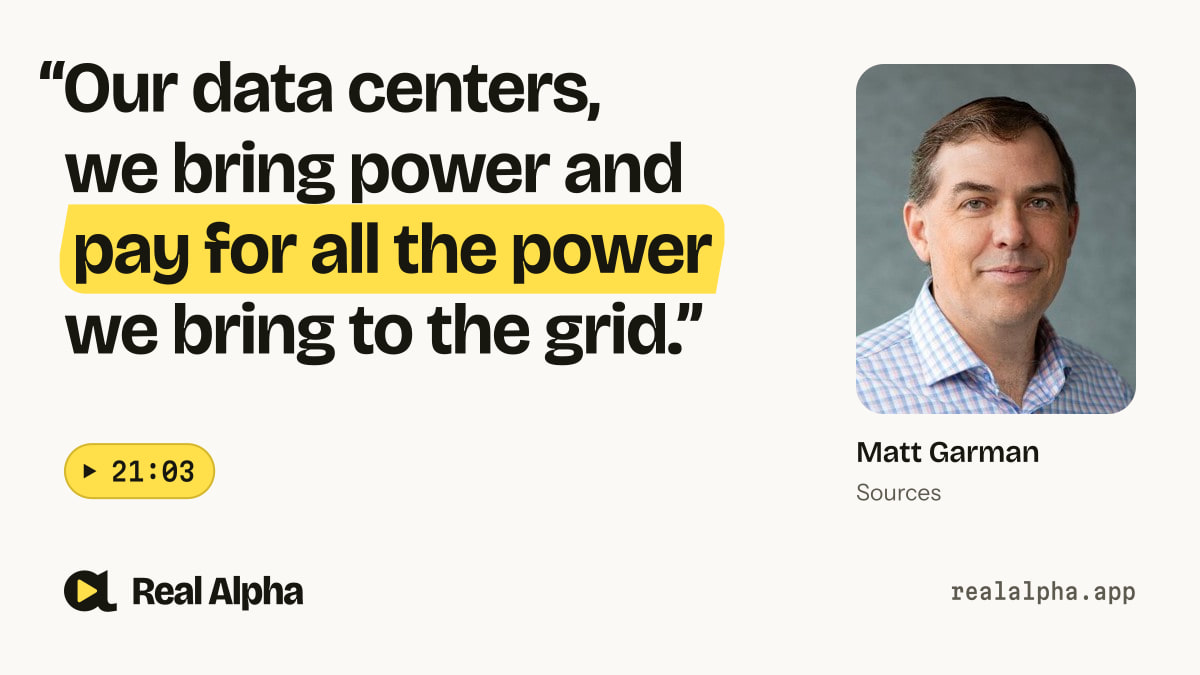
“Our data centers, we bring power and pay for all the power we bring to the grid.”
 Matt Garmanat 21:03 · Sources
Takeaways
- AWS says it pays for the power it brings to the grid.
- It aims to return more water than it uses by 2030.
- Garman wants states to codify community practices into programs.
About this segment
Matt Garman cites power costs, jobs, tax benefits and a water-positive pledge as parts of AWS's community approach. He says the industry should work with states to turn such practices into clearer programs.

Matt Garman is CEO of AWS.

Alex Heath, Host · Founder & host, Sources
Left The Verge to start Sources in 2025; it has made over $1M since, mostly from sponsors.
From “AWS CEO Matt Garman on building a $1 trillion business”, Nov 10, 2026. Watch the full episode
Thanks. We'll look at and fix what's off.
Transcript
Transcribed by machine (Whisper) from the episode’s audio, so a word may be off here and there.
- 20:03
What do you make of where the country is on data centers, especially given the midterms and what happened in Texas where governor campaigned on pausing doled outs, one. And I know you guys have your approach where you do a lot of renewable energy, you're very conservative with water, but at the same time, I just think it's such a lightning rod issue. And it seems like it's going to get worse before it gets better, maybe?
- 20:27
Yeah, I think, look, there's a couple of things here. And I think it's incumbent on us to help educate folks as to that all data center producers are not created equal. And that's true for lots of industries, but today it's largely painted with one brush. And I think that there are a handful of us in the industry that spend a lot of time thinking about how do we make sure that we are great citizens and great community members as part of this. And we learned this early on with some of our fulfillment centers and other things like that. And we learned with data centers, we need to work with local politicians. We need to work with community members.
- 20:59
We need to show that we're bringing high paying jobs in communities. We need to make sure that we have low impact on the communities that we operate in. Our data centers, we bring power and pay for all the power we bring to the grid. We oftentimes, in many of the communities we work in, actually reduce the tax load by thousands of dollars per person in the communities that we operate in. As you think about the environmental impact, we continue where the single largest creator of new carbon zero energy sources over the last five years in the world.
- 21:31
and we continue to bring more carbon zero energy to the grid every single year, huge investments on that front. We were very early in thinking about how we use about water. Actually, we have a commitment that by 2030 will be water positive, where we bring more water to every community that we operate in than we use. And even our data centers, our largest data centers today use less water than 40 US households.
- 21:55
It's like a block, like a block of households. It's actually a relatively small amount of water. I saw a stat that like golf courses use more water. By far. My golf friends don't like that I use that stat. But yes. But yeah, I mean, there's actually, I mean, there are a lot of things out there that use way more water than our data centers. There are ways to run data centers that use lots of water, so we don't do that.
- 22:19
And not everybody takes that path that we do. And I think that it's brought a bad name to people that proudly stand up and say, you know, I go against regulations. I don't even listen. I don't get permits. I just build data centers anyway. They kind of like proudly go against working with the community. That is just not how we do it. Unfortunately, it's kind of brought this bad name to data centers.
- 22:40
And I think it's something we're going to have to work through. But I also think that many of the folks, and even you mentioned the midterms, we work quite closely with many of the folks that are both Democrats and Republicans. Like, and we have, and we will continue to do that. We've done that for five different administrations. And they appreciate it. Like, they will work with them. We don't always agree on all topics, but we work their debate there and figure out how there's win-win scenarios with those things.
- 23:05
And we'll continue to do that. So I feel very good about where we are. And I'm excited. And congratulations to everybody who won in the elections. And we feel good about what we've brought to communities and where we'll continue to go. I think technology is so important to our economy today that we can't just turn it off and decide to not have it. I don't think that that would be good for our country.
- 23:29
Some people want that. they want that they think they do they think they do but then if you ask them like you're going to give up your netflix subscription they're like well no not that and be like okay are you going to stop like instagramming your friends like well okay not that you're going to stop asking amazon to deliver stuff to you no okay not that either but those things all require data centers like it's like it's like there's a weird disconnect there and so a lot of the things that that that um people want i think is i think they want responsible they don't want the kind of technology leaks to tell them what to do but they do like it when people build good products for that they want to use. And our view is that there is a great way to do both of those things.
- 24:04
You don't have to do that. So when you woke up the next day after the results and you saw everything, was there anything you thought about like, man, what do we do? Like, what do we do as an industry? I mean, you've talked about what Amazon does, but like, does the industry as a whole need to do more? Is there anything the industry can do? I do think, and we've been working with several of the governors in the states that we operate at and thinking about how do we help codify some of the stuff that we actually do and some of the things that they want to do into more structured programs that everybody has to follow. And I think that's one of the things that we need to do to both clearly highlight why it's good to have a data center in your community, because it actually brings a tax base, it brings high paying jobs, and why it's important for the
- 24:49
country. Because the alternative is technology will still progress. We would go there, you know, it would happen somewhere else. And I think that would be bad for the security of our country, would be bad for the economy of our country, but the world is not going to stop. And so, kind of thinking about how do you balance what's great for communities, great for people, great for our country, and good and reasonable for companies, so that they're still incentivized to go work on these problems.
- 25:18
And I am very convinced that there is a path there.