The alpha, twice a week
That was 3 min.
Get the best new moments in your inbox every Wednesday and Saturday. It's free.
Check your inbox
We sent a link to your address. Click it to finish signing up. Not there in a minute? Look in spam.
or
No Priors · 3 min · May 1, 2026
Baseten is building an inference-to-training loop
 Tuhin Srivastava
The roadmap combines runtime work, such as separating prefill and decode, with sandboxes, evals and training APIs.
In this episode
Full analysis- 18:32Compute supply is tight and contracts require large bets5 min
- 13:04Customers should prove value before investing in custom modelsPro pick 6 min
- 33:42Founders should hire leaders who can own whole problems3 min
- 1:50Workflow data can give application companies a moat3 min
- 5:33Frontier AI customers reveal enterprise requirements2 min
- 28:14Baseten is building an inference-to-training loop3 min
- 38:12Lower inference costs make agents run longer2 min
- 26:13Nvidia's ecosystem makes near-term chip competition difficult2 min
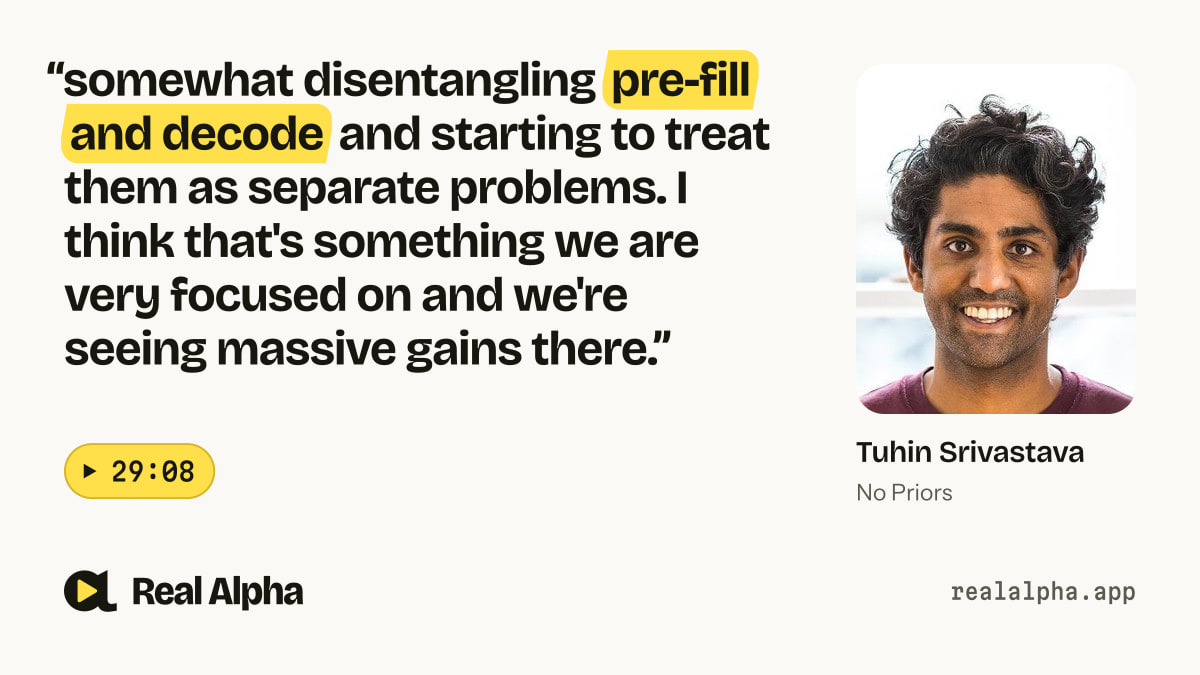
“somewhat disentangling pre-fill and decode and starting to treat them as separate problems. I think that's something we are very focused on and we're seeing massive gains there.”
 Tuhin Srivastavaat 29:08 · No Priors
Takeaways
- Treat prefill and decode as separate runtime problems.
- Build for sandboxes, diffusion and faster inference techniques.
- Connect evals and training to support continual learning.
About this segment
The roadmap combines runtime work, such as separating prefill and decode, with sandboxes, evals and training APIs. Tuhin Srivastava sees those pieces forming a loop that drives more inference.

Tuhin Srivastava is cofounder and CEO of Baseten.
Co-founded Baseten, an AI inference company powering mission-critical workloads for Writer, Abridge and Bland.


From “Baseten CEO Tuhin Srivastava on Custom Models, and Building the Inference Cloud”, May 1, 2026. Watch the full episode
Thanks. We'll look at and fix what's off.
Transcript
Transcribed by machine (Whisper) from the episode’s audio, so a word may be off here and there.
- 28:19
When you think about reacting to the market, what do you think is like happening with the actual workloads that you have to go invest in, right? Like obviously code agents and long horizon agents over time have become a big deal. People talk a lot more about CPU compute, video inference is different. I don't know if it's that, Sandbox, it's like what's important for you guys to invest in now? Yeah, look, I think for us, all the runtime stuff is obviously very important.
- 28:47
And what that means is what chips we run on, how we run, what kind of workloads we support. Do we get very good at diffusion transformers? Yes. Coding agents need sandboxes. We should code with sandboxes. There's all sorts of new speculation techniques to get faster imprints. We need to do that. Even stuff like KV cache away routing and that stuff's a bit old now, but continuing to be very good at that.
- 29:10
and somewhat disentangling pre-fill and decode and starting to treat them as separate problems. I think that's something we are very focused on and we're seeing massive gains there. That's at the runtime level. I'd say beyond that, everything we think about is how to create more of that loop between inference push training because we think that just begets more inference. And so we will build a partner in almost everything there.
- 29:42
So we're going to work with the best evals companies in the world to make sure that's very well integrated, like BrainTrust into and around base 10. We will partner with all on the sandboxes side, build the best sandboxes experience that will exist. And then we'll create the best training. APIs to make it so continual learning becomes somewhat of a solved problem. It's not just like a discrete thing.
- 30:08
That's, I think, the core base 10 product thesis. It's like, how do we build that loop? And then everything around that becomes, how do we make sure that we can do everything we can to ensure that gets the biggest possible? That's access to compute. That's an infrastructure. Make sure we can get compute anywhere. Make sure we have access to our own compute. and then I think it's all the primitives that come after that just that just become incredibly like margin of creative both for us and our customers which is you know stuff like you know sandboxes and like the async batch inference like how we drive utilization by having a first class batch inference experience to me this is like what an inference cloud looks like it's that you are very good at inference and then you you start to do all the things tangential all that loop into
- 30:55
inference and partner and where necessary and build where necessary. But we really do want to own, like start with that core inference story and then go down to unblock supply and create margin and go off the stack to unlock value. What would surprise people about some of the