The alpha, twice a week
That was 2 min.
Get the best new moments in your inbox every Wednesday and Saturday. It's free.
Check your inbox
We sent a link to your address. Click it to finish signing up. Not there in a minute? Look in spam.
or
No Priors · 2 min · May 1, 2026
Frontier AI customers reveal enterprise requirements
 Tuhin Srivastava
Baseten builds for fast-growing AI companies and for startups selling into enterprises.
In this episode
Full analysis- 18:32Compute supply is tight and contracts require large bets5 min
- 13:04Customers should prove value before investing in custom modelsPro pick 6 min
- 33:42Founders should hire leaders who can own whole problems3 min
- 1:50Workflow data can give application companies a moat3 min
- 5:33Frontier AI customers reveal enterprise requirements2 min
- 28:14Baseten is building an inference-to-training loop3 min
- 38:12Lower inference costs make agents run longer2 min
- 26:13Nvidia's ecosystem makes near-term chip competition difficult2 min
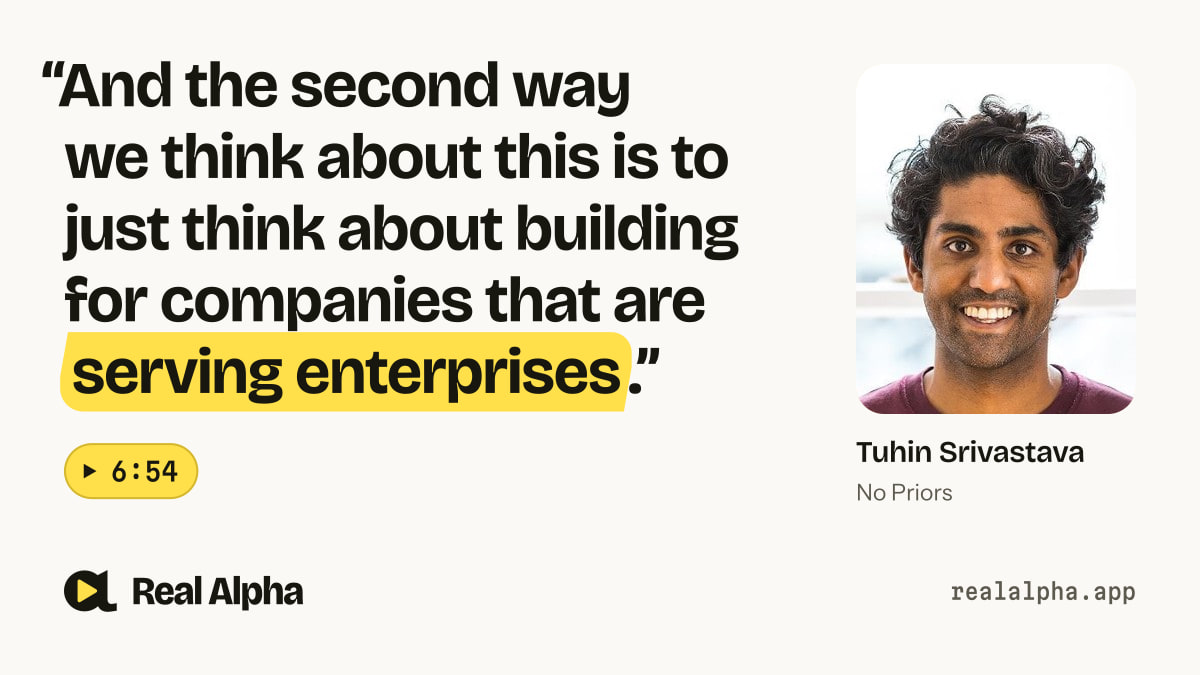
“And the second way we think about this is to just think about building for companies that are serving enterprises.”
 Tuhin Srivastavaat 6:54 · No Priors
Takeaways
- High-scale customers push infrastructure to mature.
- Enterprise-facing startups surface buyer requirements.
- Needs include retention, transparency, GPU types and latency.
About this segment
Baseten builds for fast-growing AI companies and for startups selling into enterprises. Their requests surface enterprise needs such as retention, model transparency, GPU types and latency.

Tuhin Srivastava is cofounder and CEO of Baseten.
Co-founded Baseten, an AI inference company powering mission-critical workloads for Writer, Abridge and Bland.


From “Baseten CEO Tuhin Srivastava on Custom Models, and Building the Inference Cloud”, May 1, 2026. Watch the full episode
Thanks. We'll look at and fix what's off.
Transcript
Transcribed by machine (Whisper) from the episode’s audio, so a word may be off here and there.
- 5:37
Before it was like, hey, are they using AI tools? I don't think that was immediately obvious two years ago. I think it's obvious now, but yes, they are. Are they using closed source model APIs? I think they're starting to get there. And then once you do that and then you kind of see what is possible, then comes the whole custom model adoption. I think that is all that is ahead of us today. So if the majority of your customer base today is, as you described, the former application companies, AI natives, the fast growing, some of them are at considerable scale now, like the abridged cursor, open evidences of the world.
- 6:14
What do they teach you? What does that push the company to do? How do you think about serving them versus evolving for the enterprise? Yeah. I think, firstly, you just learn a lot by building with the company's greatest scale, doing the most interesting things. We think of it two ways. I think there's the most obvious way, which is just build for the highest scale, the customers that will push you the most from technologically and everything kind of will fall into play.
- 6:47
I think the Stripe evolution as a company showed that, which is like Stripe now, like serves so many enterprises, but 12 years ago, that wasn't the case, but they just built for the frontier and kind of went with them. And the second way we think about this is to just think about building for companies that are serving enterprises. So yes, we don't serve the enterprise, but our customers serve enterprises.
- 7:08
Abridge serves every enterprise, OpenEvnance, Decagon, all these, Ryta, Gamma, all these companies, serve enterprises in mass and what we actually get is like a translation of the requirements from them which is like you know they're like hey we need this sort of data retention we need this type these web models need to be deployed um There's the types of GPUs or the latencies they're okay with. There's the model requirements from like a transparency perspective that they care about.
- 7:36
And so I think that is actually the more nuanced answer is that if you listen to what their needs are, we actually get a full translation of what the enterprise was required. I would say that by serving companies like Abridge and OpenEvidence, we're probably pretty well suited to go serve the healthcare system, given that they are selling and latent health, given that they are selling to them. How much of a shift are you seeing in terms of the types of open source models that are being used?