The alpha, twice a week
That was 3 min.
Get the best new moments in your inbox every Wednesday and Saturday. It's free.
Check your inbox
We sent a link to your address. Click it to finish signing up. Not there in a minute? Look in spam.
or
80,000 Hours Podcast · 3 min · Nov 19, 2026
Chinese AI labs push back on travel and deal restrictions
 Julian Gewirtz
Chinese labs seek compute and capital but also face limits on employees’ and families’ travel.
In this episode
Full analysis- 12:24Beijing sees AI loss of control as a threat to political security7 min
- 38:27China’s compute purchases may reveal whether leaders fear falling behindPro pick 4 min
- 1:07:01China may reverse its open-weight stance if risks threaten stabilityPro pick 6 min
- 1:01:02AI deal verification needs technical evidence, not trust alone6 min
- 8:21Chinese reporting incentives could keep AI incidents from the public4 min
- 33:20Chinese AI labs are more AGI-focused than the government5 min
- 45:39Chinese AI labs push back on travel and deal restrictions3 min
- 57:09US–China AI talks would first need shared technical vocabulary4 min
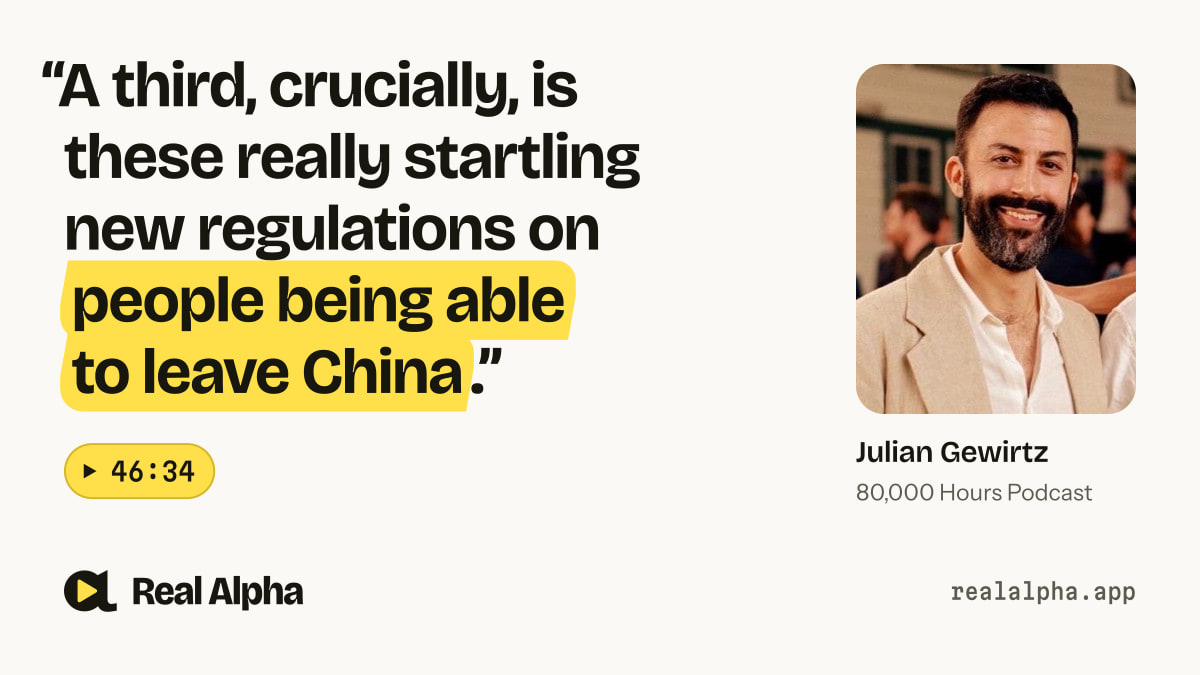
“A third, crucially, is these really startling new regulations on people being able to leave China.”
 Julian Gewirtzat 46:34 · 80,000 Hours Podcast
Takeaways
- Labs want more compute and capital.
- Travel restrictions can affect recruitment and retention.
- Regulators stopped the proposed Meta-Manus deal.
About this segment
Chinese labs seek compute and capital but also face limits on employees’ and families’ travel. Julian Gewirtz says blocked exits and a halted acquisition can complicate hiring and startup plans.

Julian Gewirtz is a historian and former senior director for China and Taiwan affairs at the NSC under Biden.
Authored histories of modern China and advised Biden administration leaders on U.S.–China policy.
- TR
Tom Reed, Host
From “Beijing’s Unprecedented Campaign Against Anthropic”, Nov 19, 2026. Watch the full episode
Thanks. We'll look at and fix what's off.
Transcript
Transcribed by machine (Whisper) from the episode’s audio, so a word may be off here and there.
- 45:44
sooner than many of us expect. Other than asking for more chips, what sorts of things do you think the Chinese AI labs are lobbying the CCP for? A lot of things. And I think a really interesting dynamic that is super underreported, because it's really hard to report on, is we know a lot about the bargaining and all the rest between the labs and the government here in the United States. We know much less about it in the Chinese ecosystem. But if you talk to people who work at Chinese AI labs, they complain constantly about government overreach and, you know, all this stuff they have to go through and, you know, government getting in the way of X, Y, or Z. So there are these dynamics there. Now, I think so, right. So compute is one. The government has been trying to channel much more capital into this sector. But obviously, that's another. A third, crucially, is these
- 46:42
really startling new regulations on people being able to leave China. So there have been a series of reports about initially employees of Chinese model companies, and then even their family members no longer being able to travel abroad without permission. And this is the kind of restraint on, you know, human mobility, ordinary life that I think will affect, you know, somebody's a PRC national working in the United States, and they're thinking about going back to China to take some sweet deal they've been offered, or to stay, like, that's a pretty big difference that goes beyond whatever your compensation number is. And then, you know, one other thing to just say is, like, I think for a number of these companies, they look at what happened to the Meta-Manus deal, you know, meaning a Chinese startup that was super buzzy, you know, got a lot
- 47:41
of attention, moved to Singapore, and then Meta wanted to buy, it almost happened, and then the Chinese regulators came and yanked the chain and shut it down. I mean, that is the kind of thing that, as you know, like is any startup founders nightmare wherever they live that like the dream. deal comes through and, you know, the government stops it. And so this is so there are all of these pain points. Now, there's a lot of stuff that is they're getting. I want to be really clear that like the government is, you know, pushing resources and prestige and support in other ways into the sector. But but it is complicated. It's making their life difficult in other ways. That's right.