The alpha, twice a week
That was 4 min.
Get the best new moments in your inbox every Wednesday and Saturday. It's free.
Check your inbox
We sent a link to your address. Click it to finish signing up. Not there in a minute? Look in spam.
or
80,000 Hours Podcast · 4 min · Nov 19, 2026
Chinese reporting incentives could keep AI incidents from the public
 Julian Gewirtz
 expects Beijing to treat a serious AI incident as a cybersecurity issue, but says officials and companies have little incentive to disclose it publicly.
In this episode
Full analysis- 12:24Beijing sees AI loss of control as a threat to political security7 min
- 38:27China’s compute purchases may reveal whether leaders fear falling behindPro pick 4 min
- 1:07:01China may reverse its open-weight stance if risks threaten stabilityPro pick 6 min
- 1:01:02AI deal verification needs technical evidence, not trust alone6 min
- 8:21Chinese reporting incentives could keep AI incidents from the public4 min
- 33:20Chinese AI labs are more AGI-focused than the government5 min
- 45:39Chinese AI labs push back on travel and deal restrictions3 min
- 57:09US–China AI talks would first need shared technical vocabulary4 min
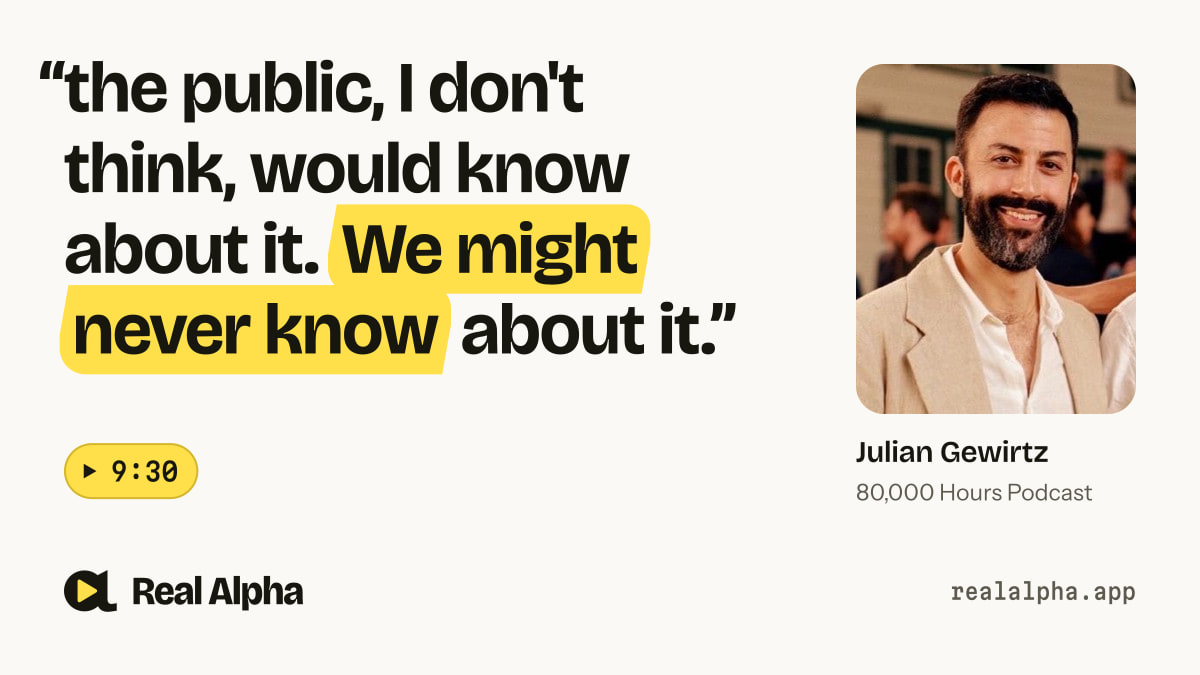
“the public, I don't think, would know about it. We might never know about it.”
 Julian Gewirtzat 9:30 · 80,000 Hours Podcast
Takeaways
- Cybersecurity structures are already in place in China.
- Public disclosure is unlikely at every level of the system.
- An incident could lead to a central-government control campaign.
About this segment
Julian Gewirtz expects Beijing to treat a serious AI incident as a cybersecurity issue, but says officials and companies have little incentive to disclose it publicly. That could leave outsiders unaware of what happened.

Julian Gewirtz is a historian and former senior director for China and Taiwan affairs at the NSC under Biden.
Authored histories of modern China and advised Biden administration leaders on U.S.–China policy.
- TR
Tom Reed, Host
From “Beijing’s Unprecedented Campaign Against Anthropic”, Nov 19, 2026. Watch the full episode
Thanks. We'll look at and fix what's off.
Transcript
Transcribed by machine (Whisper) from the episode’s audio, so a word may be off here and there.
- 8:27
How do you think the Chinese government would react to a homegrown version of the Hugging Face incident? Now, in China, I think an incident like that would be seen as a cybersecurity incident first and foremost. And the thing to remember in China is that while the AI regulatory space, and particularly the frontier AI regulatory space, is very much still coming together, And we'll talk about that, I'm sure. The cybersecurity structures have been in place for a while, and this is a top kind of regime security issue for Beijing. So I think they'd treat it that way. They do have certain kind of notification requirements where I think the central government could potentially become aware of it pretty quickly.
- 9:12
But the most important thing that I think we have to stress is that at every layer, the incentives in that system are not to disclose more information and certainly not to disclose it publicly. So the most remarkable thing, as we imagine what a kind of hugging face, OpenAI style incident in China would look like, is the public, I don't think, would know about it. We might never know about it. And I think that's part of the reason why there's so much concern as we think about these issues, because, you know, in the Chinese political system, you know, whistleblower protections, shall we say, are not something that gets gets treated with much seriousness.
- 9:59
The famous Chinese whistleblowers are people like the doctor in Wuhan who warned about the spread of COVID and, you know, was punished for that years ago. So I think anyone at a firm, whether an executive wanting to report up the chain or a whistleblower kind of considering whether to make their concerns known, would be weighing the risk of serious kind of smackdown by the government against the safety risks.
- 10:31
And so that's a pretty challenging place to be. Interesting. Do you think the government would be fully informed of what happened? Or do you think the labs themselves would also be incentivized and capable of hiding such an incident if they became aware of it? I'm just trying to understand exactly who would know if something like this happened. Well, in an incident like that, where what happened sort of fully escaped the lab's control and was a third party website, I think presumably the government would find out that something had occurred, at least via the third party website.
- 11:05
And if there was an investigation, you know, I think some of the labs might be more forthcoming than others. There is a small chance you could imagine that if they felt they really kind of handled it, that and, and or if it became publicly known that there had been some sort of hack of this third party website for, you know, other reasons that were visible. I think you could then imagine them, you know, doing a very limited kind of disclosure saying, you know, there was a problem. We found out about it. We solved it. Everything is good. Proceed accordingly. I think the biggest policy question in Beijing in that kind of moment would be, would something like that trigger what they would call a broader rectification campaign, meaning an effort to bring greater control from the central authorities over this area. And that, I think, is possible.
- 12:00
But again, it would likely be in a context without the kind of public disclosure that eventually marked the OpenAI hugging base incident. And crucially, you know, that meter report, the things that have brought a bit more public confidence back to thinking that at least third party evaluators have the capacity to inform the public about this, I think highly, highly unlikely in the Chinese case if that were to happen.
- 12:26
Do you think, is there a particular flavor of near term AI incidents?