The alpha, twice a week
That was 4 min.
Get the best new moments in your inbox every Wednesday and Saturday. It's free.
Check your inbox
We sent a link to your address. Click it to finish signing up. Not there in a minute? Look in spam.
or
80,000 Hours Podcast · 4 min · Nov 19, 2026
US–China AI talks would first need shared technical vocabulary
 Julian Gewirtz
The sides could use the same words differently: Chinese uses one word for safety and security.
In this episode
Full analysis- 12:24Beijing sees AI loss of control as a threat to political security7 min
- 38:27China’s compute purchases may reveal whether leaders fear falling behindPro pick 4 min
- 1:07:01China may reverse its open-weight stance if risks threaten stabilityPro pick 6 min
- 1:01:02AI deal verification needs technical evidence, not trust alone6 min
- 8:21Chinese reporting incentives could keep AI incidents from the public4 min
- 33:20Chinese AI labs are more AGI-focused than the government5 min
- 45:39Chinese AI labs push back on travel and deal restrictions3 min
- 57:09US–China AI talks would first need shared technical vocabulary4 min
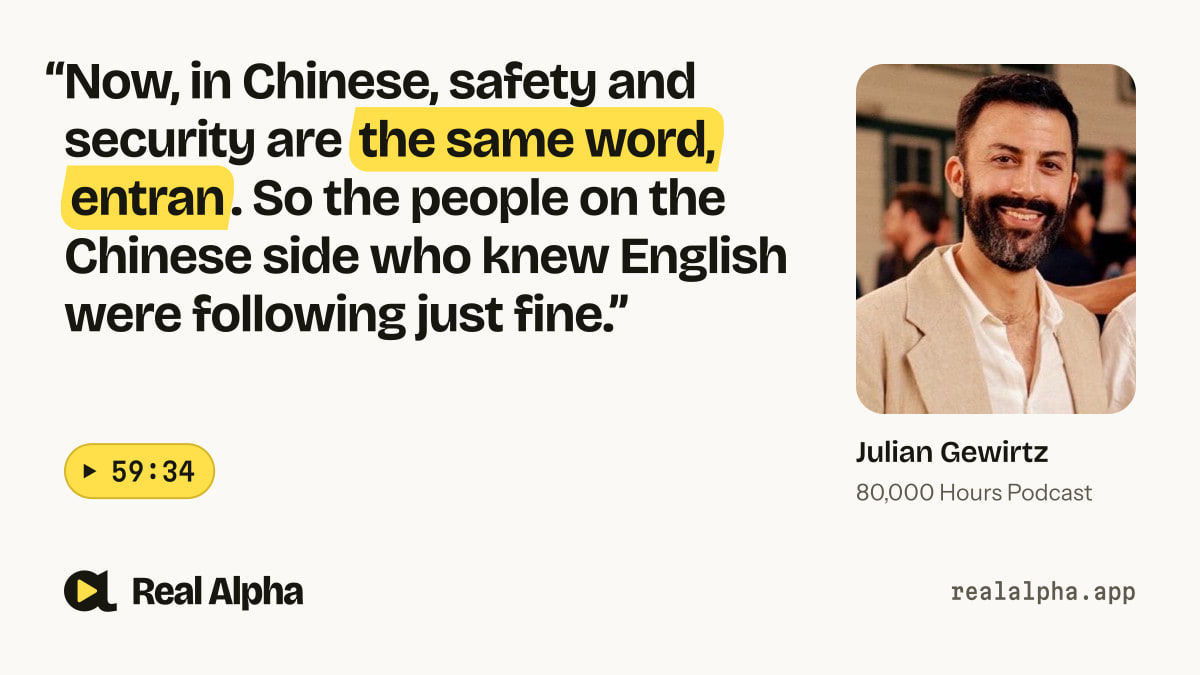
“Now, in Chinese, safety and security are the same word, entran. So the people on the Chinese side who knew English were following just fine.”
 Julian Gewirtzat 59:34 · 80,000 Hours Podcast
Takeaways
- Safety and security translate to the same Chinese word.
- Language gaps can confuse technical discussions.
- The sides may disagree on which risks to discuss first.
About this segment
The sides could use the same words differently: Chinese uses one word for safety and security. They would also need to agree whether talks cover near-term harms or frontier risks.

Julian Gewirtz is a historian and former senior director for China and Taiwan affairs at the NSC under Biden.
Authored histories of modern China and advised Biden administration leaders on U.S.–China policy.
- TR
Tom Reed, Host
From “Beijing’s Unprecedented Campaign Against Anthropic”, Nov 19, 2026. Watch the full episode
Thanks. We'll look at and fix what's off.
Transcript
Transcribed by machine (Whisper) from the episode’s audio, so a word may be off here and there.
- 57:15
be the early sticking points of this kind of cooperation? Okay, so first, I would say getting something like that is itself going to take some work. So, yeah. So, like, you know, I think it was really striking to me where I had pretty low expectations for what the Beset-Khalifeng meeting and then the Trump-She meeting would produce on this score, pretty low expectations, and they were not met. I thought we would get at least some sort of technical working group commitment because that seems so obviously necessary, like such a no brainer and not hard to do, meaning you're not committing them to do anything, you're just creating that kind of connectivity. And we didn't even get that. And I thought we would get some kind of commitment to sort of, you know, more intense cadence of interaction and crisis communication when they're, you know, incident
- 58:13
response communication. And it appears that we basically just have a kind of verbal commitment to, you know, call each other under a pretty vague set of circumstances, which, let's be honest, was the status quo ante. They can, you know, Besson and his counterpart can call each other when they want. So, but let's say we were to get that kind of connectivity established. i think the first sticking point would actually be terminology language um because if we're talking about like a fairly professionalized approach from casey here and and you know the way that uh these these bodies in china approach it like there are some basic language questions that need to be worked through what are we talking about when we talk about loss of control what are we talking about when we talk about bio risk and i think actually there's a lot of work to be done
- 59:11
in just nailing those pieces. But I don't think that would happen naturally. I mean, for your listeners, like, even at the most fundamental level, I was in a meeting not long ago where an American, very senior American AI expert gave a long spiel to a bunch of Chinese AI safety experts, where he was making a fundamental distinction between safety and security, you know, the safety of an AI system and its alignment and other aspects like that.
- 59:36
And then this is, you know, security and more sort of cybersecurity, model security sense. Now, in Chinese, safety and security are the same word, entran. So the people on the Chinese side who knew English were following just fine. And the people who didn't were deeply confused because, again, it was just so that kind of thing is actually like it's a real blocker. Yeah, it's a sticking point. And it's like, it's not like an ideological disagreement, but it needs to be worked through. It's one of the reasons why what track two dialogues do is actually important, even if it sometimes can feel kind of painful, because it's helping deal with that.
- 1:00:14
Second, you know, in those kind of let's say this kind of technical conversation happened, I think there would be a big set of debates over whether they were talking principally about near term immediate risks or frontier kind of risks that may emerge in a sort of shift toward RSI. RSI. And, you know, assuming that the Americans wanted to talk a lot about the latter, I think there might be some resistance from the Chinese side to fully getting into that, particularly if they felt, you know, that it was kind of being presented to them as something the United States was going to get to first. And again, just this trope of like, they're ahead, they're trying to