The alpha, twice a week
That was 3 min.
Get the best new moments in your inbox every Wednesday and Saturday. It's free.
Check your inbox
We sent a link to your address. Click it to finish signing up. Not there in a minute? Look in spam.
or
No Priors · 3 min · Feb 20, 2025
Founders need to adapt beyond their original research
 Kyle Vogt
 says funding surges draw many teams without strong founder-product fit.
In this episode
Full analysis- 10:03Home robots can return time lost to choresPro pick 5 min
- 21:13Robot design should match what the product can doPro pick 4 min
- 33:56Small teams can still take on ambitious company goals3 min
- 0:44Cruise shifted from retrofits to robotaxis as demand emerged3 min
- 15:29Home robots can launch with narrower functionality than robotaxis3 min
- 17:50Founders need to adapt beyond their original research3 min
- 26:43US robotics firms can compete with global manufacturing3 min
- 29:14Phased regulation can create a path to robotics scale5 min
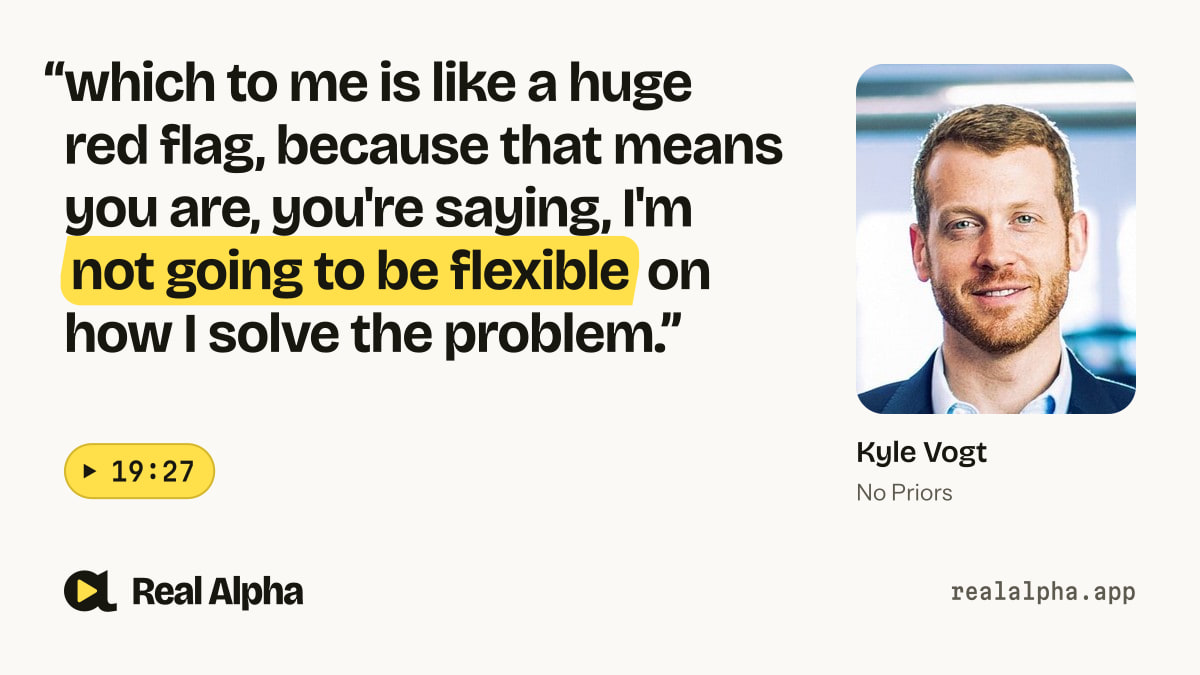
“which to me is like a huge red flag, because that means you are, you're saying, I'm not going to be flexible on how I solve the problem.”
 Kyle Vogtat 19:27 · No Priors
Takeaways
- Funding waves draw teams that are only partly committed.
- Commercializing a fixed research agenda can block adaptation.
- Product-centered founders can pivot as the evidence changes.
About this segment
Kyle Vogt says funding surges draw many teams without strong founder-product fit. He calls founders who force their research into a market a risk because startups must adapt.

Kyle Vogt is cofounder of Twitch and Cruise, and CEO of The Bot Company.
Co-founded Cruise, a self-driving car company GM acquired, and now leads The Bot Company's household robots.


From “No Priors Ep. 102 | With The Bot Company CEO Kyle Vogt”, Feb 20, 2025. Watch the full episode
Thanks. We'll look at and fix what's off.
Transcript
Transcribed by machine (Whisper) from the episode’s audio, so a word may be off here and there.
- 17:55
I guess while we're on the analogy to self-driving, if you look at what happened from a market structure perspective there, there are originally, you know, dozens of startups that raised collectively billions of dollars. And one could argue that the end winners of the things that actually somehow worked in the market were two incumbents, Tesla and Waymo, Cruise slash GM, and then maybe to a secondary extent, applied to tuition, which is building more general software for cars and things like that.
- 18:23
And then most of that market kind of didn't end up with the outcomes one would have hoped for. Do you think there's going to be a similar sort of shakeout here in robotics? And do you think there will be incumbent bias? Do you think there's a lot of room for startups? How do you think about how that market will evolve? I think for sure, both in AI generally, like, you know, just pure software companies.
- 18:40
And then also, I think the next wave is starting on robotics. There will be like that bubble effect. And this is just like kind of how the Silicon Valley ecosystem and venture capital market works. You know, there's either a couple of big rounds that get everyone excited. And then other investors start throwing money into the same space because they see the markups happening quickly. And that following effect kind of floods the market. And when there's a lot of investors talking about funding these companies, more people kind of drop out of their PhD programs or quit their job to start a company.
- 19:05
and i think the majority of those companies i would say are like low quality in that um they're a founder that's like half into it or a founding team that's like half into it and half hedging going back to work or whatever maybe they're hoping it's a get rich quick thing um or they're just the wrong you know like founder market fit or founder product fit isn't there even though they're smart technically i saw this in the self-driving wave like people who are really brilliant academically but have the wrong mentality not a product-centric mentality they will leave their academic program because they want to commercialize their research which to me is like a huge red flag, because that means you are, you're saying, I'm not going to be flexible on how I solve the problem. I'm going to force my solution into the, you know, square peg into
- 19:43
the round hole. And I think that can be very problematic for a startup when you're constantly wrong and need to adapt to whatever you see. So most of those companies will be a low quality. And as a result, we'll say that the bubble popped and like, you know, there's a huge wipe out in the industry, inevitably, whether it's robotics or AI. But I think really what it was is there was a handful of good companies that were started doing that.
- 20:00
time and before. And those companies did it just fine. I don't think they'll be affected by the collapse. It's just all the noise and sort of the follow on and, you know, sort of the hype and mania that follow us that sort of gives the impression that, you know, these things are collapsing or not viable when in reality, I think there are lots, you know, a handful of companies doing really good work. I don't know if they're necessarily limited to the incumbents, but that is possible, especially in hardware. It's really hard. But, you know, there were companies like Aurora and Zoox that one of them went public and one of them is acquired by Amazon. And so has the resources to keep going. Cruise fell into that category. So these were not incumbents. These were companies that were started from scratch during the beginning of that self-driving car
- 20:39
cycle and are enduring and hopefully do well. Thanks for that overview and an explanation