The alpha, twice a week
That was 5 min.
Get the best new moments in your inbox every Wednesday and Saturday. It's free.
Check your inbox
We sent a link to your address. Click it to finish signing up. Not there in a minute? Look in spam.
or
No Priors · 5 min · Feb 20, 2025
Phased regulation can create a path to robotics scale
 Kyle Vogt
 argues that AV rules should pair safety oversight with protections that let firms operate.
In this episode
Full analysis- 10:03Home robots can return time lost to choresPro pick 5 min
- 21:13Robot design should match what the product can doPro pick 4 min
- 33:56Small teams can still take on ambitious company goals3 min
- 0:44Cruise shifted from retrofits to robotaxis as demand emerged3 min
- 15:29Home robots can launch with narrower functionality than robotaxis3 min
- 17:50Founders need to adapt beyond their original research3 min
- 26:43US robotics firms can compete with global manufacturing3 min
- 29:14Phased regulation can create a path to robotics scale5 min
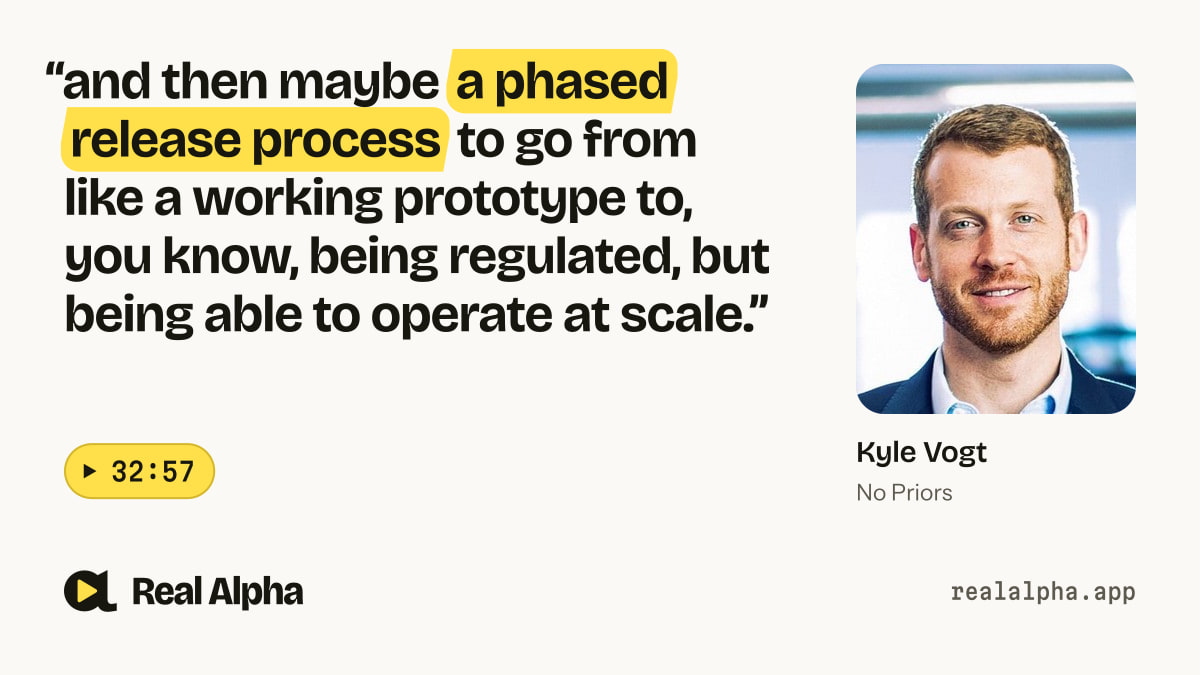
“and then maybe a phased release process to go from like a working prototype to, you know, being regulated, but being able to operate at scale.”
 Kyle Vogtat 32:57 · No Priors
Takeaways
- Clear AV standards could pair oversight with reasonable liability limits.
- Home robots need cybersecurity and safety practices tailored to homes.
- Phased approval can widen deployment as performance is proven.
About this segment
Kyle Vogt argues that AV rules should pair safety oversight with protections that let firms operate. For home robots, he calls out cybersecurity and safety gaps, and favors phased approvals.

Kyle Vogt is cofounder of Twitch and Cruise, and CEO of The Bot Company.
Co-founded Cruise, a self-driving car company GM acquired, and now leads The Bot Company's household robots.


From “No Priors Ep. 102 | With The Bot Company CEO Kyle Vogt”, Feb 20, 2025. Watch the full episode
Answers “Should AI be regulated?” See all 51 answers
Thanks. We'll look at and fix what's off.
Transcript
Transcribed by machine (Whisper) from the episode’s audio, so a word may be off here and there.
- 29:19
If you could wave a magic wand, we just call Trump right now. What do you think is the right policy approach to make sure we have a competitive domestic robotics industry, if that's relevant? First of all, I mean, I think there should be tons of regulation on AV. It reminds me what's happening in the AV space and sort of, you know, companies like Cruise got wiped out. Companies like Waymo are growing or expanding, I think, much more slowly than they should based on the merits and the safety of their technology.
- 29:44
And it reminds me of like when the first airlines were formed in the U.S. and there was no FAA. There was no regulation. if you had basically any kind of plane crash, you would get sued out of existence and you just wiped out. And many of the first airlines are no longer in existence because of this. And so the FAA was creating... because you know the government decided that actually we should have airlines and if they keep going out of business no one's going to start an airline anymore and so create the faa monitor airplane manufacturers and airlines make sure they meet safety criteria and in exchange give them you know reasonable protections and limits on liability so they can actually operate you know in a society like the u.s that hasn't happened for self-driving cars and so i think the only
- 30:22
can today the only companies that stand a chance um are the ones where you know they can afford to take on that liability because they're a giant tech company that makes money in other places. Otherwise, it's very bleak. So I would recommend that for ADs. And for home robots, I think a similar thing is true. There are no regulations right now on cybersecurity, for example. You can have a Chinese manufactured robot in your home with cameras and a microphone running and sending that data who knows where. And in fact, many of us do. And that's not regulated. That's not inspected by any government agency. And I think that's a major concern. On the safety side, I would love to see that too. There's, um, you know, lots of best practices from the industrial robot industry. They're not a great fit for home robots. Um, there's lots of good best practices
- 31:05
for other consumer products, but particularly home robots is a bit of a vacuum. And I think that generally, um, regulation is a very, very good thing for, uh, you know, companies operating in environments like this that are especially ones that are unpredictable. Um, it encourages discussion of best practices and encourages, um, you know, oversight, all of these things lead to better outcomes for i think both companies and for consumers so uh in terms of regulation even though like i think trump administration is anti-regulation we actually it's like a necessary enabler to get these industries going as odd as odd as that sounds seems like there's some circumstances where your point a clear regulatory framework helps a lot like for the crypto community during the biden administration a lot of what they wanted from the sec was just guidance
- 31:43
in terms of what to do and then everybody's going to go do it and it was that ambiguity that really hurt the argument i've heard around drones in particular is due to the faa the u.s is now behind on the drone side. And China was really able to get a leg up. If you look at everything from drone shows, it's just what DJI drones can do. It's sort of very low cost and they're being used for military and other applications in Ukraine and other places. And so there are the argument as well, the FAA over-regulated drones in airspace, and that kind of prevented the US market from evolving down a proper route. So I'm a little bit curious how you think about that balance between, you know, too much and too little regulation and how that may apply to the robotics world, given what's happened in drones.
- 32:23
Yeah, it's a good point. I mean, I agree. I would love to see more transportation innovation generally, but aviation, like, you know, electric takeoff and land. airplanes. There were tons of startups in that space and they've all kind of like sort of fizzled out it seems like or bumped into these like FAA certification challenges. And as far as I understand there's still no pathway even today to make a pilotless plane of any kind. There's like baby steps that we're taking but I would love to see these sort of two-track approaches where you have a very mature track for existing you know industries and technologies like you know passenger airlines today and then an innovation track where basically you're almost encouraged. I mean there's grants or other programs to like spur innovation in this category, and then maybe a phased release
- 33:04
process to go from like a working prototype to, you know, being regulated, but being able to operate at scale. Like, I think it would be okay for us to sit down and say, here's what we expect to see at each level of maturity. And then provided you demonstrate to us that you meet that level of maturity, we'll progressively open up, you know, the regulations or the areas that you can operate. And this is like a standard thing. This is like, you know, what we did in self-driving cars, but also like even new airplanes, like the boom supersonic jet that just made history they started off with like a low and slow flight and then like gradually as they as they saw the data checkout ratchet it up until they hit supersonic and so i think regulations are there to prevent irresponsible from people from going zero to supersonic but
- 33:42
there are plenty of responsible people willing to sort of take the stepped approach provided that there is a pathway to do so um and so i think that's the right balance of having regulation