The alpha, twice a week
That was 4 min.
Get the best new moments in your inbox every Wednesday and Saturday. It's free.
Check your inbox
We sent a link to your address. Click it to finish signing up. Not there in a minute? Look in spam.
or
Decoder · 4 min · May 26, 2026
Google expects agent tasks to work across products
 Sundar Pichai
 describes reasoning, tools and coding as building blocks for agents, and says Spark is a Gemini mode.
In this episode
Full analysis- 8:31Google unified its AI teams to make decisions faster4 min
- 26:07AI anxiety reflects social change, not just product quality7 min
- 33:40Publishers are adapting as search traffic and user behavior shift5 min
- 20:55Pichai says Search should be less opinionated on some queries5 min
- 41:15Pichai says AI still cannot make scientific discoveries alone5 min
- 17:04Google expects agent tasks to work across products4 min
- 12:53Google expects agent teams to spread beyond engineering3 min
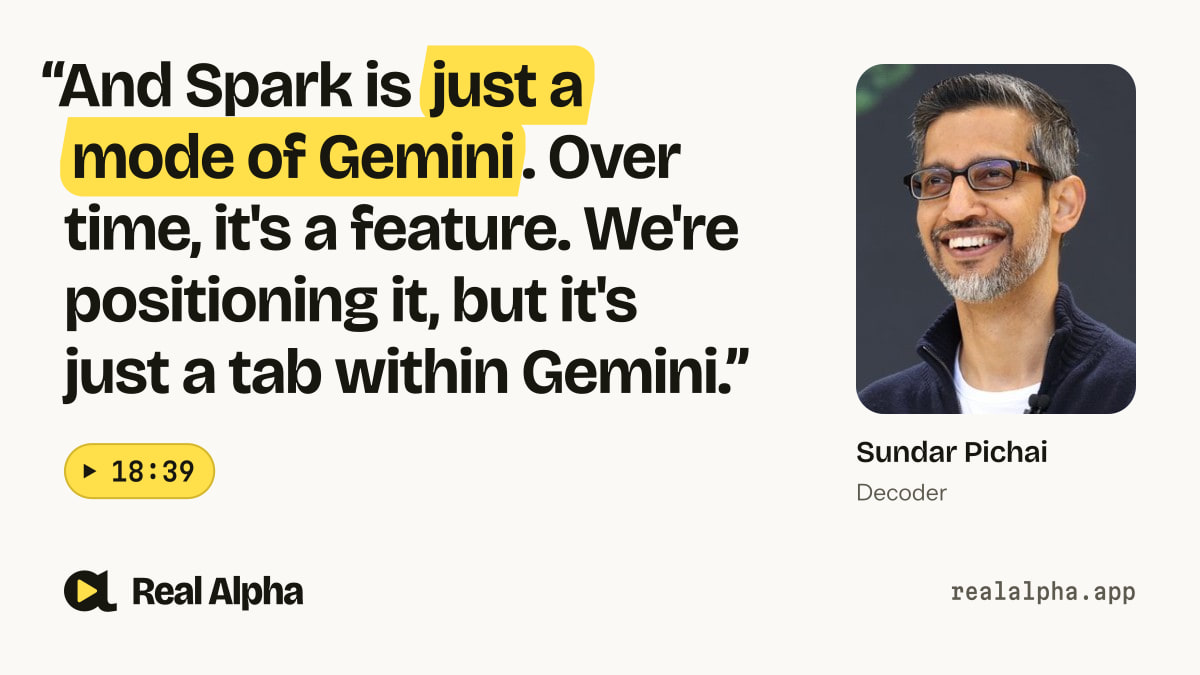
“And Spark is just a mode of Gemini. Over time, it's a feature. We're positioning it, but it's just a tab within Gemini.”
 Sundar Pichaiat 18:39 · Decoder
Takeaways
- Agents combine reasoning, planning, tools and coding.
- Pichai describes Spark as a mode of Gemini.
- He expects tasks to work across product surfaces.
About this segment
Sundar Pichai describes reasoning, tools and coding as building blocks for agents, and says Spark is a Gemini mode. He expects users to start tasks without needing to care which product runs them.

Sundar Pichai is CEO of Google and Alphabet.
Helped build Google Toolbar and Chrome, then led Google from 2015 and Alphabet from 2019.

Nilay Patel, Host · Editor-in-chief, The Verge
Helped start The Verge in 2011 and has hosted Decoder since 2020.
From “How Sundar Pichai is rethinking Google for the AI era | Decoder”, May 26, 2026. Watch the full episode
Thanks. We'll look at and fix what's off.
Transcript
Transcribed by machine (Whisper) from the episode’s audio, so a word may be off here and there.
- 17:16
let me ask you about that and agents some of those demos are fascinating the idea that the search is going to build custom software for everybody that seems like a an idea in software engineering a first impression right the idea that the computer you're going to ask it a question and the response will be for it to make you software that helps you get to an answer i'm fascinated by this idea but that is fundamentally changing search and then you kind of look at Gemini Spark, which is your agent platform in the cloud, where you will say, go book me some tickets, and Spark might run around and book you some tickets or do some tasks for you. And then there's Antigravity, the agentic coding platform. Broadly, every year, there's a new paradigm for AI. There was LLMs first, and then maybe we're going to chain some LLMs together. Then there's
- 18:01
reasoning. And then now we're agents. Is this the foundation, or is there another paradigm shift to time? I think it's a great question. We are laying most of the building blocks in place, I think. Fundamentally, being able to reason, use tools, and code are a lot of having intelligence and reasoning, being able to plan, being able to look up things, use tools, and if you need as part of that to build something.
- 18:35
So you are kind of laying all the primitives. And obviously, anti-gravity is for developers, but the anti-gravity engine, the harness, is built into a Gemini now, right? And Spark is just a mode of Gemini. Over time, it's a feature. We're positioning it, but it's just a tab within Gemini. And so you're bringing that agentic harness. We need to think about, developers will understand it over time in Spark, they can code powerful things.
- 19:10
But as users, you may be building something, creating something, planning a trip, and all that is working behind the scenes. So I do think we are laying a lot of the primitives of what we need agents to work end-to-end, or more importantly, AI to work. You know, this long-running vision of Assistant we've all had and worked through myriad forms of it and failing to fully do it well, I think we are closer than ever before to deliver on that promise.
- 19:46
We haven't delivered it yet, but that's the journey, which I think is closer than ever before. I look at all the products, and they do seem like they should converge, right? You have the new intelligence search box, and I definitely want to talk about search in more detail. but you look at that search box and then you look at it's canvas that makes you the apps but you're planning a wedding and it'll just make you an app to help you plan a trip or a wedding or something and then you have spark where it can go off and do things and I looked at that and I was talking to people yesterday and it just seems obvious that that should be one product it you know it will the agents just like I gave the earlier notebook example of like you know you're creating notebooks what are notebooks you're effectively putting
- 20:26
all the context you want in one place and then working off it It's folders as they've always existed for people. And notebook should be a consistent primitive across the Google products you use. I just view agents that way. It shouldn't matter. And so I do think when you're at the earliest stage of innovation, you create the capability. I think teams are experimenting with it. But for a user over time, if you fire off planning a trip, it should work across both places is how i would think about it you're right in that there's something very important about google search it is a source of truth for people