The alpha, twice a week
That was 5 min.
Get the best new moments in your inbox every Wednesday and Saturday. It's free.
Check your inbox
We sent a link to your address. Click it to finish signing up. Not there in a minute? Look in spam.
or
Decoder · 5 min · May 26, 2026
Pichai says AI still cannot make scientific discoveries alone
 Sundar Pichai
 says powerful AI may arrive before people agree on an AGI label, but current models cannot make novel scientific discoveries on their own.
In this episode
Full analysis- 8:31Google unified its AI teams to make decisions faster4 min
- 26:07AI anxiety reflects social change, not just product quality7 min
- 33:40Publishers are adapting as search traffic and user behavior shift5 min
- 20:55Pichai says Search should be less opinionated on some queries5 min
- 41:15Pichai says AI still cannot make scientific discoveries alone5 min
- 17:04Google expects agent tasks to work across products4 min
- 12:53Google expects agent teams to spread beyond engineering3 min
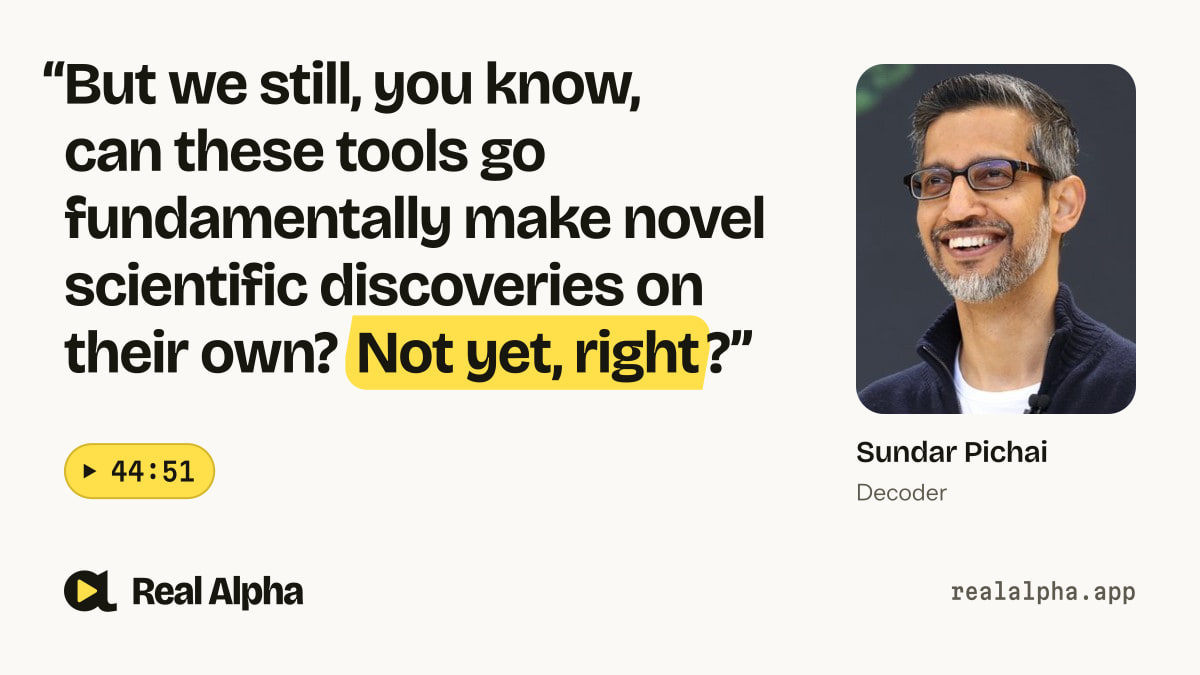
“But we still, you know, can these tools go fundamentally make novel scientific discoveries on their own? Not yet, right?”
 Sundar Pichaiat 44:51 · Decoder
Takeaways
- Frontier labs broadly expect AGI sooner rather than later.
- LLMs have not made novel scientific discoveries independently.
- Pichai says powerful systems matter more than the AGI label.
About this segment
Sundar Pichai says powerful AI may arrive before people agree on an AGI label, but current models cannot make novel scientific discoveries on their own. He argues the technology is evolving and society should prepare.

Sundar Pichai is CEO of Google and Alphabet.
Helped build Google Toolbar and Chrome, then led Google from 2015 and Alphabet from 2019.

Nilay Patel, Host · Editor-in-chief, The Verge
Helped start The Verge in 2011 and has hosted Decoder since 2020.
From “How Sundar Pichai is rethinking Google for the AI era | Decoder”, May 26, 2026. Watch the full episode
Answers “When will we get AGI?” See all 26 answers
Thanks. We'll look at and fix what's off.
Transcript
Transcribed by machine (Whisper) from the episode’s audio, so a word may be off here and there.
- 41:27
and UCP and Amazon and Walmart and everyone are going to use a new standard we're building for shopping. And all that is very tangible. And then Io ended with Dennis Asabas, the CEO of DeepMind, coming out. And he said this thing that I have not been able to stop thinking about. He said, Google's cutting-edge research in products will help unlock AGI's incredible potential for the benefit of the entire world. When we look back at this time, I think we will realize that we were standing in the foothills of the singularity. Can you tell me what it means to be in the foothills of the singularity? Demison, I've had long, deep conversations on this topic. I think in this context, I think for him, the advent of AGI is what he thinks of as the singularity. Do you have a definition of AGI? Have you debated? Do you have an agreement?
- 42:11
We debate it a lot. I think both Demis and I are very close to how we think about. We think about AGI and there is a harder definition of AGI, which is that it has to be more comprehensively do the wide range of tasks, including cognitive tasks, in a way that's comparable. So I think we'll at some point actually put it out as a company, I think, and we are working on that. But I think that's what he's talking about in this context.
- 42:47
By the way, I think it's important for us to understand that this technology is progressing very rapidly. And later today, I'll be going and spending time with our AI researchers, and not just in our company, but amongst the frontier labs. I think there's wide consensus that this technology, you know, AGI is people may quibble around like, you know, is it like three years, but the technology is sooner rather than later.
- 43:17
And so I think it's more important to communicate that because that's what, you know, to an earlier part of the conversation, it's important that we as a society understand. it and are preparing as much as possible. I asked you this question that maybe the first time we ever talked about AI, I asked you if language was intelligence. And the progression here is we're layering more and more on LLMs.
- 43:37
We're doing longer chains of reasoning. We're building harnesses. We're doing all this stuff. But the core technology is still Transformers. It's still the thing Google invented so long ago. Can LLMs get you to AGI? Is that path clear? The trajectory over the last three years has been incredible. and looking ahead. The LLMs of today have evolved in many ways too, so we are constantly evolving it. And to me, it's like asking, can computers get us to the way, the von Neumann architecture is still what powers most computers today, but he won't recognize the modern, one of our TPU parts, right?
- 44:17
Or maybe he would, there's still a lot of commonality to it. So I think the underlying technology keeps evolving so profoundly. I look at every year, we have had major breakthroughs. I recently, I mean, you just saw this demo in anti-gravity and ability to prompt and create an operating system, right? It's very dangerous for Google to be able to make new operating systems. We'll have to make sure we don't token max on creating.
- 44:46
I'll give you that. It's fair. But, you know, that is the power of what these things are doing, right? There are the top mathematicians in the world, top physicists in this world who are interacting with these tools and using them in important ways. But we still, you know, can these tools go fundamentally make novel scientific discoveries on their own? Not yet, right? And so it's both remarkable how much it's progressed.
- 45:15
I do think it has important evolutions to happen. And then there are strong opinions out there in the world about how much of a real understanding of the world you need to take that next leap. I'm pretty optimistic that we will continue to make a lot of progress. Yeah. All right. So last question. What is your timeline? Is it three years, five years, Sagey? Where are you at?