The alpha, twice a week
That was 3 min.
Get the best new moments in your inbox every Wednesday and Saturday. It's free.
Check your inbox
We sent a link to your address. Click it to finish signing up. Not there in a minute? Look in spam.
or
TBPN · 3 min · Jan 27, 2026
Insurers spend $70 billion a year on back-office BPO
 Jamie Cuffe
Pace targets insurance back-office work across submissions, policy servicing, and claims.
In this episode
Full analysis- 3:05:17A personal assistant emerged from a simple messaging hack6 min
- 1:37:41Media companies lose their way when they chase scalePro pick 7 min
- 3:38:31Agent payments need better economics and a clear use casePro pick 8 min
- 1:20:20Insurers spend $70 billion a year on back-office BPO3 min
- 2:18:39Northwood built eight satellite ground units in four weeks4 min
- 2:08:26Open-model labs compete on research talent, not nationality4 min
- 3:20:56Personal agents could reduce apps to APIs4 min
- 1:28:45Insurance agents can learn repetitive tasks in legacy systems4 min
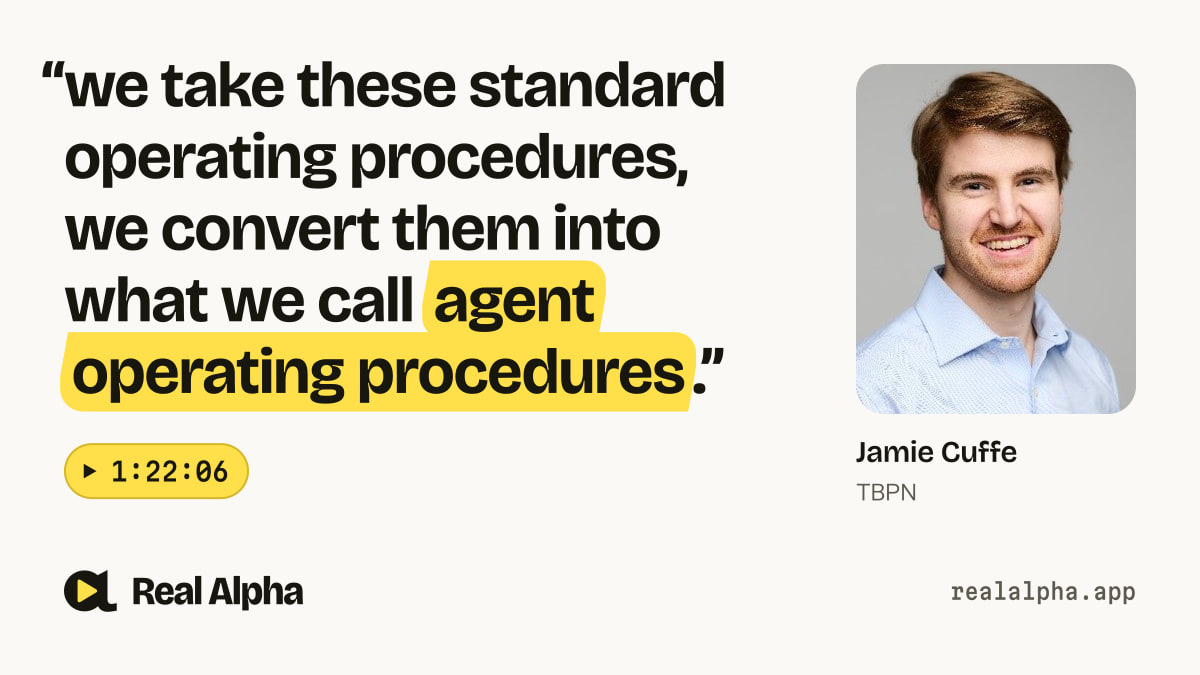
“we take these standard operating procedures, we convert them into what we call agent operating procedures.”
 Jamie Cuffeat 1:22:06 · TBPN
Takeaways
- Insurance back-office BPO costs about $70 billion annually.
- Pace starts with submissions, policy servicing, and claims.
- Agents must work with legacy systems, including green-screen applications.
About this segment
Pace targets insurance back-office work across submissions, policy servicing, and claims. Turning those procedures into agent instructions could address a large pool of repetitive labor.

Founder & CEO, Pace
Built AI agents that automate insurers’ back-office workflows, turning standard operating procedures into agent operating procedures.

John Coogan, Host · Co-host, TBPN
Co-founded Soylent and Lucy; OpenAI bought his show TBPN in April 2026.

Jordi Hays, Host · Co-host, TBPN
Founded Branded Native; co-founded fintech Capital, which Rho bought.
From “🦞 Moltbot / Clawdbot Creator Peter Steinberger, Palmer Luckey, and more”, Jan 27, 2026. Watch the full episode
Thanks. We'll look at and fix what's off.
Transcript
From the transcript TBPN publishes with the episode.
- 1:20:26
In insurance, about $70,000,000,000 is spent every year on on back office BPOs. Okay. Oh, great. A lot of that is driven by sort of the largest carriers. Yeah.
- 1:20:37
And so you're basically the BPO's worst nightmare. Yeah. So what I think Yeah. Yeah. What what what like like, walk through a specific back office procedure. Is that, like, claims processing? Is it scanning PDFs? Like, try and ground it for me a little bit more.
- 1:20:53
Yeah. It's a great question. So we're starting off, you know, with we're primarily focusing this back office operations. So what that really means is sort of three big buckets. Mhmm. It's new businesses coming in, taking in new risk submissions, you know, document processing, calling back when there's missing information, writing back into internal systems. It's a policy servicing, so any changes you're making, adding new products, things like that, and then all the way through to claims. So whether that's first notice of loss, calling in when something, happened, went wrong, all the way through to quality assurance. How do we make sure that every claim gets paid correctly every time?
- 1:21:26
Yeah. How much like, what is the actual tech stack? I mean, I imagine that you're not training your own models, but have you done your own RL environment on top of these? And and do you do that at a company level and then everyone gets sort of, like, the same AI? Or are you doing it on a per client basis? How much fine tuning is going on?
- 1:21:46
Yeah. So for a lot of our process, because we've started by focusing a lot of these BPO workflows, they're already codified as sort of these standard operating procedures. It's a great start because it's already well chunked up for agents. Yeah. And the accuracy bar for where BPOs are today is pretty low, and there's a lot of opportunity to improve that Yeah. And to be able to sort of, you know, run more accurately, more scalably, and and and more efficiently for these customers. And so we tend to start primarily with those, and we take these standard operating procedures, we convert them into what we call agent operating procedures. So this is just natural language instructions. You can think of it like a document.
- 1:22:21
Like a markdown file. Like a skill. It's a skill. Yeah. And so the main thing that we're really bridging here is these are processes that are gonna be run hundreds of thousands of time. Mhmm. And for us, we're processing tens of thousands of tasks a month. Mhmm. And critically, these these agents have to reliably run, you know, many tens of pages worth of a process Mhmm. With very insurance specific tools and logic. So that's, you know, certainly a lot of the document processing pipelines that we built Yeah. On top of, you know, OpenAI, Anthropic, Gemini.
- 1:22:53
Yeah. But also, it's going into deep industry integrations. It's voice calling and multimodality, but also kind of actually being able to take actions in systems that don't have APIs. You know, in insurance, we see everything from the cloud, you know, products, but a lot of it is desktop apps, even like green screen CLIs. Like, I'm talking like IBM systems. Yeah.