The alpha, twice a week
That was 4 min.
Get the best new moments in your inbox every Wednesday and Saturday. It's free.
Check your inbox
We sent a link to your address. Click it to finish signing up. Not there in a minute? Look in spam.
or
TBPN · 4 min · Mar 12, 2026
Karp says AI rewards expertise over routine skills
 Alex Karp
 argues that AI makes routine coding, reading and writing less valuable while increasing the importance of technical or industry expertise.
In this episode
Full analysis- 1:15:48AI job losses will require major changes to education and policy7 min
- 1:05:19Palantir combines software with deep deployment expertise4 min
- 45:33AI should expand work rather than just cut headcount3 min
- 37:21AI lets frontline experts shape the software they use6 min
- 19:43Drone businesses earn margin in autonomy and integrated systems3 min
- 1:09:53Karp expects AI job losses to fuel nationalization calls6 min
- 28:39Rodeo analytics could improve teams and deepen fan coverage3 min
- 1:01:02Karp says AI rewards expertise over routine skills4 min
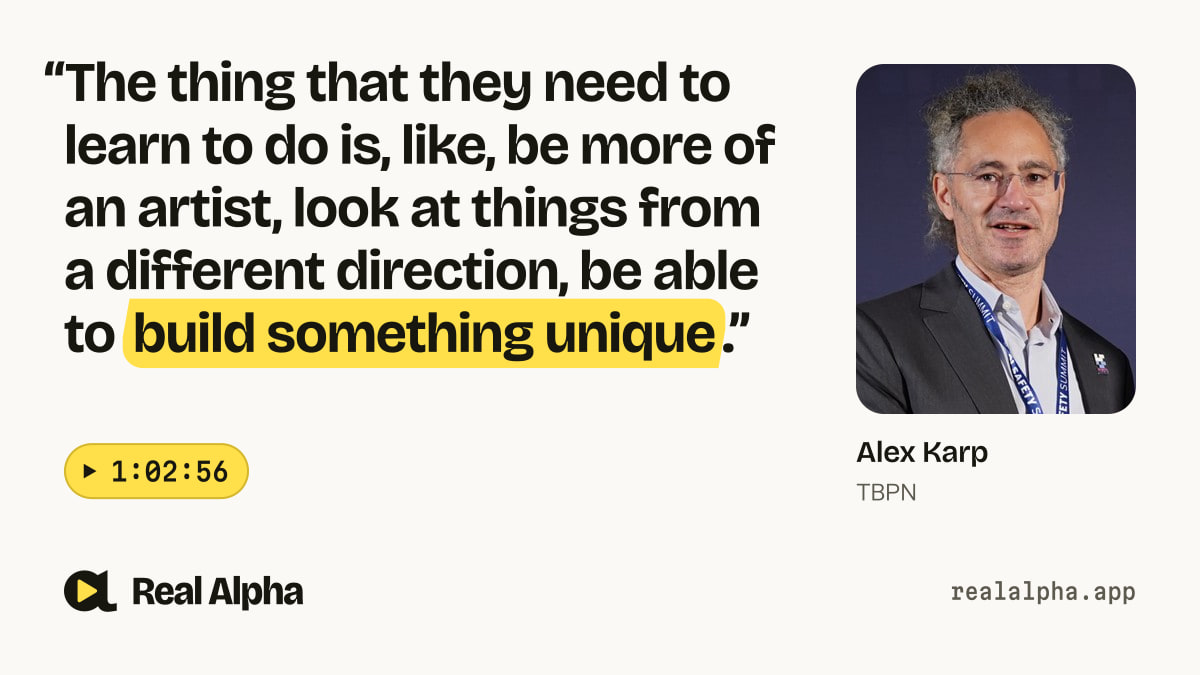
“The thing that they need to learn to do is, like, be more of an artist, look at things from a different direction, be able to build something unique.”
 Alex Karpat 1:02:56 · TBPN
Takeaways
- Routine coding, reading and writing are becoming less scarce.
- Deep expertise helps people direct AI toward real work.
- He prizes people who can build something distinctive.
About this segment
Alex Karp argues that AI makes routine coding, reading and writing less valuable while increasing the importance of technical or industry expertise. He says people will need to create and build in distinctive ways.

Alex Karp is cofounder and CEO of Palantir Technologies.
Co-founded Palantir with Peter Thiel and has run it as CEO, selling data and AI software to governments.

John Coogan, Host · Co-host, TBPN
Co-founded Soylent and Lucy; OpenAI bought his show TBPN in April 2026.

Jordi Hays, Host · Co-host, TBPN
Founded Branded Native; co-founded fintech Capital, which Rho bought.
From “🔴 Dr. Alex Karp LIVE on TBPN”, Mar 12, 2026. Watch the full episode
Answers “Which jobs will AI replace, and which are safe?” See all 241 answers
Answers “Is a computer science degree still worth it?” See all 5 answers
Thanks. We'll look at and fix what's off.
Transcript
From the transcript TBPN publishes with the episode.
- 1:01:08
But but when you're not dead hanging, what should people be doing with the new coding agents? How important is it to learn to code? How important is it
- 1:01:15
to Look. There there are two that everybody's worried about, like, their future, but there are basically two ways to know you have a future. One, you have some vocational training. Okay. So it's like or two, you're neurodivergent. And and I when I say neurodivergent, I mean broadly defined. Like, your guys are sitting here. You coulda had a corporate tool job. Yeah. You coulda been, like, I don't wanna pick on Goldman, but, like, just say, you know, like a job.
- 1:01:39
I applied there. They took me down. But yeah. See, I I did work at whatever. You coulda had a job where you're like You tried. You tried to fail. It's like, yeah. No. Actually, maybe they didn't know the right way to test. Yeah. Like, it's like yeah. They were like like, you know Yeah. Hey. Whatever. I'm not picking on one or the other. I'm just saying, you you you know, they're like, you're probably here. You think you're here because it's actually, you probably wouldn't have been able to do that shit because there's like it's the same thing as sit down in class and learn some bullshit. Mhmm.
- 1:02:07
Like and you just regurgitate it. Mhmm. Like, that's not a valuable thing. Mhmm. If you are actually have insights into anything and you have real technical expertise Yeah. Like, you know, you can look at a company, but you actually can look at it because you know something about how these things work or something about how clients work, you know. Then all the other stuff that used to be precious, like being able to do low end coding Mhmm. Being able to do low end luring, being able to do low end reading and writing. Mean, you got this is like I feel like Odin came down and was like, I'm gonna make the world just right for dyslexic. It's like it's like, yeah.
- 1:02:42
I know Odin has come down from our Lockheed has come down and said, you know what, Karp? You suffered so much as a kid. Yeah. I'm just gonna make the whole world. So everyone else can suffer. I don't want that. It's like now, but it's really an inversion. Like, everybody with, like, the normal shape skills are dyslexics because, like Yeah. The meaning, the thing they can do that used to be valuable is not so valuable. The thing that they need to learn to do is, like, be more of an artist, look at things from a different direction, be able to build something unique.
- 1:03:10
Mhmm. I think and you see this on the battlefield, like, one of the most underappreciated things about fighting a war, which is the I mean, there are basic core things civilizations do, like build technology for war Mhmm. Is every society fights differently. Every component of the society fights differently. And when, like, American as allies, we do not even approach these problems in the same way. What it makes America lethal more so than any currently country is, like, a combination of, obviously, the technology, which we're super interested in and and and believe we're paying a huge part in. But it's, like, twenty years of, like, operators figuring out what worked, what not what worked in a manual.
- 1:03:50
Mhmm. Like, what worked in reality. Also, even selection. If you look at the selection of people, like, meet, like, tier one operators Mhmm. They don't look anything like what people would think. Yeah. It's not like the movies. They're like these, like, these they're like this big and like Yeah. You know, it's like because like refining. Yeah. We have we have we have specialized ways of doing that. All that is crazy valuable. As a proxy indicator, people who are getting their news from you are just likely to massively outperform. Mhmm. People are getting their news from something that's a regurgitation of you gotta vote for one party or the other.
- 1:04:23
Sure. And then the the real problem we have in society is not your listeners or Palantir's customers or our partners. It's like, well, what happens to everyone else? Are they gonna lynch us? Mhmm. Because, like, that's the real problem. Like, these products, like, what we're building, like, our our our our agents mean that, like, the most I mean, the most powerful people in the Democratic Party are highly educated female voters. And these technologies, like, they love they I mean, like, yeah, I actually get along with all these people in private, there's a public dispute. But, like, largely, I've talked to Daria over and over, and it's like, yeah. You love one company because they they're not pro Trump.
- 1:04:59
That company's taking your job. How are you gonna feel about that company when you find that you have no job? Mhmm. What what what do you think the the Republican Party's gonna do to products that do not support our military? What do you think the Democratic Party's gonna do to products even if you're voting for them that are taking away the jobs of every one of your constituents Mhmm. And saying, oh, people are gonna love you so much, and you're gonna be poor. Mhmm. By the way, we love you so much. We're gonna give you a little handout once a month.