The alpha, twice a week
That was 3 min.
Get the best new moments in your inbox every Wednesday and Saturday. It's free.
Check your inbox
We sent a link to your address. Click it to finish signing up. Not there in a minute? Look in spam.
or
Latent Space · 3 min · Nov 2, 2026
Law firms need incentives to turn expertise into durable assets
 Jacob Lauritzen
 argues that partnerships keep human capital inside the firm, but firms could also build durable assets from their working methods.
In this episode
Full episode- 8:39Legora tests agents in simulated legal workspacesPro pick 3 min
- 26:13Client confidentiality forces Legora to infer product failures3 min
- 34:25Tabular Review lets lawyers test a workflow on ten rows firstPro pick 4 min
- 14:12Law firms need incentives to turn expertise into durable assets3 min
- 42:33Legal engineers configure workflows while FDEs write code4 min
- 47:22Legora delayed APIs to avoid locking in a fast-changing product3 min
- 50:12Legora grew beyond its plan to stay at 20 engineers3 min
- 58:13Long contracts can lose meaning when split into chunks2 min
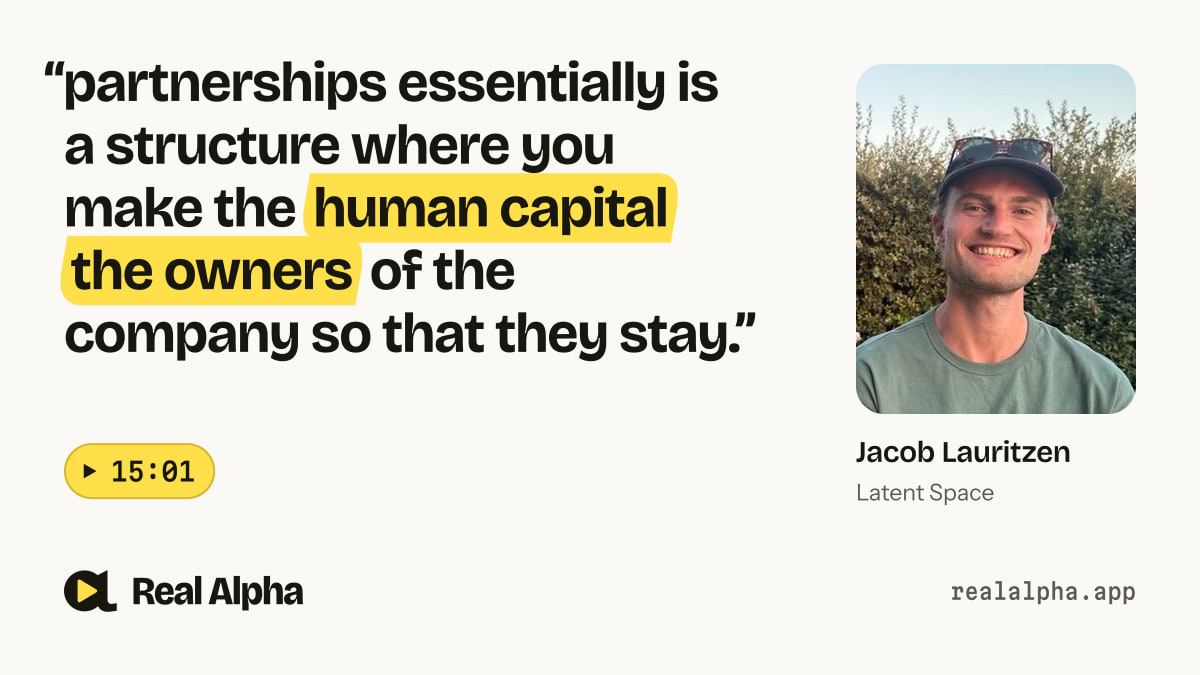
“partnerships essentially is a structure where you make the human capital the owners of the company so that they stay.”
 Jacob Lauritzenat 15:01 · Latent Space
Takeaways
- Partnerships make lawyers owners so they stay.
- Firms could codify precedent and working methods as IP.
- Partners need a reason to build assets that outlast them.
About this segment
Jacob Lauritzen argues that partnerships keep human capital inside the firm, but firms could also build durable assets from their working methods. Partners need incentives to codify expertise that can outlast them.

Jacob Lauritzen is CTO of Legora.
Leads engineering at Legora, building legal AI agents for research, contract review and drafting.

Shawn Wang (swyx), Host · Co-founder, AI Engineer
Wrote “The Rise of the AI Engineer” and founded Smol AI, maker of AI News.
- BC
Basil Chatha, Host · Forward Deployed
From “Building Legal Agents When You Can't See the Data — Jacob Lauritzen, CTO of Legora”, Nov 2, 2026. Watch the full episode
Thanks. We'll look at and fix what's off.
Transcript
Transcribed by machine (Whisper) from the episode’s audio, so a word may be off here and there.
- 14:18
What do you think is going to happen in the partnership model? Do you think that stays or what happens? I actually gave this a lot of thought just like last week. The partnership model, I don't want to get into too much of the details, but the partnership model kind of exists because the only type of capital that these companies have is human capital. So it's not like us or a software engineering firm or a manufacturer or whatever.
- 14:42
You have physical assets or some sort of intangible assets that you accrue over time and they pay dividends to the shareholders. But if you work in an industry like professional services and it's the same for like consultancies and whatever else. All of your value is in your people and you can't really own human capital. You know, you can't, you know, slavery is abolished. You can't own people, but you can rent them.
- 15:04
You can pay them money. And so partnerships essentially is a structure where you make the human capital the owners of the company so that they stay. Yeah. Will that change? Like, I don't, it doesn't have to, but I think what we really want to do with the lawyers, we actually want lawyers to be able, law firms to be able to build some sort of intangible capital, some durable capital. And you can build a system that learns of how you work.
- 15:29
A lot of firms right now think about, well, there's the ex-law firm way of doing things, and we can codify that, I think. And we can build a system, whether that's a self-improving knowledge graph or whatever it is, and precedent files and documents, where there's a way of working that produces a really good output, and that can be their IP. so it's like a way to codify the human expertise and judgment into a system that i think is now i'm just rambling completely but like um that's something that we want to help empower and does that change the partnership model then because the incentives are different in the partnership model you just got to bring more clients and you don't want to take away time from bringing in clients to codify your information basically because like you get rewarded from you know eat what you kill or
- 16:15
maybe this lockstep whatever um that needs to change a little we need to figure out an incentive structure where partnerships, partners are incentivized to codify things for, to build an asset for the company. But right now there aren't because as soon as they leave the partnership, they don't get any dividends from the assets that they built. Yeah. So that's like a, yeah, I think the, the, the whole business model is, is, uh, we'll, we'll see. Yeah. Yeah. It's all,