The alpha, twice a week
That was 3 min.
Get the best new moments in your inbox every Wednesday and Saturday. It's free.
Check your inbox
We sent a link to your address. Click it to finish signing up. Not there in a minute? Look in spam.
or
Latent Space · 3 min · Nov 2, 2026
Legora grew beyond its plan to stay at 20 engineers
 Jacob Lauritzen
 once planned to keep Legora at 20 engineers, but demand pushed the team to 100.
In this episode
Full episode- 8:39Legora tests agents in simulated legal workspacesPro pick 3 min
- 26:13Client confidentiality forces Legora to infer product failures3 min
- 34:25Tabular Review lets lawyers test a workflow on ten rows firstPro pick 4 min
- 14:12Law firms need incentives to turn expertise into durable assets3 min
- 42:33Legal engineers configure workflows while FDEs write code4 min
- 47:22Legora delayed APIs to avoid locking in a fast-changing product3 min
- 50:12Legora grew beyond its plan to stay at 20 engineers3 min
- 58:13Long contracts can lose meaning when split into chunks2 min
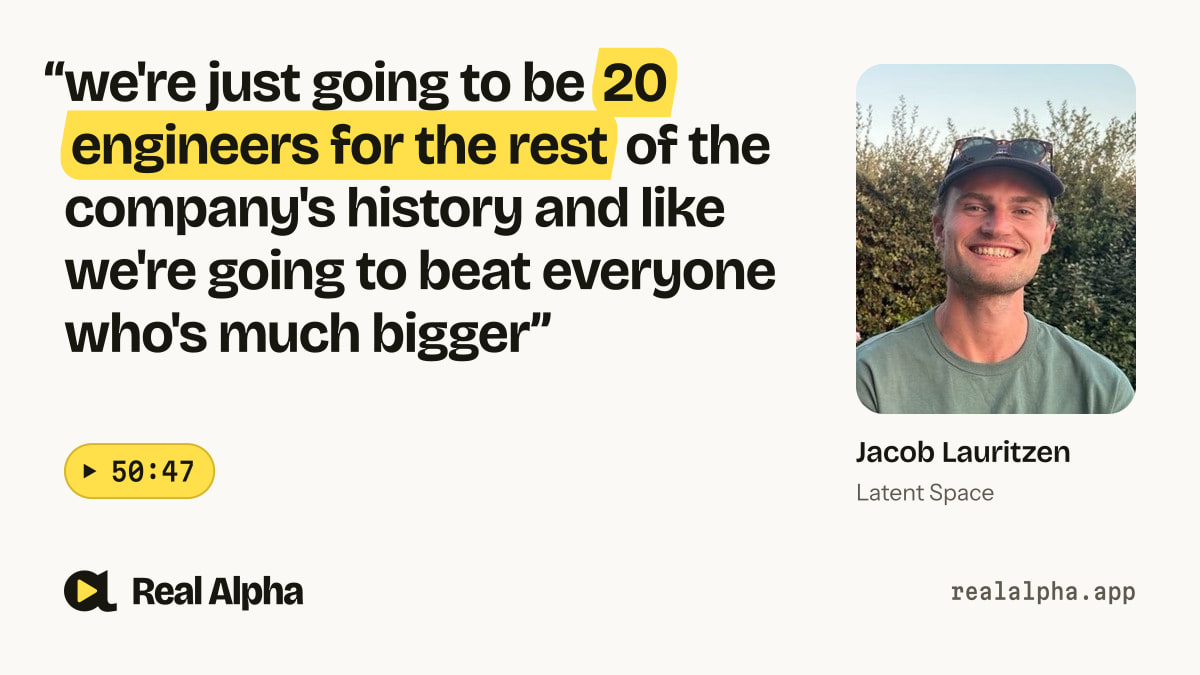
“we're just going to be 20 engineers for the rest of the company's history and like we're going to beat everyone who's much bigger”
 Jacob Lauritzenat 50:47 · Latent Space
Takeaways
- Jacob once pitched a plan to stay at 20 engineers.
- The team grew to 100 and still feels too small.
- Reusable primitives let a small team build more products.
About this segment
Jacob Lauritzen once planned to keep Legora at 20 engineers, but demand pushed the team to 100. He aims to build many customer-facing capabilities from a smaller set of reusable primitives.

Jacob Lauritzen is CTO of Legora.
Leads engineering at Legora, building legal AI agents for research, contract review and drafting.

Shawn Wang (swyx), Host · Co-founder, AI Engineer
Wrote “The Rise of the AI Engineer” and founded Smol AI, maker of AI News.
- BC
Basil Chatha, Host · Forward Deployed
From “Building Legal Agents When You Can't See the Data — Jacob Lauritzen, CTO of Legora”, Nov 2, 2026. Watch the full episode
Thanks. We'll look at and fix what's off.
Transcript
Transcribed by machine (Whisper) from the episode’s audio, so a word may be off here and there.
- 50:17
about restraint, about what you don't do, because you could do all that. And obviously, there's a prioritization issue. Are you more on the point of, let's say no to most things and then only do a short number of stuff? Or no, actually, we want to do more things and we just need to hire like 100 people? I was very strongly the first thing for a very long time let's just say no to everything like keep the English team I think I've said this before but like one of our presentations after I've been at Legora for half a year I pulled up this slide of you know the 300 Spartans for the movie and I was like we're just going to be 20 engineers for the rest of the company's history and like we're going to beat everyone who's much bigger and we're 100 engineers now and it feels like we're way too small
- 51:00
I wanted to do that but I think in the real world we're in fierce competition, people want so much stuff. I could be a Puritan and just be like, no, we have to stay 20 people and we can only build whatever, but then we just lose and people would go elsewhere. So we have to build more, and so I think my job is to figure out how do I build a system where we can build a lot, but actually only... The customer feels like we've built so much stuff, but we've actually only built a few things.
- 51:25
That's how I think about my job right now. Yeah, I mean, primitives is right, you know? Yeah, exactly. I think that's really powerful. Do you test new products, just seeing if like, hey, there's like any pull here and then you just kind of like, you're like, no, let's just focus on our main thing. We haven't made, I mean, we've made certain strategic bets, but we've not tried anything that we don't have a lot of confidence in already, mostly because we just have like a mountain of demand.
- 51:50
It's like, we want all of these things. And so it hasn't really made sense for us to try to be like, hey, maybe this thing could work because like there's so many people screaming for the other things. And so we mostly build those. And then sometimes we'll disagree with clients and we'll be like, actually, I think this thing over here will make a lot of sense strategically, and then we'll try to build that anyway.
- 52:07
Like strategically for you? Yeah, exactly. So what are those things? So one of those things was the agent, actually. So no one was actually asking for it. I want the assistant that I'm using to have more agency and do things without me asking it. No one ever, but we're just like, this is definitely where the industry is going. This is going to empower you to do so much cool stuff. Collaboration was another one where we think the industry is going a place where you can collaborate inside of where you're working, which is Lagora and not in emails and text messages. So yeah, there are a few of those. And then once you say, okay, yeah, we want you guys to use agents, I'm assuming internally at the law firm, it's going to take a lot for them to actually learn how to do that. And so that's where you kind of like say, hey, FD is going
- 52:50
there and teach them what they can do. Yeah, legal engineers mostly. Oh, legal engineers. But they're like, some people call them forward deployed legal engineers if you want, but that's essentially where they are, then they go and help them structure their workflows around the capabilities of the agent.