The alpha, twice a week
That was 3 min.
Get the best new moments in your inbox every Wednesday and Saturday. It's free.
Check your inbox
We sent a link to your address. Click it to finish signing up. Not there in a minute? Look in spam.
or
Latent Space · 3 min · Nov 2, 2026
Legora delayed APIs to avoid locking in a fast-changing product
 Jacob Lauritzen
Legora delayed APIs because a fast-changing product would make old versions costly to maintain.
In this episode
Full episode- 8:39Legora tests agents in simulated legal workspacesPro pick 3 min
- 26:13Client confidentiality forces Legora to infer product failures3 min
- 34:25Tabular Review lets lawyers test a workflow on ten rows firstPro pick 4 min
- 14:12Law firms need incentives to turn expertise into durable assets3 min
- 42:33Legal engineers configure workflows while FDEs write code4 min
- 47:22Legora delayed APIs to avoid locking in a fast-changing product3 min
- 50:12Legora grew beyond its plan to stay at 20 engineers3 min
- 58:13Long contracts can lose meaning when split into chunks2 min
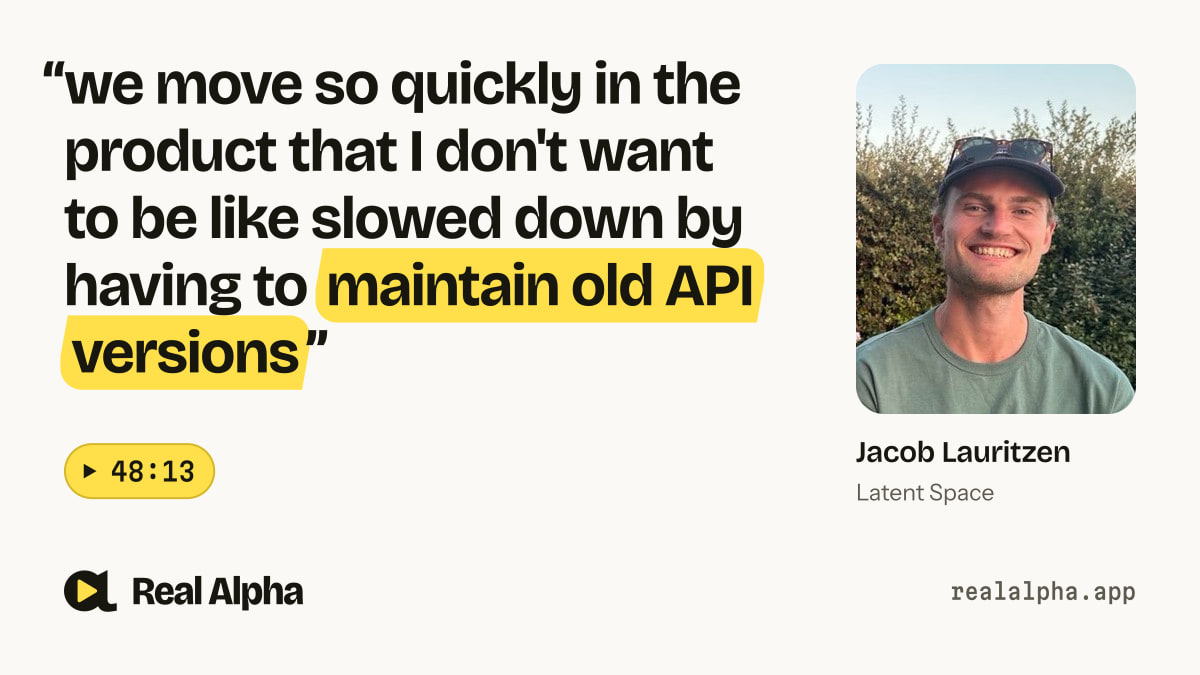
“we move so quickly in the product that I don't want to be like slowed down by having to maintain old API versions”
 Jacob Lauritzenat 48:13 · Latent Space
Takeaways
- Legora started building APIs about six months before the interview.
- Maintaining old API versions can slow product development.
- Agent-triggered actions may replace some API calls.
About this segment
Legora delayed APIs because a fast-changing product would make old versions costly to maintain. Jacob Lauritzen is also considering whether agents can replace some API calls, despite reliability and cost trade-offs.

Jacob Lauritzen is CTO of Legora.
Leads engineering at Legora, building legal AI agents for research, contract review and drafting.

Shawn Wang (swyx), Host · Co-founder, AI Engineer
Wrote “The Rise of the AI Engineer” and founded Smol AI, maker of AI News.
- BC
Basil Chatha, Host · Forward Deployed
From “Building Legal Agents When You Can't See the Data — Jacob Lauritzen, CTO of Legora”, Nov 2, 2026. Watch the full episode
Thanks. We'll look at and fix what's off.
Transcript
Transcribed by machine (Whisper) from the episode’s audio, so a word may be off here and there.
- 47:28
because that's another rule that you can have where you are a CTO maintainer of the Logoira platform. We will offer everything that we have in the Logoira web app as an API and then you guys can use whatever. Is that a promise you make? That's not something we're promising now. We do have APIs that you can build against, but not the entire surface of the product. That's the curious thing. Is that the strategy?
- 47:52
And obviously, some people will love it because I don't have to learn a new tool. I can just use the existing tool I have. And then I just install Agora, for example, with the Word document stuff. Other than that, I do think then you have to maintain it. Exactly. So that's been my thing. That's why we've tried not to do it. We haven't had APIs. I mean, we started our APIs like six months ago or something. We folded for a very long time.
- 48:16
Mostly because, yeah, I just don't want to, we move so quickly in the product that I don't want to be like slowed down by having to maintain old API versions for like a data model that we've changed. I mean, now we're bigger and things are different. So now it's a cost that we can take on. But like when we're 20 engineers, it's just like, we move so quickly that we can't do this. I've toyed with this, right? Like, it's just generally good for all companies to have a platform team and a product team because the product team, you have one, but then you can easily spin up a second one as long as the platform is not super tied to product.
- 48:47
Yeah. You know, like a very simple one is Web App Mobile App, right? Or like Web App Mobile App, MCP, and then like, you know, whatever, like other integrations. Then your FDEs just are one more client to the overall platform. Yes. Yeah. And I think like even the agent, you can think about it this way. There's like a harness team or like that runs the agent and then you can even, you can build a product around it with like skills and automations and whatever else.
- 49:11
Yeah, this is like very famously the Amazon Web Services mandate. Like Bezos was like, guys, no more backdoor access. You only offer other teams your APIs, the same APIs you offer customers. If you don't have it, you build it. And then the customers also get it. Yeah, I think that's also changing a little bit. A lot of APIs now, like one thing that we're toying with is like, can the agent be the API?
- 49:35
I know it sounds weird, but like for some of this stuff, what they actually want to do is they want to trigger certain things to happen. For some part of this, you could just be, I'm not saying that we're doing this, but it's like a thing that I'm toying with in my head is, could that just be like, okay, you trigger the agent and ask it to do this thing? Like, obviously, it's way less efficient than if you just had like an API that you always hit.
- 49:52
And it's like, you know, but it's something that I'm toying with is like, how much of our product can just be the agent versus all the other stuff? Well, you know, unbounded execution and costs and latency. That's the, is that the only holdback? Yeah, and then I think deterministic,