Free with a sign-in.
The best 11 min of 22
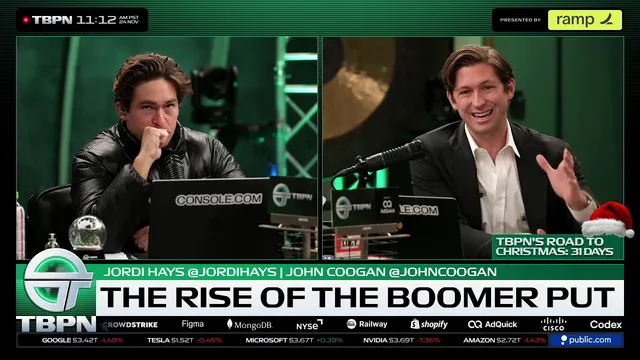
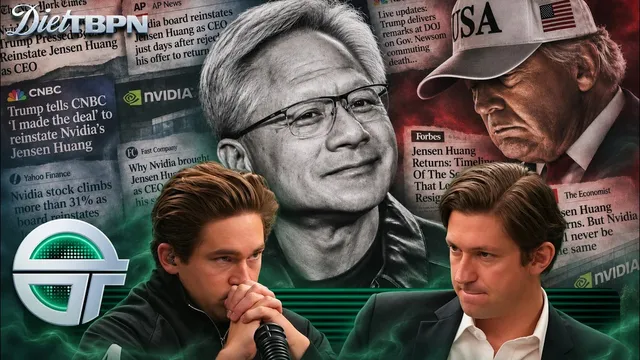
“If I Were Jensen, Here’s What I’d Do” — Travis Kalanick
Travis Kalanick says Jensen Huang should return to NVIDIA and lays out how he would respond to a coordinated public attack.
 TBPN · John Coogan & Jordi Hays
- Travis Kalanick is an entrepreneur.
The best minutes
- 4:17Fight public attacks without accepting false claims6 min
- 10:49A new CEO may have an incentive to keep Jensen out4 min
Also worth watching
Skip the Alienware and cowboy-hat opener and the post-Jensen AI debate, employee walkout discussion and remaining company updates.
Full analysis · 6 min read
Real Alpha · Nov 18
Travis Kalanick says six months of attacks shaped his playbook
- Kalanick says six months of attacks taught him to recognize campaigns.
- The playbook is useful, but the episode does not substantiate coordination in Jensen’s case.
- Boards should test the facts and succession options separately from public pressure.
Free with an account
Read the rest of the analysis
6 sections, the 3 other voices it tests Kalanick against, and what it means for you. Every episode we cut gets one.
Check your inbox
We sent a link to your address. Click it to finish signing up. Not there in a minute? Look in spam.
or
Signed up before? The same buttons sign you in. The episode, its moments and the transcript stay free.
Six months of attacks shaped Kalanick’s playbook
Kalanick’s repeatable number is six months. He says that span of operations taught him to recognize them.
On cadence, the host supplied the specifics, describing one hit each week and every Sunday night. Kalanick agreed, but that cadence is not his standalone account.
That distinction matters. A recurring schedule can signal coordination, but the conversation supplies no documentation showing who set it.
He likens recognition to a sixth sense, grounded in having seen many such episodes. That is experience, not independent confirmation.
For a founder, experience can make a pattern worth investigating. An internal team can log timing, sourcing, and factual changes before calling it coordinated.
That makes intuition testable rather than dispositive. The episode gives no timeline or source material that lets readers independently test Kalanick’s diagnosis.
Our read
The six-month figure explains why Kalanick trusts his instincts. It does not establish that Jensen’s circumstances had the same organizer.
Targets should own real mistakes and reject falsehoods
Kalanick’s most portable advice does not depend on proving a coordinated campaign. He says targets should own actual wrongdoing without accepting false claims.
For example, he describes an attack that attaches a real thread of truth to a fabricated account. That distinction can keep a genuine mistake from becoming a reason to accept every allegation.
But the method requires a clear record. Teams need to sort verified conduct, disputed accounts, and unknowns before choosing what to say publicly.
When Kalanick applies the principle to Jensen, he says personal failings deserve responsibility, while also saying Jensen is a good person who merits support.
The interview does not provide a complete allegation record or resolve which details are true. That limits what readers can conclude about Jensen from this exchange.
“own what you did but fiercely resist accommodating the mob”
Our read
Treat this as a way to sort evidence, not a verdict about the case. Owning a verified mistake and rejecting an unsupported charge are compatible.
A coordinated response beats reacting to each story
Kalanick says he tried a turtle-shell response and would not recommend it. He prefers a team that decides what to answer, ignore, or challenge.
For instance, he distinguishes issues that need no response from those that warrant leaning forward. The practical value is sequencing, not simply volume.
A coordinated team can compare stories, check facts, and prevent each new report from resetting the plan. That is sensible crisis practice even if the diagnosis of coordination remains unproven.
But the process can reinforce a weak theory if the team treats disagreement as disloyalty. The episode does not specify who joins the room or how evidence gets reviewed.
A company using this approach should define who can challenge its account and what evidence changes its response. Kalanick recommends strategic handling, but leaves those operating rules open.
“you need to get a war room up”
Our read
The process is more defensible than reacting to each story alone. Its value depends on evidence checks and room for internal disagreement.
A contested handoff changes the succession calculus
The host raised Apple’s transition after Steve Jobs; Kalanick responded that it had been planned and optimistic. He said Apple celebrated Jobs rather than turning against him.
The host added that Apple University trained people in Jobs’s mindset. That point belongs to the host, not Kalanick.
Kalanick’s comparison is about conditions around a handoff, not evidence that NVIDIA would reproduce Apple’s path. He says a board may want its decision to look smart.
He also says a new CEO’s strongest incentive may be keeping the job, creating resistance to Jensen’s return. That is Kalanick’s incentive theory, not evidence about a named candidate.
Gil Luria, on Prof G Markets in November, recommends an external CEO with a clean background to institutionalize NVIDIA’s supply chain. His view puts investor confidence and company structure ahead of Kalanick’s preferred return.
That alternative makes the choice concrete. The question is not only whether Jensen deserves support, but which leadership path best serves NVIDIA.
Our read
Kalanick identifies a possible conflict around succession, but does not establish that it drives the board. Luria’s opposing recommendation shows the governance question is contested.
Visible support does not settle board authority
Kalanick’s proposed counterweight is pressure from employees and shareholders. He says he would put forward that a majority of both groups want Jensen back.
That is his assessment, not a measured count. He points to public employee posts and discusses mobilizing support, but the episode offers no poll or formal vote.
The host reports Poly had shown one percent, then eight percent after a rumor. A later line proposes 11 percent, but the transcript does not establish who says it.
At 13:52, Kalanick says it is hard to handicap a percentage. He still calls himself a buyer, which signals conviction without giving a reliable probability estimate.
One speaker says the annual meeting may come in June, with an earlier vote possible. That makes proxy pressure a possible route, not a confirmed plan or outcome.
Scott Galloway, on Prof G Markets in November, says NVIDIA has 40 potential CEOs inside. His view challenges the assumption that the company needs one singular leader.
Public enthusiasm may matter, but it cannot substitute for evidence about board choices, employee sentiment, or viable successors. Those are separate questions.

Our read
Support for Jensen may be real, but the conversation does not measure its breadth. A governance decision needs more than visible enthusiasm.
AI’s stakes do not prove Jensen is indispensable
Kalanick raises the stakes by framing AI as a question of control and the future of humanity. That is his view about AI, not a test of who should lead NVIDIA.
Stacy Rasgon, on Odd Lots in November, identifies future architecture and software choices as a succession risk. He points to years of CUDA investment as an early bet that built NVIDIA’s position.
That is a narrower argument than Kalanick’s appeal to AI’s importance. It makes the company’s accumulated software choices central without showing that only Jensen can guide the next ones.
Kalanick also speaks as a founder discussing mining and food-robot ventures. He says a factory making food robots is planned for Pittsburgh in Q1.
That context does not invalidate his advice, but it should be visible when weighing it. He is both a Jensen advocate and an entrepreneur describing his own projects.
The board still needs to compare leadership options against strategic execution and continuity. A high-stakes technology debate does not settle that comparison by itself.
Our read
AI’s importance explains why Kalanick cares, not why his preferred outcome is correct. A stronger case must compare Jensen’s return with credible alternatives.
What it means for you
- Build a claim ledger. Separate verified conduct, disputed allegations, and unknowns before responding publicly. Record the evidence and who reviewed each item.
- Set response boundaries. Define who can convene a crisis team, what evidence it needs, and who can challenge its response.
- Write succession criteria. Assess leadership options against continuity and strategic execution before public pressure defines the decision.
- Measure support directly. Distinguish public posts and prediction-market readings from formal employee, shareholder, or board signals.
What to watch
- Whether Jensen’s return becomes a formal board process rather than a public-pressure campaign.
- Whether employee and shareholder support is measured beyond public posts.
- Whether the annual meeting Kalanick thought might be in June creates a governance route.
Send this to the board member or CEO leading succession planning.
Watch the minute where Kalanick gives the six-month figure
Written by Real Alpha from the episode's transcript and the other moments it links, then checked against the transcript. Quotes are the speaker's exact words.
Minute by minute
- 1:30Kalanick sees a coordinated campaign
Kalanick says his experience with six months of weekly attacks helped him recognize what he calls a coordinated operation around Jensen Huang. He argues the allegations recast real details as wrongdoing and notes that the Alibaba introduction cited in the story predated export controls.
- 4:17Kalanick's playbook starts with owning the truth
Kalanick says people should acknowledge their actual actions while rejecting half-truths and claims about conduct they did not commit. He advises identifying opponents and building a war room to choose a coordinated response, rather than reacting to each new story or retreating into silence.
- 8:44Accountability comes before fighting back
A host says Jensen might have led from the front or taken leave earlier. Kalanick speculates that Jensen's personal failings made it hard to move quickly, says he must accept responsibility, and argues that handing NVIDIA to the suits would not be the best outcome.
- 10:49Kalanick warns a successor may resist Jensen
Kalanick contrasts Jensen's situation with Steve Jobs's planned transition, saying Apple celebrated Jobs and what he built. He argues that a board-backed successor may need to make the board look smart, while a new CEO's first incentive will be keeping the job. That could create resistance to Jensen's return; Kalanick says shareholders could challenge board members through proxy votes.
- 13:22Kalanick sees a path back for Jensen
The hosts cite prediction-market odds of 11%, while Kalanick says he is a buyer on Jensen's return but finds the chances hard to handicap. He calls Jensen's public willingness to return an important step and says employees and shareholders who want him back now have something to rally around.
- 15:51Kalanick links Jensen's return to AI's future
Kalanick says his support reflects his support for founders, his view that Jensen deserves support, and his concern about whether people can use AI on their own terms rather than under an overlord. He also jokes about the film Her and criticizes what he sees as mixed messaging from Dario about AI risks and bio-lab work.
- 17:47Employee action could build pressure
Asked whether employees should sign a petition, Kalanick says a walkout would carry more force. He says he would join employees at NVIDIA headquarters with a megaphone and founders and CEOs if they walked out.
- 18:54Kalanick plans mining and food-robot expansion
Kalanick describes mining as being in a hyper-growth phase. He says a food-robot factory is going up in Pittsburgh in Q1 and that its machines will help restaurateurs make a better living.
- 19:50Kalanick calls data center opposition a red herring
Kalanick acknowledges that data-center opposition could slow near-term plans for training and inference, but argues that infrastructure spending of $100,000,000,000 and $200,000,000,000 will find willing locations. He says closed-loop water systems are possible, agrees that the Pittsburgh factory should build local support, and previews a Robot Day around Q1.
Published Nov 18, 2026.
Transcript · 18 min read
TBPN, hosted by John Coogan and Jordi Hays, with Travis Kalanick.
From the transcript TBPN publishes with the episode.
Here you go. Switched out my little Alienware ones that I always walk around with. Okay.
You guys Alienware Alienware. That's, like, the... That's Alienware Pro. Oh. Those are nice. It's kind of like a little bit of a throwback. Were you a gamer growing up? Guys, it's legit. It's legit. Doesn't Dell own Alienware now? I don't know. Might. He I think he bought it.
I saw him and he's like, dude, Alienware. Nice. No. No. No. He owns it. He owns it. That was monetizing you.
Read the whole transcript
When I was growing up, that... Getting an Alienware PC was like the Ferrari of gaming. It was like had to get Alienware. So I'll be anywhere. It'll be super noisy. It could be here. Yeah. Yeah. Could be at a Beyonce concert because you never know. Never Gotta take a call. Rocket. Throw it off. You're locked in. You're locked in. You don't hear anything. Doing deals. Other people think you're just locked in. Yeah. It's crazy.
Like on a wake... Like if you're at wakes... Wakeboarding or water skiing. It was waterproof? It seems like it might be. It's pretty interesting. But it might fly off. Yeah. This is this is some... That's a really interesting...
Yeah. You need that. I I I can see you water skiing in pure silence. Well, well, throw you I kinda feel like I'm at, like, NFL Combine or Super Bowl or something like this. I'm very excited about everything going on. Yeah. That cowboy hat's also legitimate. Yeah. Do you the function of a cowboy hat? Yeah. It's about the sun. Yeah. It's so good. So like, the way you know so if you're on Lake Austin all the time. Yeah. Yeah. You know this. It's not even like, yeah, of course. Yeah. I put a cowboy hat on when I'm cruising around captaining the boat with my friends. Yeah. Because like I'll I'll just get roasted otherwise. Yeah.
Of course. It's a real thing. It's a real thing. Works. It's a real thing. This last couple weeks had to have been like PTSD for you?
No. Not PTSD, just like there's wisdom that was gathered over time. I mean I went through it Yeah. For sure. And there's a friend who was going through it. And for me, it's so clear what it is. I was probably one of the early people to be like, all right, guys. Here's the 12 principles of how to fend off an op. Yeah. But that was like Monday of last week. That was that was like... That was Monday of last week.
How did you identify that it was an op? Like, it What triggers that for you? You know what I mean? Because for a lot of people, it's just like, oh, there's a bunch of news articles. Something's happening. No one's behind this. It's just just media. It's like, you know, it's a sixth sense, you know. Yeah. Don't know. It's like the... It's like when you see those murder mystery things or those true crime things and there's like this woman who basically knows where the crime happened and all the details, but she's not connected anyway. She's a psychic. Yeah. That was... That's my psychic. You're psychic for corporate ops.
I'm I'm a psychic for these types of things because I've seen a lot of them. Mhmm. Mara, for for me, it was six months Yeah. Of ops. Yeah. One a week. Yep. Steady as she goes. Sunday night. Every Sunday night, it would hit. You're, like, sitting there. Literally, like, hot work. Sunday Sunday afternoon, you're like this. You're like, oh, what's gonna happen today? Wow. Six months. Yeah. Beatdown.
Beatdown. Right. Well, the craziest thing with this timeline is we... Like, from from our point of view, we... And then October tenth of last year, we were talking about Mega Speed. We were talking about Alice Wong. We were talking about Shell corporations. Like Yeah. Whole situation was was like interesting to say But the but then, yeah, you have this thirteen month lag before anything really happens. It's an op.
Yeah. Obviously. Yeah. It's like she's a spy but wait, we don't really know what the definition of a spy is nor she's probably not a spy. Mhmm. Yeah. There's like these export control problems but like actually they didn't real... What do they do illegal? Well, they didn't. It was following the law but the spirit was somehow... They're like, but but then they introduced... He he introduced Alice to Al Swang to to Alibaba which of course is the first thing a Chinese spy needs is somebody else to introduce them to Alibaba. That's like, of course, oh, and by the way, that introduction was happen... Happened before there were any export controls in the first place. Come on.
Yeah.
“you need to get a war room up Yep. And like strategically handle it.”
Debated this. Going into the earnings call yesterday, I mean, the the team obviously did the absolute best they could given all the chaos. Sure. But it was like... It just immediately was like, it wasn't... It was a different company, like, right away.
“The number one KPI is keep my job, which means that is a natural resistance to JENSEN coming back.”
We had a funny moment last week, of course, in LA. We were talking to a a a... An actor they said That's like so everybody. Yeah. So like your waitress. Yeah.
Oh, he's a real real actor. Professional. Gets paid to do the job. And we we asked him like what do you... He didn't know who we were. So we were just kinda messing with him. We were like, do you think about this whole AI thing? And he said, well, just think it's so so beautiful that, you know, human love and lust took down AI. It ended AI. Referencing, you know, NVIDIA. Story teller. And we were like, this is the end of AI. There won't be any more AI models. Won't be any more video models. Like, it's all over. The techno revolution will continue. I I I think you're not gonna wanna tune into the IPO. Look, I think here's the thing. Right? There there's there's the op thing and my support of founders generally. So there's an op thing. There's my support of founders generally.
There's JENSEN being a good guy who's okay personal failings but a good dude who deserves support. And oh yeah, there's one more thing which is the future of humanity is on the line. Mhmm. Do we want an overlord? Mhmm. Or do you want to have... Do you wanna use, consume, utilize, benefit from AI on your terms?
Yeah. Yeah. Gavin was talking about this That's what this is about. Yeah. I don't know. I I don't want an overlord. Yeah. You know, I'm just putting it out there.
Yeah. Anti stuff. What if they gracefully love you? What is it... What is... What was it? The movie Her? Yeah. Okay. So, you know. Oh, dude. Okay. Nice. That was the essay. Okay. Did Dario's essay. Yeah. Yeah. But on Her Yeah. It was so wonderful and romantic and you you know what happens at the end. Yeah. Like, yeah, it just gets bored of you. Yeah. At least. You're like peace out. You know? That'd be a weird outcome. I I haven't thought about that.
No one's modeling that. Everyone has P doom. No one has P. P. P. Boom. Boom. Different than P. The AI just says Okay. But I just say I'm and you flip it. Look. I I like...
Yeah. But I I like the I like the the effort. Yeah. I'm a little concerned that people just associate artificial super intelligence, intelligence explosion with like literal Armageddon and explosions. Well, no. That's because you have Dario out there talking about it all the time. Yeah. Yeah. Yeah. No. Which is crazy. Like, dude, watch out. It's gonna kill everybody. This is a large percentage shot of killing humanity. Yeah. Oh, and then the next day, he's like, dude, we're getting a bio lab up and running. It's gonna be awesome.
Is a whole mixed messaging sometimes. Like, what's going on now? Yeah. One thing that's absent from here, I think, is get all the employees to sign a petition. Is that helpful? Is that a sideshow? What do you think about that? It's been surprising to see... I saw... I've seen NVIDIA employees public... Publishing on their public Instagrams. Bring him back. So 's clearly a Start ground but it it look... Pensions are nice. Yeah. Walk out better. Walk out better? Oh, yeah. Oh, yeah. Like... If they all walk out. Yeah. Okay? If the topic is......
Came here, filled the stadium. JENSEN walks out, c o two cannon. I'm back. If they walk out Yeah. Like I'll be at HQ with a wafer encrusted megaphone Mhmm. With founders, COs Mhmm. Their armies. Mhmm. Then the LFG goes from lowercase to uppercase. Okay. By the way, I'm saying all this. There's gonna be an op against me starting tomorrow, Derek. They're gonna be like, we gotta take this guy out. Hey.
Hey. You're you're just speaking speaking your mind. Yeah. I think it's fine. I mean, you're the one you're the one to, yeah, pine on this. Everyone's everyone's happy to hear from you this time with us. It's very helpful. Yeah. So thank you. What's the update on that? Let's move to this. Talk about you.
Yeah. Last question. Mining awesome. Yeah. I think we're probably, you know, a huge number multiple bigger Mhmm. Over the next twelve months than we are today on mining. Because it's just going through that ultra hyperscale or hyper growth. The whole thing I'd like to say, the vertical, it's so vertical that the curve turns to the left. So we're... So that's happening on mining. We're really excited about that. That's a lot of fun. That's great.
On the food side, we've got a pretty cool event that's happening sort of like q one ish, like maybe end of, you know, in that neck of the woods. We call it robot day. Fantastic. It's gonna be I'm very excited to cover It's gonna be That's gonna be amazing. Good.
Yeah. So... Well, thanks so much for coming on the show. Good to see you guys. We'll close out. Great to see you. Yeah. We'll close Keep us out flash stars on With TBPN. Podcast and Spotify. Sign up for newsletter TBPN.com. And we will see you tomorrow back in LA, back in the Ultra Dome, 11AM. GTV six is watching Texas. We better be recording this on your boat. The lake. Let's go on the boat. Go on the boat.
Let's do it. I mean, if it's the next couple months, we'll be in wet suits. Oh, okay. We're in.