Free with a sign-in.
The best 18 min of 101
TSMC Hacked, Vibes Down Outlook Down, 41 Days Till Christmas, Nvidia v2
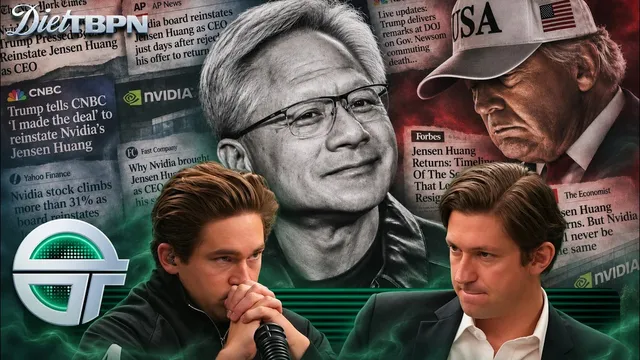
Tae Kim argues that NVIDIA can navigate Jensen Huang’s departure if it retains key leaders and divides his roles across a strong team.
 TBPN · John Coogan & Jordi Hays
- Tae Kim
- Ben Smith · Co-founder & editor-in-chief, Semafor
- Gunjan Banerji
- Abhishek Malani · Partner, Sequoia Capital
The best minutes
- 37:25NVIDIA may need several leaders to replace Jensen’s range8 min
- 58:32NVIDIA’s China chip story is colliding with Washington’s system5 min
- 1:30:18Poker bots adapt by learning opponents and playing new variants5 min
Also worth watching
- 50:42Distillation curbs could widen the US-China model gap4 min
- 47:11Neo-cloud financing faces more pressure than hyperscalers4 min
- 1:09:31Washington memos can shape the first account of a scandal4 min
- 1:25:25Candid interviews need details audiences have not heard before4 min
Skip the opening GQ recap and Jensen succession debate, the TSMC/Outlook/Blackwell updates, and the closing announcements.
Full analysis · 5 min read
Real Alpha · Nov 20
Tae Kim says Nvidia may need to retain roughly 10 people
- Kim said Nvidia may need to retain roughly 10 people, based on sources he spoke with.
- His interviews support a bundled-role diagnosis, but not a verified succession slate.
- The board’s test is retaining the bench as politics and financing reshape the job.
Free with an account
Read the rest of the analysis
7 sections, the 3 other voices it tests Kim against, and what it means for you. Every episode we cut gets one.
Check your inbox
We sent a link to your address. Click it to finish signing up. Not there in a minute? Look in spam.
or
Signed up before? The same buttons sign you in. The episode, its moments and the transcript stay free.
Kim puts roughly 10 people at the center of succession
Kim’s most useful number was not a successor’s name. He said Nvidia sources identified like 10 people the board may need to lock down. That makes retention the first measurable succession test.
He first raised locking down the top two or three, then widened the potential group to like 10. The transcript gives no names for the full group.
The hosts cited Wired’s report that an employee suggestion-box post drew more than 1,600 comments. Nvidia has 42,000 employees, so that shows support, not a company-wide vote.
“If the board is able to lock down these people, I think NVIDIA can be successful.”
Our read
Kim’s figure is a sourcing lead, not a succession map. The immediate question is whether Nvidia can keep the people who already carry its work.
Kim says the conduct reports make a return unlikely
Kim said that after a second report about an alleged relationship with a direct report, he thought Huang’s return was over. He pointed to Nvidia’s code of conduct and conflict-of-interest rules.
That is Kim’s reading of reporting, not a final finding from an investigation. He distinguished it from the export questions, which he said remained unresolved.
For a board, that narrows the usefulness of a return as contingency. Employee calls for Huang and his eligibility to lead are separate questions.
Our read
Kim’s view makes a return a poor base case, while leaving the allegations distinct from the unresolved export investigation.
Kim’s reporting shows Huang bundled several jobs together
Kim is writing a book about how Nvidia was built, drawing on more than 100 interviews. He rejected the idea Huang was mainly a dealmaker who left technical work to others.
Kim described Huang as chief marketer and business strategist, and as a recruiter who micromanaged people. Those functions connect dealmaking, talent, and internal judgment.
Kim described short status emails and weekend writing. That account supports his view that Huang stayed involved, though it does not quantify his work on chip architecture.
Our read
Nvidia is not replacing one title. It is trying to preserve a bundle of operating functions and the authority that connected them.
Nvidia can divide Huang’s work across a team
For example, Kim named ARM CEO Renee Haas for public-facing leadership and business management. He named Ian Buck for data-center relationships and technical vision, with GPU engineering under a separate leader.
Kim said the board was taking its time and vetting candidates. Separately, Angelo Zeno on Bloomberg Daybreak in November favored an industry insider within three to six months. He also called succession a team effort.
That timetable belongs to Zeno, not Kim. The overlap is the team requirement, while Kim’s argument is that an incoming CEO should know their limits and preserve autonomy.
The board would need to clarify who makes final calls when those leaders disagree. Without that, dividing roles could recreate the committees Kim sees as a risk.
Our read
Kim offers a plausible structure, not evidence that it will work. The test is whether a new CEO can coordinate strong leaders without recreating a committee.
Near-term products buy Nvidia time, not certainty
Kim said Nvidia’s product quality was, in his view, baked in for the next two or three years. He called the strategy three to five years out the critical question for the next CEO.
Take that horizon. Near-term execution can continue while the company faces a longer test over dealmaking, partnerships, and strategic direction.
A strong roadmap is not proof Nvidia will make the same bets, move at the same speed, or keep the same customer relationships. Yet the pipeline may delay when a leadership gap becomes visible.
The board should separate confidence in near-term products from confidence in decisions beyond that window. Kim’s timeline makes those different questions, not one forecast.
Our read
The next few product cycles may soften the immediate succession shock. They do not answer who will shape Nvidia’s strategy after that.
Compute demand can hold while financing tightens
Kim expects overall GPU compute demand to stay high, even as he expects the data-center route serving Chinese customers to close. He described pressure on neo-cloud financing as incremental so far.
Kim said hyperscalers have free cash flow. He contrasted them with neo-clouds, which face tighter financial conditions, higher rates, permitting hurdles, and energy costs.
For instance, that separates demand for compute from each provider’s ability to fund capacity. Kim did not describe a broad demand collapse or a forecast that a large share of revenue would disappear.
Kunjan Sabani on Bloomberg Tech in November said Huang used Nvidia’s relationships and balance sheet to finance the wider AI buildout. That puts dealmaking in the infrastructure-funding picture, not just chip sales.
- KSKunjan Sabani · Bloomberg Tech · Nov 13Nvidia's balance sheet helped finance the wider AI buildout
Our read
Demand strength does not guarantee every provider can fund capacity. Nvidia’s next leaders may inherit a healthy market and a harder financing environment.
Washington can narrow the next CEO’s room to act
Ben Smith, Semafor’s cofounder and editor, described Silicon Valley’s alignment with the Trump administration meeting resistance from the national-security bureaucracy. He said committees and internal investigations could keep the chip-export story expanding.
Smith also described a memo shared with officials that put the first account of the scandal on a clock and shaped its framing. He said later reporting had complicated the initial characterization of the alleged spy relationship.
Max Chafkin on Bloomberg’s Everybody’s Business in November predicted investigations and subpoenas would keep the story alive. That forecasts continued scrutiny, not what investigators will find.
Keep the export-policy debate separate from allegations around personal conduct. One affects sales and access; the other bears on leadership and conduct.

Our read
Political scrutiny is a constraint on the job, but not proof of any allegation. The board must plan for uncertainty without treating every strand as the same issue.
What it means for you
- Map critical roles. List the leaders who own GPU engineering, customer relationships, recruiting, and major deals. Kim’s account suggests retention by function matters as much as the CEO appointment.
- Track retention directly. Ask which senior technical and commercial leaders are staying, and who has authority over each major decision. Kim’s estimate of like 10 people is a prompt to verify, not a target to assume.
- Separate demand from credit. Track compute demand separately from providers’ financing access. Kim expects demand to stay high while neo-clouds face greater pressure than hyperscalers.
- Review export exposure. Map customer access paths that rely on data centers outside China. Kim expects that route to close, so model it as a scenario rather than a settled rule.
What to watch
- Whether Nvidia retains its senior technical and commercial bench.
- Whether the board names a permanent CEO and clarifies decision rights.
- Whether chip-export scrutiny expands into new restrictions or investigations.
Send this to directors and operating leaders planning CEO succession.
Watch the minute where Kim gives his rough 10-person retention estimate
Written by Real Alpha from the episode's transcript and the other moments it links, then checked against the transcript. Quotes are the speaker's exact words.
Minute by minute
- 4:02The Jensen story breaks beyond tech
John Coogan and Jordi Hays said the story had spread beyond tech into Hollywood and social media; one person they spoke with read it as the end of AI, which they rejected, saying model progress and diffusion had not slowed. They also cited employees calling for Huang’s return, including a suggestion-box post with more than 1,600 comments among NVIDIA’s 42,000 employees.
- 10:25WSJ reports Jensen criticized Kress
The Wall Street Journal reported that Huang had called interim CEO Colette Kress a deer in the headlights and questioned her ability to help define strategy after she challenged some dealmaking. Coogan and Hays laid out competing readings: Kress favored financial restraint, while Huang’s aggressive dealmaking supported NVIDIA’s growth; they noted a more manager-led successor could still deliver.
- 16:02Founder authority can speed decisions
Coogan and Hays argued that a founder’s role can be to break committee deadlocks, draw on experience to choose among competing plans and speed execution. They said Huang combined engineering and product judgment with dealmaking, and suggested losing those functions could weaken NVIDIA’s position.
- 22:46Hosts report TSMC and Outlook failures
Coogan and Hays said TSMC confirmed that an outside cloud provider leaked employee records; the seller claimed to hold 46,000 records and asked for 3 bitcoin, around $220,000. They also reported that Microsoft 365 and Outlook had been degraded for more than 24 hours; a staff voice said the outage did not appear to be a cyberattack.
- 27:32Chinese labs reportedly used Blackwell
The hosts discussed a report that DeepSeek, Moonshot, MiniMax and Ant Group trained newer models on Blackwell chips despite import restrictions; Dylan Patel said the use was already visible in open-source code. They said distillation and not reserving GPUs for inference could let labs train with fewer chips, while calling for more explicit investigation.
- 30:29Kim says conduct makes return unlikely
Kim said he believed the second report describing a relationship with a direct report made Huang’s return impossible under NVIDIA’s code of conduct, distinguishing it from the unresolved China-related investigation. Kim said his book research drew on more than 100 interviews; sources described Huang berating executives, while accounts also portrayed him as closely involved in recruiting, strategy, marketing and operations.
- 39:04Kim outlines succession options
Kim named ARM CEO Renee Haas and NVIDIA’s Ian Buck, creator of CUDA, as possible successors. He proposed that a new CEO handle public-facing and business duties while Buck and senior GPU engineers lead technical work, and said the board should retain five to ten key executives.
- 47:11Kim sees strong demand, tighter financing
Kim said closing the overseas data-center route for Chinese customers could reduce some sales but would not materially change aggregate AI compute demand; he said hyperscalers could fund spending from cash flow. He expected neo-clouds to face tougher financing and permitting, while noting that macroeconomic conditions could affect their access to capital.
- 52:47Kim predicts a wider AI model gap
Kim predicted that the gap between U.S. frontier models and Chinese models could widen as OpenAI and Anthropic restrict distillation. He cited a reported October Anthropic ARR above $80 billion and said its planned IPO was six to seven times oversubscribed after a valuation reset; he also argued that AI research and development would drive more chip demand.
- 58:00Smith sees Washington fallout intensifying
Smith said Silicon Valley figures who backed the Trump administration, including Huang, may now face costs as chip-export decisions collide with national-security officials. He framed the story as a collision between technologists and policymakers and expected congressional scrutiny and internal administration investigations.
- 1:03:42Smith and hosts debate NVIDIA without Jensen
Hays argued that NVIDIA may lose a rare combination of engineering, product leadership and dealmaking; Coogan said a more disciplined successor could still grow the business, as Tim Cook did at Apple. Smith said Wall Street may reward tighter spending even if innovation slows. Coogan and Smith also described China sales as marginal at NVIDIA’s scale because buyers elsewhere want the chips.
- 1:09:31Smith traces story to a Washington memo
Smith said the story moved through Washington after Marco Rubio circulated a memo he viewed as destined to leak; he said the alleged spy role was more complicated than the initial framing. He said the administration’s response to known chip diversion remained an open question, and described an upcoming Semafor summit with political leaders from South Africa, Estonia, the UK and Taiwan, alongside technology figures.
- 1:16:08Banerji says investors buy through crises
Banerji said successful investors often put money to work during crises such as the financial crisis and COVID-19. She described wealthy people spending on collectibles, million-dollar European trips, private jets and high-end hotels, and said new technology wealth was affecting San Francisco rents and jet demand. She said candid interviews with specific financial details can be useful, but viral clips cannot be predicted.
- 1:30:26Malani explains the poker-bot contest
Malani said Sequoia, OpenAI and Citadel Securities organized a poker-bot tournament after new models made a weekend build possible; more than 7,000 people applied, over 700 competed and 20 teams reached the finals. Bots had to respond within one millisecond, and some teams classified opponents from about 15 hands. Malani said Sequoia hoped to support participants as founders, researchers or hires.
Published Nov 13, 2026.
Transcript · 1 h 19 m read
TBPN, hosted by John Coogan and Jordi Hays, with Tae Kim, Ben Smith, Gunjan Banerji and Abhishek Malani.
From the transcript TBPN publishes with the episode.
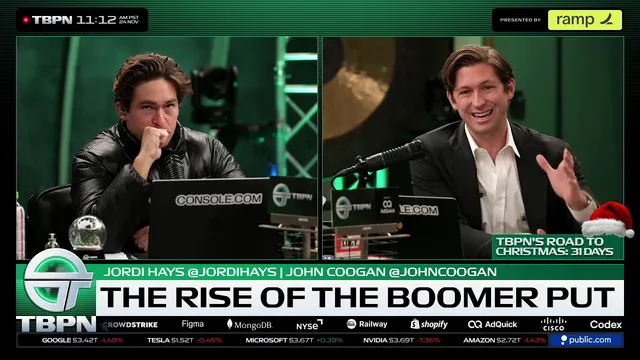
You're watching TBPN. Today is Friday, 11/13/2026. We are live from the TBPN UltraDome, the temple of technology, the fortress of finance The capital of capital. I feel like your voice is coming back a little bit. Maybe. Let me tell you about ramp.com. Time is money, save both. You can use corporate cards, bill pay, accounting and a whole lot more all in one place. I think we're I think we're over the hump. Over the hump of both our sickness and...
Very weird because we were sick like a long time ago. Yeah. And then like, you know, long road. Long road back.
Well, speaking of roads, let's check it on the road to Christmas. Perfect. How many days until Christmas? You need to count it down. That's what you come to TBPN for. We have you covered on the road to Christmas. Forty one days until Christmas. Sam Altman, forty one days... What? 41 years old. Not his birthday today. Not today. Just he's 41. Random There you go. Number association. Fun fun fact. Anyway, we are... Through most of the NVIDIA news, feels like the the week is winding down. It really crescendoed in the middle of the week. Yesterday was was was crazy. The most fallout I think of everything as Jensen resigned as CEO and doesn't even hold a board position anymore. So there's a few lingering stories that we should catch people up on. But we do want to move on from this story because there's so much else to talk about.
Read the whole transcript
Is there? Yes, there is. There is. The mansion section. Yeah. That was funny. I saw a comment from from somebody I think this morning saying, alright guys, you've been talking about the Jensen story for nine days. We get it. Nine days? I don't think it's been... I know I know you want to talk us to talk about other stuff but I think it's ultimately the biggest story Yep. In technology, in my lifetime Yeah. In many ways. The other thing is that has the most potential downstream impacts on like the entire... All the private... Everything happening in the private markets Yeah. Public markets. We're we're not done. We're gonna keep talking about it.
The other thing is that when one of these big all encompassing timeline takeover current thing stories happens, Like, people do pull back on creating more news. So on Monday, we were sort of like, woah, weird timing for Anthropic to drop Fable 5.2. It's gonna be hard for them to break through with that model. Whereas if it's a really slow news week, a bunch of people are going to be sharing, here's what I built with it, here are the benchmarks, let's debate AGI timeline, safety, blah blah blah. It was kind of just like, here's the release card, go for it. And it didn't break through nearly as much. And that's something that they clearly had planned in preparation for the IPO next week. They weren't going to cancel that. But many other companies are pushing back releases right now because of the Jensen story. Because if you have a funding announcement or some product launch, you know that it's going be harder to break through.
So that also gives us a little bit less to talk about. But fortunately, the good folks at The Wall Street Journal, they're still publishing the mansion section and so we will have plenty to talk about. But first, we should do a little review of last night. Jordi, how did you enjoy GQ Man of the Year? Really fun. Great party. Really fun. First red carpet ever? Yes. Yes. We should get a red carpet in here, I feel like, for the for the guests to enter. Yes. Don't you think that's underrated? We have a couple black carpets but...
But it was really fun. Honestly, we spent the entire time going around hanging out with all the The business. Media people.
Yeah. Yeah. The business and media people. It's not really our scene but we had a really great time. Yeah. Louis Vuitton was kind enough to dress us. Yes. Thank you Louis Vuitton. Fantastic. We felt incredible out there.
Yeah. It was remarkable. It was a movie. Yeah. We needed... Chad's saying we need a green carpet.
Green carpet. Okay. Yeah. Maybe we do a green green carpet. Yeah. Dylan was there with us. We had lot of fun. Anyway, not much. Oh, the one the one interesting takeaway was hearing from folks in Hollywood about their take So on the Jensen the Jensen story has broken through. I mean, we've discussed it as breaking through in the sense that I will see Instagram creators and Reels creators who normally their domain is just impressions or day in the life or doing something non tech related. They're all taking the Jensen story and doing their version of content around it. But it's also broken through to Hollywood media broadly. It's not a pure tech story by any means. We know this. But what was interesting was that we were talking to one individual who was saying that this signaled the end of AI in some way and that it was this ironic beautiful story that something so human Oh, no. Unfair would bring down the techno machine, the relentless march of techno capitalism.
Yeah. The... Yeah. His takeaway was... But that it was completely over. Yes. Like AI is done for Yeah. Which was which was fascinating.
We had to be like, we got some bad news for you. This concentrates power in just a smaller handful of companies and might might actually create create more acceleration in a in a weird twist. And certainly, nothing is slowing down in terms of model progress or AI diffusion. It's not really showing up in the numbers that way. This is a very very different story. But I do think that the Yeah. Impact sure we ruined that guy's night. At the Yeah. Start of I think I I I think he took it with a grain of salt.
Were also asking for his opinion on different tech leaders. Loves them all. Loves them all.
Equally. Equally. Which is negative a 100% love. Yes. Almost... The other interesting discussion downstream of this is just lots of people are rallying around Jensen, not just in the venture capital and startup ecosystem, which was the first community to really rally behind Jensen. The employees are now rallying behind Jensen. Of course, there are 42,000 of them, so hard to say exactly what the what the approval rate is. But Zoe Schiffer over at Wired and Paresh Dave have reported that some NVIDIA employees are calling for Jensen Huang's return even after his multiple reported extramarital affairs and abrupt resignation according to internal correspondence reviewed by Wired. An internal suggestion box post submitted before Huang's resignation by a longtime engineer at NVIDIA urged the company's board to take employee sentiment into consideration prior to taking any action.
The submission has attracted more than 1,600 comments since then with several asking board members to find a way to bring him back. If you believe in the mission, bring back the boss, all caps, wrote one anonymous commenter. So 1,600 out of 42,000 employees. Interestingly, it's not just private comments. This was a public Instagram post from someone who works at NVIDIA, bring him back very clearly stating her opinion that he should be brought back. I thought this was interesting because this account is normally focused on bringing... Engaging with the startup ecosystem and the person that runs this was using this opportunity to rally the troops. NVIDIA is nothing without its people. A lot of OpenAI folks were saying, Go read the original letter that Mira and Ilia and everyone signed during this, during the blip, during the OpenAI blip. And so these things can kind of flip back and forth.
There was some speculation that he might be back at some point. I was trying to get people to weigh on, both seem unlikely, but Jensen at SpaceX running TerraFab versus Jensen back at NVIDIA, which is more likely between those? I think most people would say the most likely scenario is, you know, sail off into the sunset, maybe do some investing, maybe start some philanthropy, maybe even start up a start a new company, robotics space, something interesting where you can be surrounded by engineers but you're sort of out of the limelight. If you were to go back to NVIDIA or go to SpaceX, you would be very much back in the limelight. Those both seem low probability events, but which one do you think is more likely?
I think going back to NVIDIA is probably more likely than working... Than being a founder for thirty years and then going and working as an employee effectively at SpaceX. Yeah. I don't know. At the same time, you know, Michael Trudeau Such a wound up working at SpaceX.
Such a tough information environment right Yeah. It's all speculation at this point. It's just people people people guessing.
And you can see why employees want it back. Look at the stock Why shareholders want it back. Yeah. Look at the stock Like the discount that the business is going to have without Jensen, I think, is undoubtedly going to be extreme. Yeah. Not all the impacts will be felt immediately. Yeah. You know, for obvious reasons. Mhmm. It's a it's a, you know, unique culture and and, you know, extreme talent density. Yeah, it's this interesting thing where I feel like people are sort of normalized to extreme variance among individuals, right? Like, I'm sure, looking at Elon, you have this like, some things that are just absolutely incredible about Elon, and then some things that are maybe less ideal Mhmm. For...
Demon mode? Demon mode. Mhmm. Right? As Walter Isaacson talks about or Yeah. Just like the...
In the bad column you put demon mode, in the good column you put Diablo abilities. Yes. Yes. See, somewhat... But think people are so used to understanding at this point Yeah. Understanding individuals as like extremes, right? Yeah. Mercurial. And...
And all about trade offs. Yeah. Well, let's go to Colette Kress's former employer, Cisco. Critical infrastructure from the AI era. Unlock seamless real time experiences and new value with Cisco. Jensen is on the cover of The Wall Street Journal again taking shots at Colette Kress, the new interim NVIDIA CEO. The headline, before his ouster, Jensen belittled the executive replacing him. Interim CEO Colette Kress has questioned some long deal making. He called her a quote, deer in the headlights. He said that she was more of a reporting CFO, quote, not someone who could help him define a strategy or make decisions.
And there's two reads on this. One is she was wrong. She wasn't risk on enough during... She was holding him back during the the greatest economic boom in this industry in history. The other is that leverage is risky and that for such a profitable company, it is more financially responsible. It is doing a duty to the shareholders to be a little more risk off and not act as the central bank and not use as much leverage and not do do so many circular deals. So there are two sides of this coin, and we'll see what happens to NVIDIA if they continue to run the Jensen playbook with a new CEO who's just as risk on in the deal making world and just as much of a fast fast action mover and shaker. Or if they go to someone like, you know, a Tim Cook or a or a a Colette Cress who would probably be a little more buttoned up, little bit more restrained in the deal making.
Who fits that who fits that deal making CEO archetype? To come in? No. No. I don't think there's anyone outside of Sam.
Sam? Yeah. Who else is doing stuff? I don't know. It's hard. Yeah. It's rare. It's very rare to be to be moving that quickly. Don't know who else would would be coming in. I mean, Satya did to his credit like make that very weird deal with OpenAI early on and everyone was like, what is this? And that pan Underbagger. Right? Yeah, exactly. So so it's not a pure... It's not only the domain of founder mode CEOs. I mean, would put Satya in the founder mode CEO even though he's not a founder. He's not the founder of that company. Whereas Tim Cook has been very restrained throughout his career at Apple, but the stock didn't suffer because of it. And so there's a world where NVIDIA switches into this manager mode, more committee led, but they still manage to produce incredible growth, incredible cash flows, and the stock appreciates a ton. And we're looking back at, oh, yeah, the actual...
The the succession era. Sure, it wasn't the Steve Jobs era anymore. It was more like the Tim Cook era. But NVIDIA has performed incredibly well because they were set up for success and the manager that was able to come in delivered. So that's another possibility. But we'll see, we'll see. The other interesting thing is there's been some debate over Jensen's character or who he really is because he's doing a ton of press, a ton of events. He's always around, always traveling. He's also incredibly aggressive on deal making and doing all these deals. But then he's also a technical leader. He's also an engineer. And so how much time can he really be spending looking at architecture of new chip designs? We talked to Dylan Patel about that a little bit yesterday. And I I think I now understand it. There's this piece of lore about Jensen that he has like 60 direct reports and no one on one meetings and he's reading a thousand emails a day and it seems almost too much to believe based on the schedule, the travel schedule, all the other things going on in his life, especially with the new revelations.
But the interesting thing is that I do think that part of the founder mode purpose is to purely be there to break committees and that actually is not a very time intensive piece of the job. So I think there's this world where an Elon or a Jensen can come in and and see and read the room and understand that lieutenants have been biting it out and working really hard and bringing their best to bear.
Making their case and you understand the history Exactly. Of the individual, their track record and and where their where their what their biases are Yep. Yep. And then What their individual Yep. Aims.
Yeah. And so even if you're sometimes not 100% on the technical architecture because you haven't done all the research yourself and you're making sort of a gut call, you're going to be right because of the thirty years of experience. You're going be right like 80% of the time. But basically a 100% of the time you're speeding up the organization because you're like, look, we're going to disagree and commit. We're going with Steve's plan or we're going with Colette's plan or whatever on this. I I I want to do it this way. And so everyone fall in line. We're going full tilt on this thing and that's the that's the benefit of this founder mode aggressive CEO. And that doesn't mean eighty hours a week working on that one decision. It can be a fifteen minute meeting or an hour long meeting, but just having that authority in the room to say, the buck stops with me.
I'm going to be dragged over the coals if this doesn't go right. You take the pressure off, but we're going with this plan. We're going to move forward accordingly. And so, yeah, finding someone to fill that role is is very, difficult. But, yes, people are are are debating this left and right both in the in the founder CEO community and the venture capital community, also with the employee base within NVIDIA, obviously. Before we move on, let me tell you about CrowdStrike. Your business is AI. Their business is securing it. CrowdStrike secures AI and stops breaches. Good. More important than ever, we have some more news on cybersecurity this... Today. So Toby Looky chimed in. He said generational blunder, at least based on the information that's available. And he's quoting the NVIDIA newsroom, which was announcing the CEO transition.
Ronald Vibes says thirty three years as CEO and no permanent successor ready. The blender started way before... So this is just like an AI response. Okay. This is like how they... This is this is basically how AI bots respond on hacks. They just sort of like add some Mhmm. Fact Yeah. Than a more relevant real time fact and then like they... Their take, but it's not really a take.
You think this account is AI? It has a blue check mark and 25 followers, Jordi. Come on. That stretches the imagination. No. But Toby engages. He says there's no replacement. Just don't care for AI. Ratios him out out of the solar system. 13,000 likes. A... Silence bot. Silence bot. There's no replacing a founder like Jensen. There has never been and there can never be a true succession for a founder like him. NVIDIA ends today. What does that mean? And he's replaced with a thing cosplaying NVIDIA. It will be run by custodians trying and failing to preserve the flame he ignited. And yeah, people are going back and forth in the comments to this.
The good news is the AI trade has a new potential bull case. Which is? Jensen coming back. Oh. I mean... You think... It's like back to the back to the you know, the war. It's like Oh, yeah. The war started but...
But that creates a bullish catalyst because if we end it. There there hopefully is bullish catalyst.
Sure. Sure. Sure. Yeah. That makes sense. Yeah. DHH, it takes ten years for the culture of a great company to fall apart once the CEO seat is given to someone without an engineering or product background. That's been the story of Boeing, Intel and now Apple. The degree to which it's over for NVIDIA cannot be stated. You cannot have Not be overstated. Charged. Can... Cannot be overstated. You cannot have been counters in charge of a technical organization like that. Okay. Yeah. The interesting thing...
Yeah. So here's here's my view on this is like it takes ten years for the culture of a great company to fall apart once the CEO seat is given to someone else. Mhmm. To someone without an engineering or product background. Mhmm. So the crazy thing about Jensen is he has that engineering background and the product background and also the, like, the deal making machine Mhmm. Which is a huge factor in NVIDIA having so much market share Yep. The the... Your your belief that they're gonna continue to maintain a huge amount of market share. That they're continue to make the the the best products in the category. And so this is even like... The the potential impacts are not...
I look at like Apple, where Apple now struggles to make new products that people really love, that seem to work, and they feel kind of stuck in time. Right? And the sort of like, it's lighter, faster, thinner, more breakable than ever before. And it's sort of like playing out Steve's legacy. And it's the biggest company in the world. Yeah. It's a fantastic business. But Steve wasn't playing the role of like the central bank of like an entire industry. He wasn't doing this deal making. And so the difference is that I do believe that is just like so important to... That's like a real part of NVIDIA's moat. It's like Jensen's deal making. Yes. And so now you lose the engineering and product leadership, that founder led company, and you lose the deal making, and that's how you end up in just like Yeah. And that's why every single, you know, shareholder that I'm seeing, every single, you know, all these employees are saying like, bring this guy back, he has his flaws.
Yeah. He's shown poor judgment, but if these investigations happen and there's no smoking gun and he was just selling computers Yeah. To the best of his ability within, you know The letter of law. The letter of the law, then like I can see at this point in the same way that like the intensity of the story earlier this week by Tuesday was like I can't really imagine him staying in the seat. Now it's like know, you're starting to see a world where where he could go back.
Mhmm. Interesting. Yeah. Another thing on the deal making side is that it feels like his his... One of his advantages there is being the engineer and being able to clock technical teams. Like a lot of the investments that he's made, he's able to move very quickly on the finance side, but he's able to, you know, evaluate. Maybe this company is overvalued on a revenue basis, but are they building something real? Is the team there real? And being able to being able to correctly clock the technical abilities of teams is really important in those, like, fast fast deal making scenarios. Taylor Swift might be in the running.
Pop Beis is reporting that Taylor Swift is making a big announcement today on Good Morning America. And Paul Graham says, now I'm really starting to wonder about NVIDIA's board's judgment. I don't know. Put her in. I think she might be good. Who knows? We should move on because otherwise we'll just be here. And we have Tae Kim joining at 11:30 to discuss this more. Is there anything else you wanna talk about with NVIDIA before we move on? Last post Mhmm. From Hunter SPX Thompson. Mhmm.
He says, alright, this is tough. Huang had once found a soup vendor in Japan, he said, with a long line of customers. He joined the line and after a long wait enjoyed one of the best bowls of soup he'd ever had. When he asked for another serving, the soup seller told him no. He had too many customers waiting and not enough soup for all of them. He's a better businessman than all of you, Huang told the cloud computing CEOs. The soup man doesn't sell out all his inventory to one or two customers, but instead keeps prices high and his customer base diverse, the CEO said. Wow. You're not establishing the value of my products, he said.
Wow. That's a great metaphor. So elite because that's exactly what he's doing. Yeah. That's very funny. And, you know, encouraging his customers to do.
I love it. Let me tell you about Codex. Codex is a powerful workspace for getting work done with AI agents. Whether you're writing code, analyzing data, creating content, or automating business workflows, Codex helps you move projects forward from start to finish. Tricking glaze. You're looking glaze on Codex. TSMC was hacked through an outside cloud provider that stored records on its current and former employees. The company confirmed the leak after dark forms and breach forms listings offered 6.9 gigs. The seller says holds around 46,000 employee records. The price is 3 bitcoin. It's awfully cheap. Around $220,000 with a threat to dump everything free after a week unsold. We should we should buy it and just mail them nice care packages. Thank you for your service. You know?
If we're gonna get all the TSMC employees, could just send them nice Christmas presents, you know? That's right. Or at least a card. Put them all on the nice list. Make sure that they're on the nice list.
So do we know what is actually in the employee records? Is it compensation? Is it...
Per person including national ID numbers. So basically, Security numbers, addresses, bank details, and emergency contacts. So very, very bad from a... If this falls into someone who wants to attack TSMC employees, very, very bad if you just want to create a bunch of fraud alerts and identity theft and all sorts of stuff.
Mean, I'm just tracking... The corporate espionage Totally. Angle Yeah. Is potentially really...
Yeah. Then also, I mean, a lot of companies are starting to keep their broader employee bases a little more anonymized. Because you don't want see if it worked.
If you're gonna ask for money Yeah. Like who yeah. Who's Yeah. Yeah. Who's silly enough to like, I have all of your employees' data and I will leak it to the world creating massive downstream implications for their safety and the, you know, safety of your corporate secrets and, you know, I am asking for $220,000 because if you're TSMC, you're just thinking like, do we pay the ransom or not? Right? Yeah. It's a very binary thing. Yeah. Like if the ransom was like a $100,000,000 Yeah. I don't... I mean the trick is that like, you know, you pay the ransom. Who knows if there's another ransom? Yeah.
It's always hard. The game theory there is always tricky. Do we have an update to the naughty list, the nice list? We've been tracking...
I think we gotta put these hackers on the naughty list.... VPN list. Oh, we got a graphic to the naughty or nice list. Who... Oh, Microsoft Outlook has been added to the naughty list. It went down. It has been down for a while. The latest direct from Microsoft t l d r, this is very very bad. Status.cloud.microsoft, if you're checking up. There's service degradation on Microsoft three sixty five. Is it still down? Microsoft Consumer Products. So some people are saying that they're able to log in but not all emails are being transferred. Tyler Cowen had a post on his blog Marginal Revolution that said, my GMU Outlook email is down. Go figure out my Gmail if you need to get in touch with me. And he was like, or try Twitter.
Yeah. Microsoft's status page is still saying service degradation. Yep. So very very rough. What... Tyler, can you figure out the like the most significant outage of Microsoft three sixty five or Outlook in in history this has going going going we're now past twenty four hours.
If you're Microsoft Outlook, Jordi, and you get added to the naughty list, what is your reaction emotionally? If you're Microsoft Outlook, you get added to the nice list to the naughty Potentially a bullish catalyst which is getting the service.
I think if you're Microsoft Outlook and somebody says you're you're down in the worst outage ever, there's only one thing to say. There's only one way to go up. There's only one word to describe what you're feeling. What's that? Good. Good. You have the opportunity You were really setting me up for nice list. If you're on the naughty list, you need to lock in. You need to say good. You have the opportunity to make the nice list. And if Microsoft Outlook comes back and there's no information stolen and they learn a lot, I'm putting them on the nice list. You heard it here first. Good.
Yeah. So I believe this is the worst Microsoft 365 outage, like, ever. So I I... In 2023, there was one where it was down for, like, around five hours for Yeah. In the worst case.
Is there any from there. Is there any news on, like, what's going on? Are they under attack? Or is this just somebody was vibe coding and and shipped something accidentally to prod that they shouldn't have? Like, is it... I don't think it's a cyber security breach or anything like an attack. Interesting. Yeah. But I don't Yeah. Exactly the Burning burning the scale too much. Too many... Maybe... I I mean, GitHub was going down because of all the agentic coding traffic. Like, it is possible that there's just higher load from agentic emails being sent across Outlook. You have to imagine that a lot of Outlook addresses are the targets of of agentic effectively spam. So, yeah, it might just be like a load balancing issue or something. I don't know. Will has been digging into the top four Chinese AI labs, DeepSeq, Moonshot, MiniMax, Ant Group. He claims that they built their newest models on NVIDIA's most advanced Blackwell chips which are barred from import and so they shouldn't have been.
These Blackwell should not be making it to China and yet he was digging into the to the training methodology, the code bases. Now Dylan Patel chimed in and said this is widely known because you can just look at the code and see that deep seek open sources it and if you just look at it for ten seconds you can figure out that it's trained on Blackwell. But Will is replying and saying like, yes, like, but we need to be more explicit about this. We need more investigation and analysis. And this moves Dylan Patel's, you know, insider knowledge a little bit forward and a little bit more out into the open.
What's very interesting is just how small, how how few black wells you need to train one of these models. And and for a few reasons, like the big labs have much more compute, many more black wells. But I think that when it comes to the the methodology of the American labs, first, they have to serve their models, whereas the open source Chinese models often get served from other clouds. So you don't have to hold back. If you only have so many GPUs, you don't need to be like, oh, well, we gotta save some for inference or there's a lot of inference demand for our previous thing. Can't take that offline. And then also, a huge amount of training compute goes towards sort of experimental training runs where you don't know if it's going to work or not. If you're doing a distillation model, something that's where you're a little bit more sure that it's going to work, you actually wind up needing less compute to basically catch up or stay near frontier. So interesting that you can do this with, you know, I don't think they're talking about hundreds of thousands of black wells going there. It's probably a much smaller amount, probably in the billions of dollars, which of course makes the NVIDIA story with Mega Speed and the other affiliates even more problematic because it's a small amount of revenue relative to NVIDIA, but it's been a huge thorn in the side of everyone who's been worried about the impact of of open source.
Of course, there are a lot of people that are excited about open source and so it's been a it's been a hot debate for a long time. Well, you're sick of our coverage About Figma. Of... Go for it, John. Agents. Meet the canvas. Your AI agents can now create and modify your Figma files with design system context.
Dude. If you're sick of our coverage of the NVIDIA story, you're gonna hate... You're gonna get sicker. Get ready to puke because we got the NVIDIA expert himself. Take him in the TBPN UltraDome. We're bringing him in. Welcome to the show, Tay. How you doing? You so much for joining the show.... Week this week. Yeah. Slow news week indeed. I'm exhausted. How are you doing? It's it's been rough. It's been rough.
Barely getting in the lead. Yeah. That that that night when the board was meeting, I had to like You were saying figure out, do I get any sleep or should I stay up all night? Only a new leader. Decision was gonna happen. Yeah. Yeah.
Sometimes when you have a week of of like an insane news cycle Mhmm. It's been a different experience just because it's like it's such a, you know, you can't look away, but it's also incredibly tragic Mhmm. Right, for the technology industry, for NVIDIA, for Jensen, America. And, I think people are actually seeming to do a good job of holding two things, which is people can be flawed and make mistakes and simultaneously be one of one and incredible in other domains. And so despite all the chaos of like, know, insane... Over on Instagram is like crazier. I'm seeing posts with like, you know, half a million likes that are just like, I'm like, You know, the story's not niche at all.
No. It's like everyone knows you know, Jensen and all the... They can recognize all the the other people involved. But overall, I think people have generally been pretty balanced about it Mhmm. Which I I guess is a silver lining.
Yeah. I I've been talking to people on NVIDIA and it's complete shock Yeah. Disappointment. They're angry. Yeah. So many of the causes that Jensen was a proponent of. Now now those things are are in big trouble. Stranded. Yeah. The the China hawk stuff Mhmm. The open source movement. Yeah. But like all these things that are legitimate positive Yeah. Forces. Like, that's all at risk now. And I just want to say, like, this is just such a sad ending for probably one of the greatest CEOs of American history. Like, to have his tenure end like this, all the stuff that he contributed to society, the technology industry, and pushing AI forward, it's really it's really disappointing and sad.
Yep. I have a hedge fund manager friend who's... His his... One of his big overarching thesis is that we are coming to the end of the boomer bubble. And this obviously relates to the the handover of generational wealth from the boomers and boomer politicians going... Know, we've had boomer politicians for something like forty years or something like that. And he was calling out that Jensen was the final boomer CEO to go and now we're firmly in like the Gen X millennial territory across all the big tech companies essentially. It's a it's a it's a very remarkable time. As you think back on...
Which is crazy because Jensen at no point in time have I mentally thought in my head, okay, boomer. Yeah. No. No. No. It's like so much so much energy. I guess like what are you... You know, I would say by Tuesday I couldn't imagine Jensen staying despite that just with all everything sort of piling on. Despite that NVIDIA would never be the same and there was gonna be a bad... A bunch of bad downstream implications. It just felt like like just too much in in some sense. Now it's like... I still think you have to believe there's a chance he comes back, but there's a lot of investigations.
I I think it's over. It's like I I tweeted it out as soon as the the second Yep. Affair report came out with five sources like Yeah. I I knew then it was completely over because This is direct report. The Direct report. And and and a direct report is in the NVIDIA terms and conditions, basically, employee handbook. Code of conduct. Code of conduct. Yeah. Yeah. Yeah. And it's it's much more cut and dry, which is weird to say because we're talking about allegations of spying with a geopolitical rival, like the most controversial thing, but there is... That that investigation has not concluded. This one is cut and dry, and so the second one was truly the end.
And the board must have known that if there's two Yep. Two ants in the kitchen as people say, there's probably more. Then Reuters came out with a third one. Third. Yeah. Yeah. I I mean, it was just game over because the code of content says conflict of interest Yep. And the ethics decision tests. Like, if this was in social media or on top of the New York Times, would you wanna do this? And obviously, it did not meet those tests. And, yeah, you can't you can't have an affair with the customer Yeah. That's a conflict interest, and you can't have affair with your subordinates because you have power over these people. And Yeah. That's that's just game over.
Yeah. Yeah. No. And it makes sense if you're working at a company and you're the one not having the affair, know, like, this is not a level playing field for a company. There's so many reasons why that I mean, I was writing my book Yeah. I did over a 100 interviews. It's... It was focused on how NVIDIA was built Yeah. How how effective it was at business culture. But I did ask, are there any negative behaviors I should worried about? Mhmm. And no one said infidelity. Mhmm. All the negative behavior, dozens of stories of him, all the bad behavior was him, like, berating Sure. Executives and employees in meetings. You're completely incompetent. We're gonna go out of business because you're so incompetent. And that, you know, that's his... Frank, that's just his management style.
Saw the Washington... The Wall Street Journal report in Colette. That's just what he does in every meeting. It's not it's it's not different. That's his standard operating procedure for thirty years. So I kinda laugh that people are like going off off...
Also standard operating procedure in a lot of companies, not just... Really? Okay. I mean, yeah. The the the... Like, going back to the the financial crisis, you hear about bankers and hedge fund guys like, screaming at each other across...
John always likes to say the good part of getting yelled at on a conference call is you can turn the volume down. Yeah. Yeah. So the one thing I want face, I did circle back I did circle back to some of my sources. Yeah. And they... I asked about Kimberly Powell Mhmm. And they said that they didn't suspect any infidelity, but multiple sources told me they were kinda surprised how quickly she moved up the ladder, how quickly she got promoted. Interesting. It didn't go through the normal process of Yeah. The... That's that's that's really rough.
Stuff like that, you can't... It's over. Like, you you can't deal with things like that.
“The important thing is you need to hire a good CEO that knows his limits, his or her limits”
Yeah. What what do you think Jensen does next? Still feels like... It's hard to imagine him going out like this and then just being done. Like, he... I mean, I think... Despite company?
Well, I mean, first of all, he needs to go through this investigation process and go before congress. Mhmm. You know, he's gonna be very busy on the legal, political front the next few months or maybe even a year. Mhmm. I don't think he's retiring because like like he's famously said, work is the way he has fun. So Yeah. I don't I don't think he's done. Like, as soon as all this political stuff and all this legal stuff that he has to go through and he's done, say, you know, six to twelve months from now, he'll do something. Yeah. I do think he still loves NVIDIA. Like, NVIDIA is his life's work. So I don't know if he'll compete with NVIDIA, but but we'll see.
Yeah. Well, we found the post, the picture of Tim Cook. Retirement side quest update. Can we pull this up? Tim Cook spotted buying rug for $18,000 at the Grand Bazaar in Turkey. Do we have the image? I think we put it in the timeline in the... So this is real. This is this It looks like a real image, but it's from EOIG, entrepreneurs on IG, which is I don't know if it's Wall Street Journal level. I'm not leaning on it. But it it it is it is a good indication of where Tim... It it's believable even if it's fake news. We'll see.
I mean, after all the work and all the stuff he he's he's gone through Mhmm. Like, the man alone. He's... He did a great job for Apple. Yeah. He doesn't need to be the center of geopolitics Yeah. And running another major technology company.
“On the margin, I think the financing environment for Neo Clouds has become more difficult.”
Yeah. Jordi? I have one more. Go for it.
“The only reason these Chinese models are good is because they're just distilling the American models.”
It feels like they reset the valuation and it's perfect. Right?
Yeah. And the October ARR, which is... Mean, I've this other places. I think part of OpenAI's strategy of, like, really putting putting pressure on Anthropic Yeah. From July to September Yep. Kinda backfired Mhmm. Because it it made Anthropic's numbers look worse in September. And then they dropped. Exactly. And then Opus five five came out and it's such a great model Yeah. That their growth... The way their growth curve looks from the September quarter to October looks great. Interesting. Wall Street is not that smart. Like, they're kind of like goldfish. They just, you know... What happened this month? Yeah.
Yeah. Makes sense. So if if if you see what happened in the last week, all this sentiment, like, everyone's freaking out, Anthropic IPO's not gonna happen. Mhmm. And then someone very brilliantly at the bottom of the market leaked the October ARR saying it was gonna be over 80,000,000,000 to to Wall Street Journal. And then sentiment completely flipped around. Yeah. And now we're... And then there was also the valuation reset.... Times. Yep. And six six, seven times oversubscribed. They set the thing low, and now it's gonna go great, and the the the IPO is gonna go bonkers next week. So so that's gonna help sentiment.
Yeah. Yeah. That makes a lot of sense. And this RSI thing, by the way, is very bullish for AI semiconductors because the more... The dances you get, the more chips you need to buy to to accomplish the RSI.
Yes. But it feels like it's bullish for semiconductors broadly, the the semiconductor oligopoly. It's good for TPU, Tranium, Intel, AMD It... The startups, Hatched. Yeah.
Agents and GPUs. And, you know, I've been interviewing the head chip designer at OpenAI. Yeah. And all they say is we're taking everything we can get. Yep. I talked to a meta a meta executive conference. Yeah. We're just taking anything we can get. But there's overwhelming demand Yep. For chips.
And they can bring them up faster with agents. They can actually get things running on the... On on different pipelines.
The the OpenAI chip design... Head head chip architect tell... Told me that agents has been a dramatic multiplier and accelerant Yeah. In terms of their chip design.
If you had to write another book, who would it be about? Would you do AMD Intel?
I did I did tell people I'm working on a second book. I'm not ready to You're not ready to disclose it? Dispose it. Yes. I think we might need 10 more books. We need a TPU book. We need a training book, an Intel book, an AMD book, maybe a I can't call them. I'm not I'm not an AI book. It. I I can only write one book at a Get working, Ty. Get working. We need these books faster than you can write them because the the semiconductor race is fully fully on. We are we are potentially leaving the monopoly era, so many interesting stories.... Every week. Every week. Every week. We even talk about the midterms and elections that that much.
It's just incredible. Yeah. Every week is like a brand new crazy story. Yeah. Yeah. We were This talking is exciting. Yeah. Yeah. Yeah. The... Yeah. It'll be interesting to see you. The the the Full employment for Tay Kim. Full employment for anyone with a tape. It's a it's a great it's a great time and Great to see you. Hope you can get some rest this weekend.... Rest. Happy Friday. Next week will be interesting. We'll talk to you soon. Oh, God. Cheers. Goodbye.
Me tell you about MongoDB. What's the only thing faster than the AI market? Your business on MongoDB. Don't just build AI. Own the data platform that powers it. We were close. We were close there. Our next guest is in the waiting room already. We got Ben Smith from Semaphore, the co founder and editor in chief. Ben Smith, how are you doing? Happy Friday. Here he is. Welcome to the show.
Nice to see you. I am... I'm overwhelmed with news, but Oh, yeah. What a week. Everyone's having indigestion. You're mostly focused on GTA launch next week. Yes. What kind of leaks around that or or...
We're we're we're locked in on on that. Yeah. Thanks for asking. Top story There's of this nothing else going on.
“what you're seeing now feels like kind of the revenge of the system, of the national security bureaucracy.”
And it's never felt felt like there was this monumental of a of a story throughout that entire period. Yeah. At least that I that I can remember. I'm still going back and forth...
NVIDIA without Jensen? What's your is your view on NVIDIA? Oh, I think it's immediately a shell of its a shell of its former self. And, you know, it's tough enough to pull a founder out of an organization. The the culture is very strong. The culture will endure for some amount of time. But, everyone that talks about NVIDIA on a go forward basis is saying, well, well, this person will be this part of Jensen, and this person will play this other role that Jensen played. And you end up all roads to me lead to like, you know, running a company by committee. And what has made NVIDIA so successful is that like, you know, effectively running it like dictatorship style, willing to make Mhmm. You know, fast decisions, willing to do this sort of like... I just... I don't believe there is a CEO out there that can do the deal making and and navigate the supply chain relationships and all of the downstream customers, the hyperscalers, the neo clouds, the application companies, open source, and then also do all the engineering and and product leadership that that Jensen was so good at.
So like completely irreplaceable. And that's why I think you see calls from shareholders and employees right now to bring him back even though there was like a very severe, you know, code of conduct violation that that is inexcusable in pretty much every...
I think I I firmly disagree with this. I think if you bring... If you find the Tim Cook of NVIDIA to Jensen Steve Jobs, you can see serious appreciation in the value of the business. I agree I didn't I didn't say there's no world like like Apple's like market cap has Yes. Increased dramatically. Yes. And I think that that's possible. Yes. I still would that the the soul of the company Agree. Agree. That and it's and it's naturally whatever, you know, think about... I I still believe if Apple if if if Steve Jobs was running Apple and you still had Tim Cook doing his thing Yeah. You might be looking at a $10,000,000,000,000 Sure.
Company right now and I think the same thing for NVIDIA. It's like Yeah. The stock price can appreciate, the company can get bigger, they can continue to be a beneficiary but Yeah. It just, you know, five years out from now, ten years out from now, there will be a Jensen discount.
And and to be fair, I mean, it seems like when Steve Jobs passed the torch to Tim Cook prior to his his passing, he had gifted Apple a stronger monopoly than Jensen gifted NVIDIA. I would say that the Apple monopoly is stronger than the... Market share is flipped.
Yeah. Like Steve's gift wasn't the like I'm giving you, you know, the entire market. Yeah. But it was I'm giving you a real monopoly Yeah. That's gonna come on.
On the App Store and that will just produce Yeah. Flow forever. Yeah. And then the Apple analogy is interesting. Right? Because also... I mean, the critique of Apple since jobs is they stopped innovating, but also were super focused on profits and margins and a lot of things Wall Street likes. And we did a story today on that. Just, you know, the trade off... Mean, innovation's expensive and the Wall Street doesn't always like it. And NVIDIA was spending a lot of money on big bets and things like that. That a more disciplined company may be a company that at least for a while that Wall Street likes better even if it innovates less.
Yeah. How do you think about the scale of what NVIDIA got from the administration with sales to China? Because it's always seemed small relative to NVIDIA. Mean, they're big numbers. It's like $8,000,000,000 here. Mega Speed was doing billions of dollars, but NVIDIA has $60,000,000,000 of cash on its balance sheet, a $100,000,000,000 sometimes. I think the the the buyback program is $250,000,000,000. And over the last two years, like during the Trump administration, even if you include all of Singapore, all of Hong Kong, all of Malaysia, you're you're only looking at 40,000,000,000 of revenue. It's not that much at the NVIDIA scale, which is Yeah. Crazy to say because that's a ton of money.
But it is it is marginal in the NVIDIA ecosystem for a $5,000,000,000,000 company.
Yeah. And and what's more, of course, is they're gonna be... They're willing buyers for those things. There's a lot of people awaiting the big news, obviously, of the season with the GTA release who who would like a nicer GPU and can't Yeah. Afford That's true. Yeah. They... Right. It's not like if the sort of Singapore based smuggling companies went out of business, nobody would be buying that stuff at all. There's huge demand.
I mean, you hear that story. Yeah. Of like of like Elon and Larry Ellison begging Jensen for GPUs. I don't know how that exact story is but like there's clearly insane Subversion of that. Labs and and the hyperscalers like you could sell those chips in America. Yeah.
Yeah. And they may be winners in the short term. Right? Like, it's gonna be easier for OpenAI to get chips. Totally. Totally. I mean, I think... But, you know, I think the Jensen would have this sort of bet on world domination and on particularly dominating these Asian markets on, I guess, also in the medium term, trying to run ahead of a huge Chinese investment in competitors.
Sure. Sure. Yeah. And, I mean, if you play it out, if he's thinking in thirty year time horizons and you look at the the energy production and the energy curve, the energy generation curve in China, they will have vastly more power than America. And if that becomes the most important bottleneck in AI and super intelligence, well then, if you're... If you don't have a business there, you are truly not in the game. And so, yeah, that that global thinking, that that that world domination mindset leads you to a strange place for sure. For sure.
“A memo like that is written solely to leak, essentially.”
Yeah. What else do you want to highlight at Semaphore's new Silicon Valley and the World Summit? What else? Is there anything outside of AI that people want to talk about? Do they want to talk about bio yet or things that are at least adjacent to AI? And then also I'm interested in I mean what what how else do you expand the world? Because again, the only two countries you've mentioned so far on this fifteen minute show is China and The United States. Is there anyone else that's interesting or relevant these days?
Yeah. I mean, think the the idea of this this event that we're having Yeah. Monday and Tuesday or next week, Silicon Valley and the World is, you know, that policymakers everywhere are obsessed with Silicon Valley. And Silicon Valley leaders often don't love to go to Davos and are pretty busy. And so, we sort of said to a bunch of the leaders at where you are, like, If we bring these policymakers to you, is there interest in having these conversations? And so, yeah, we'll have the president of South Africa, Cyril Ramaphosa. We've got the Mistral CEO from France, He's the leading European AI figure along with some European leaders. Prime Minister of Estonia will be there. They love tech. And then Paxilica, which is sort of The US led Sure.
Sort of attempt to build a kind of alliance. We'll have ministers from The UK, from Taiwan, from all over. Fantastic. You know, and I think, obviously, though, the questions are about AI. They're about they're about Anthropix IP. I'm sure. Mean, like, what a week Yeah. To do this, honestly. Like, I I feel very lucky, but it's all just, like, converging.
Yeah. Yeah. Lots to talk about. Well Yeah. And like you said earlier too, GTA. GTA six. Most of convergence. The GTA six.
Well, thank so remote in and do a panel on GTA and we can figure it out. We would have loved to have you. But We you were on the special we have a special guest that day.
Yeah. And also it's Thursday. So we we won't have spoilers for for GTA six. Yes. Jensen. We're doing a live play. No questions. Just try and beat the main story immediately. Have a great one, Ben. Thanks so much for coming up.
Good luck with all the prep and I'm sure it'll be a great Thank time to meet See you, Ben.
Goodbye. Let me tell you about public. Invest across all asset classes, automate anything with AI agents, run training strategies, risk management, money movements, and monitor markets with AI agents for investing on public. Up next, we have someone from the Wall Street Journal. Gunjan Banerji is the markets reporter and host of the WSJ money Interview. I'm sure you've seen these all over social media. What's going on? We have some crossover in our guests, tons of crossover in our interests. Thank you so much for taking the time to join the show. How are you doing?
Good. Thank you for having me. I'm excited to join you. Thank you for joining. Since it's the first time on the show, give us a little bit of your backstory. How long have you been with the journal? What were you doing before? What led you to the host The Wall Street Journal money interview?
Yeah. I've been at The Wall Street Journal for nine years now, which seems crazy to say. Success. We love an overnight success. Congratulations.
Exactly. Thank you. It's funny. I started as our options market reporter before options trading became cool during the meme stock mania. Yeah. And I've gotten to really broaden out, write about so many different markets topics, including the recent AI madness. Yeah. And just this year, I started hosting the WSJ money interview, which has been such a blast. Got to travel around the country to sit down with the coolest and most interesting tycoons of many different industries.
Yeah. What what are you noticing in terms of trends that are intergenerational? Like, we've been talking about the Jensen story. He's sort of the last boomer CEO in tech, but I'm sure you're interviewing lots of folks who are Gen X or Millennials. Like what have you learned about either the way different eras, generations of successful business people think about money, think about wealth, think about luxury? How has that changed or evolved over your reporting?
There's one big thing that really sticks out to me, and that's applicable especially now, where I think the most successful investors, entrepreneurs, they don't shy away from periods of market madness. And I think a lot of them have actually made their money during crises. You know, a lot of them were doubling down during the financial crisis, during the COVID pandemic. They were not afraid. In fact, they were putting money to work. They were buying build... Buildings. They were buying stocks. So I think that's especially applicable right now when you have all this AI craziness to remember that I think the people who've been really successful in markets, they really pounce on periods of crises and turn them into opportunities.
Yeah. We, yeah, we saw that a little bit with situational awareness, extremely dramatic story. Ken Griffin comes in and then a few weeks later we're here and then Leopold's back in the market and and and running the strategy again. What what...
Also Ken had been... Had some choice words that were What did he say? Leaking out prior to Oh, yeah. Capitulation. Expecting a rate hike? Is that... Yeah. Yeah. Sure. Sure. Sure. So understands the market cycle.
Yeah. Do do you... Speaking of Ken Griffin, I believe he's a dinosaur collector. Do you... Have you been seeing an upswing in dinosaur collection through the folks that you talked to? We're we're huge fans of it here. Haven't purchased a dinosaur skeleton myself, but maybe in the future. Something to strive for, certainly.
So I haven't spoken with too many dinosaur collectors. Okay. I will say I think collectibles are becoming huge. Yeah. I mean, look at all of the money that people are spending on things like baseball cards Yeah. Basketball cards. Like, recently, I heard about someone paying for a basketball card that was tens of thousands of dollars. So I think collectibles are really huge. I always love asking people how they are spending their money, and I gotta say that one thing kind of came up in a lot of my different conversations, which was a lot of these ultra wealthy investors, entrepreneurs, they love a million dollar vacation. So a million dollars spent on a month in Europe or a few weeks in Europe.
You won't be surprised to hear that private jets came up several times, and I actually had a really fascinating private jet mogul, Ken Ricky, on our show. Yeah. We love him. And he talked a little bit about how... Yeah. I I think he's been on here too.
He's been on here too. Fantastic. And he gave you a fantastic scoop about his tipping strategy, which is crazy. Oh, my... Did you remember the details? It's like something crazy.
It's it's epic. And to be honest, I've started using it. He says he tips when he gets there. Yeah. I'm not tipping as much as him, unfortunately, but he says he tips when he gets to a restaurant. So the first time he gets to a restaurant, he'll tip pay a thousand dollars to the manager. The first time he gets to a hotel or a vacation rental, he might tip $10,000 when he gets there, and he says, that way people know what type of service or hospitality you you expect. I I love... Abundance mentality about that.
I worked at a I worked at a hotel in college and I've always... Through that I realized like when you're going to any like specifically valet or really any service valet in particular, if you tip when you come in, you're gonna get an amazing Mhmm. Service. You often they'll keep your car at the top Yep. Close by Yep. Oftentimes the real hack is most valets don't actually charge you for parking. Oh, interesting. If them Sure. The way in because Yeah. They're just gonna keep your car... Faster because you don't have to deal with the and they know who you are and stuff. That's great. What is how how do you spend a million dollars on a vacation in Europe? I imagine that getting there on a Gulf Stream back and forth, that's expensive, but that's not a million dollars necessarily. What what's the breakdown?
What are people doing? What does it look like? Oh, what a great question. And and I asked I asked the same thing. I think private jet travel Mhmm. Is a big part of it. Right? But then I also heard that yachts for several weeks can can cost a million dollars. Like, think about how the prices of hotels have surged. You know, the journal had some great reporting how the number of hotels charging a thousand dollars a night. These are not even, you know, the imams of the world. These are sometimes three or four star hotels. It has just surged over the past few years. So I think you can get vacation rentals that are charging $510.15, $20,000 Yeah.
A night. So that... That's how it adds up. And I think the people I spoke with really viewed these as family experiences, experiences, like, right, investing in time with their friends and family. And that's part of the the broader luxury travel boom we've seen in the past few years.
Yeah. It it does seem like there's an entirely new class of hotel that's up at, the $5,000 a night range. That is something new. All part of like this k shape that's developing in so many categories. Are there any areas that aren't k shaped yet? Is there an opportunity to k shape something? I... I've always I've always laughed about the fact that like, you know, me me and Jeff Bezos probably watch the same movie. It's not like he has access to like a a $100,000,000 movie that no one else has seen or like we use the same devices. I don't know. Maybe... Amazon does Studios. Think about like an an album that one person has that the rest of the world doesn't and you can really only think of like Martin Scarelli. Yeah. With the Wu Tang Clan He says he says the album He was doesn't like it. But is I didn't there think about the the members clubs though. Sure. Right? Like you say, is is anything not k shaped? And I feel like things are just getting more and more k shaped.
I live in New York, and just the number of members clubs that have popped up is is insane. Yeah. So, yeah, it seems like things are heading that way.
That's interesting. What what... Have you noticed any patterns with the the new AI boom specifically, changes in preferences around luxury or or or the way tech people spend money? Obviously, there's a liquidity wave coming with labs going public and whatnot, but I'm interested in anything that you've seen that... We we we were talking about the the collectible cars often. It's like the poster that you had on your wall as a child and that used to be like a Lamborghini Countach, but for many millennials it was something much later and something that was probably from 2005, maybe a Carrera GT or a 09/18 Spider. But what are you seeing among the the young AI wealth that's being developed? Is that is that shaped differently?
So what I would say, it's it's still really early there. Right? And I think we're gonna see a ton of it with the anthropic IPO the next few weeks. The journal has had some really great reporting on how, you know, this young technology money has reshaped real estate markets Yeah. Around the country. Right? In in SF, I was talking to a friend in San Francisco who was telling me how impossible it is to find, like, rental because people are just swooping in, offering to pay hundreds, if not thousands of dollars more a month for for a rental. Yeah. I think, again, it's showing up in travel. I was talking to a private jet executive who was like, I can't get my hands on enough Gulf streams to meet the demand. Like, there's not enough planes on the planet right now or under construction to meet the amount of demand that we have and and the wealth that we're gonna have. Yeah. I also think some of these are tried and true true wealth indicators. I was chatting with, like, a YouTube executive who had a big exit recently, and he got a Rolex.
Right? So I think some things kind of are popular among many different generations.
“So I think the best that you can do is try to have a candid conversation and try to cover ground that has not been covered before.”
Yeah. So you don't want people sitting there saying, I pay myself first. Right? Isn't that the cliche, Drew? Yeah. I guess. You you want a little bit more detail, a little bit more meat on the bone. Well, thank you so much for coming on the show.
Yeah. Great to finally meet and congrats on the run. Yeah. It's been I I I look forward to the next episode dropping. Have a great day and have a great Same here. Thanks guys. Good talk to you soon. Goodbye. Let me tell you about console. Console builds AI agents that automate 70% of IT HR and finance support giving employees instant resolution for access requests and password resets. Good. Good. And up next we have Abhishek Malani from Sequoia Capital. He's a partner on the No Limit Poker Bot Tournament. We've talked about this on the show. What's going on? Excited to dig in deeper. How are you doing? Welcome to the show.
Thank you for having me. First time on TBPN and excited guys. Very excited to have you Fantastic to have you.
“And within about, like, 15 hands of data, they start to figure out what is the Geordie bot gonna play like.”
So so I'm I'm curious, like, one of the one of the interesting parts of this initiative for you guys and and Citadel and and OpenAI that, you know, you're gonna have, you know, potentially hundreds of like, know, very very motivated high agency intelligent people. How do you guys divide and conquer on bringing them into, you know, funding them, hiring them, things like that? Or is it just gonna be a free for all at the end?
I mean, I think at Sequoia, the core primitives of the business are people and markets. Mhmm. This is a great way to bring incredible people together. And Mhmm. Maybe I'll give a... Some of the students, like, when we're filtering on, like, who are competing. They're building Tesla coils that shoot three feet sparks. Some are building their own PCBs. Others are just developing their own, like, trading softwares that they've been doing in their high school PAs. It's pretty crazy, like, what students are capable of. Yeah. And then in terms of, like, Sequoia, we would love to be in business with founders from as early as possible. But whether that is founding a company, going to do research at OpenAI or trade at Citadel or join one of other portfolio companies, it's honestly trying to figure out how can we best support this new generation. And that's been the core mission from the beginning.
Long term long term view. How do you think how do you think about tool use generally? I was watching, some viral chess Instagram account, do these very funny, chess examples where he plays against the models or has the models play each other and they're just hallucinating crazy things. So it'll just be like an extra queen spawns over here and then and then it moves like a like a like a knight all of a sudden and there's just like insane things happening and I was like this feels like a very odd model because in the modern era, if I go to any any frontier model with a proper harness, it'll just fire up Stockfish and just use a real chess engine. It doesn't need to hallucinate the board or even think about it like it's solved. And so in designing these, like, how do you think about...
I mean, it sounds like you answered it with the one millisecond response time, but are there open source poker bots that the the models can build on top of? Is that relevant? Is that discouraged or encouraged? How do you think about that?
Yeah. I think the one millisecond is one thing, but the other core part is the variants themselves. Mhmm. So if you wanna do standard no limit burger, there's a lot of resources available online that will help you get you a good starting point. Mhmm. But one, I think, crisp example in the Boston Regional, here's what the variant was. You start with your standard two cards, but then instead of a flop of three cards, you have a flop of five cards, and you're actually bidding against all the other bots on the table for which three out of those five cards are going to be the actual flop. And so this is a completely new mechanic Interesting.
That changes how you're gonna play. If you just download a stockfish version equivalent for poker, it just doesn't know how to respond here. Sure. And choosing the flop is so important in the end outcome where you need to be able to develop the strategy in the tournament in order to really succeed.
Are you competing or are you recusing yourself? Have you ever built a poker bot? Give us your...
He said he did. Yeah. Yeah. Yeah. Weekend that inspired it. Yeah. Yeah. First time I built it but unfortunately not allowed to compete given I know all the secrets open.
Okay. Yeah. Well, congratulations and we're very excited. Can't wait to can't wait to see the outcome. Yeah. We'd love to... For the winner, I mean, we'd love to have the winner on if it's possible.
I I I wanna play the winner's spot. I I think I got a shot. I know what they've never seen anyone with so little experience in the training data. I'm terrible at poker. I never play. Anyway, a lot of fun. Thank you so much for coming on the show. Great to hang. Have a great weekend. Good luck this weekend. And we'll talk to you soon. Have a good one. Cheers. Goodbye. Let me tell you about Shopify. Shopify is the commerce platform that grows with your business and lets you sell in seconds online, in store, on mobile, on social, on marketplaces, and now with AI agents. And let me also tell you about the New York Stock Exchange. Wanna change the world? Where's capital at the New York Stock Exchange? There we go.
We gotta get some more of these soundboard going. Yes. Not on... Everyone always says, the shows... I enjoy the show but not enough soundboard. Not enough soundboard. I think that's it for today. Folks. Yes. Fantastic. Crazy week. Crazy week. Touch grass.
We were sick. We got through it. We're very excited that you all are here with us and I'll hopefully have some merch. Thank you for tuning in to TBPN. We'll be back on Monday. I think we have an early show Monday. We're at tomorrow acts on Tuesday and Thursday. Tuesday and Wednesday. Thursday is GTA and I think the Anthropic IPO should be going out that day. That's going be a wild story. So tune in. Don't forget to Yeah. Crazy timing. Ring the bell. Anthropic IPO happening on International Mens Day. Yes. It will be a very surreal moment for I think Dario and you know, many of the other... You think it's about International Mens Day? I thought it was because it's Tyga's birthday on next Thursday. Think they were kind of like, happy birthday Tyga. Here's an IPO.
Here's some liquidity. Maybe you're an early investor. You don't know. There's the hidden cap table. There's the... He could be in the line of successors. Right? Under the founders, there's a hidden list of people that succeed. Tiger could be one of them. You know, in a in a multi layered SPV. He also might be in a multi layered SPV.
You never know. Could be a little... You never know where where that guy's gonna pop up. Tiger.
You never know. But we'll be covering it. So leave us five stars on Apple Podcasts and Spotify. Sign up for our newsletter at TBPN.com and we will see you on Monday. Goodbye.... Goodbye. Have a great weekend. Good luck. Have the best weekend ever.