Free with a sign-in.
The best 11 min of 31
"Jensen Huang's Exit Could Change the AI Industry Forever" - Dylan Patel
Dylan Patel says Jensen Huang's departure could slow Nvidia's decisions and weaken the open-source AI ecosystem.
 TBPN · John Coogan & Jordi Hays
- Dylan Patel · Founder & CEO, SemiAnalysis
The best minutes
- 6:13Jensen’s departure puts NVIDIA’s open ecosystem at risk3 min
- 9:08NVIDIA’s next CEO must make fast technical and supply-chain calls6 min
- 24:10AI startups could lose a key source of compute financing2 min
Also worth watching
- 15:18Export scrutiny may extend from chips to AI data sales5 min
- 21:27China could use supply-chain leverage in response to restrictions3 min
- 27:39Model gains depend on domain-specific data and environments3 min
Skip the six-minute opener on phones and Jensen’s departure, plus the brief Soulja Boy and phone-number banter.
Full analysis · 6 min read
Real Alpha · Nov 12
Dylan Patel says Jensen's exit risks Nvidia's 60% capacity leverage
- Patel used 60% as an example of supplier capacity Nvidia might secure, not a confirmed commitment.
- His succession warning is plausible, but the episode does not establish an actual departure or replacement plan.
- Founders should stress-test compute access, financing and model alternatives together.
Free with an account
Read the rest of the analysis
6 sections, the 5 other voices it tests Patel against, and what it means for you. Every episode we cut gets one.
Check your inbox
We sent a link to your address. Click it to finish signing up. Not there in a minute? Look in spam.
or
Signed up before? The same buttons sign you in. The episode, its moments and the transcript stay free.
Jensen's exit could weaken Nvidia's supplier leverage
The episode treats Huang's exit as a risk, not a confirmed event. Patel's repeatable number is conditional, with suppliers possibly letting Nvidia reserve 60% or 70% of capacity below market prices.
He ties that leverage to Huang's ability to win unusual supplier commitments. Without Huang, Patel expects such deals to become harder, while committee decisions could slow.
For example, 60% is the lower end of Patel's hypothetical pair, not a reported contract or Nvidia-wide supply figure. Treating it as today's commitment would turn an illustration into a false forecast.
Patel's concern extends beyond a possible CEO change. He links technical choices, supplier alignment and investment decisions to Huang's leadership.
Our read
The number makes the dependency concrete, but does not measure its size. A board or finance team should treat it as a stress-test scenario, not a baseline.
Huang's edge was choosing and aligning fast
Patel does not describe Huang as the chip architect. Instead, he says Huang's edge was selecting among competing technical options and aligning people behind one.
That distinction matters because a successor could inherit the title without the same decision speed. At 9:45, Patel describes Nvidia pursuing several options before Huang puts the company's weight behind one.
For instance, Patel cites Nvidia's decision to add Tensor Cores to Volta about three months before tape-out. He presents it as an example of Nvidia's last-second choices, not a decision he attributes to Huang personally.
On Prof G Markets in November 2026, Gil Luria said enough stewards could carry the AI ecosystem forward. Yet he also said there was no succession at Nvidia, making its leadership gap company-specific.
Our read
Patel describes an advantage in decision-making and alignment, not just a title. Succession planning should test who can make consequential technical calls and secure supplier commitment.
Open-model companies could lose a powerful backer
Patel says open-source AI in America would not exist without Huang. He says Reflection and Thinking Machines have substantial Nvidia investment and backing.
Application companies such as Harvey and Sierra use open models, while inference providers also depend on models from China. That makes Nvidia more than a chip supplier in Patel's account.
Its backing, model access and compute supply can touch the same downstream business. On MTS in October 2026, Mistral AI's Marjorie Janiewicz discussed competitive models built without billions of dollars.
She credited open weights and design choices. But that is an alternative path, not proof every startup can reproduce it or secure enough compute.
Firms dependent on repeated open-model improvements may still need access to capital and reliable compute. Patel says companies pushed onto closed models could become wrappers, while firms that own customer relationships and switch among open models retain more product distinction.
Our read
Patel identifies linked exposures, not a guaranteed ecosystem failure. Founders should separate reliance on Nvidia's backing from reliance on open-model access and compute.
Compute financing could constrain application growth
Patel says venture investors are largely out of the major lab trade. He says leading labs are going public, leaving inference companies with a different financing problem.
Those companies need compute, credit, financing and a backstop, Patel said. His concern is that they may struggle to secure enough compute to grow.
For example, Patel asks how inference providers might grow from $1 billion to $10 billion in revenue without adequate compute access. The figures describe a question, not a forecast for any named company.
On MTS in October 2026, SF Compute CEO Evan Conrad described a lender's risk. Creditworthy labs and hyperscalers might build capacity themselves, making GPU-cloud customers less durable.
That possibility complicates financing because lenders need confidence in future rentals, not only current workloads.

Our read
The growth case needs financing and durable customer relationships, not a model roadmap alone. Application companies should ask whether providers can withstand delayed capacity and customers building internally.
China scrutiny could reach data and supply chains
Patel expects scrutiny to move beyond chip sales and cloud rentals toward data sold into China. Some data firms, he said, use frontier models to generate, extract and filter material before selling it.
He said that could transfer model-derived information in some way, while distinguishing it from traditional distillation. That creates a policy question for companies whose data pipelines cross borders.
Patel said Huang and other Nvidia figures had defended some China access, and he thinks their credibility has weakened. He hopes restrictions remain targeted, with U.S. competitiveness and supply chains in view.
On Decoder in November 2026, Brookings fellow Kyle Chan described a possible Chinese response to tighter chip controls. He said China could restrict rare earths, adding a risk beyond chip sales themselves.
Patel said Nvidia and Google TPU servers contain Chinese components. He warned China could disrupt those supply chains if restrictions went too far.
He suggested restricting some hardware while possibly allowing rentals through hyperscalers. U.S. providers could retain control and charge more, making access less advantageous to Chinese customers.
That is Patel's policy judgment, not evidence that any particular rental or data sale will face restrictions.

Our read
The tradeoff is leverage on both sides, not a simple choice between unrestricted access and separation. Companies with China-linked sales or components should map those dependencies.
Specialized data shapes where models improve
Patel says Anthropic's benchmark improved sharply in software engineering and chip design, while gains were limited elsewhere. He links that unevenness to reinforcement-learning environments and specialized data.
The point is not a general ceiling on scaling. Patel first said some areas did not improve at all, then allowed that they may have improved slightly across domains.
That hedge matters because his account leaves room for both benchmark limits and uneven data investment. On The MAD Podcast in October 2026, Mistral AI's Pierre Stock described executable coding tests, grading rubrics and simulations.
Those examples support the role of task-specific environments, but do not show that every domain scales equally. Patel said Anthropic built chip-design data itself and, as far as he understood, bought very little from those vendors.
He distinguishes expert-made data from generic labeling, while questioning how scalable expert-data businesses can become. For a product team, average benchmark scores can hide whether a model has learned the task that matters.

Our read
The practical test is task-specific performance, not model size alone. Teams should measure whether expert data or training environments improve their workflows enough to justify the cost.
What it means for you
- Map supplier dependence. List which technical choices and supply commitments rely on a single executive relationship. Model a slower approval path rather than treating Patel's 60% example as a forecast.
- Stress-test compute credit. Ask providers what credit, financing and backstop support their capacity plans. Measure how long your product can operate if new compute arrives later than expected.
- Test open-model fallbacks. Run your product against the open and closed models it could actually use. Track changes in quality, inference cost and customer retention when model access shifts.
- Measure domain data value. Pick one customer task and compare performance with and without expert data or a task-specific environment. Tie the spend to a measured product result.
What to watch
- Whether Nvidia routes supplier and investment decisions through committees, as Patel fears.
- Whether China scrutiny expands from chips and cloud rentals to data sales.
- Whether model gains remain concentrated in software engineering and chip design.
Send this to the leaders planning compute budgets, model access and supplier risk.
Watch the minute Patel gives his 60% supplier-capacity example
Written by Real Alpha from the episode's transcript and the other moments it links, then checked against the transcript. Quotes are the speaker's exact words.
Minute by minute
- 1:10Patel calls the situation a black swan
The hosts say they had expected Huang to help keep AI companies valued above $10 billion from failing by helping them raise money. Patel says the developments around Huang went far beyond industry rumors he had heard; the hosts note that Nvidia's H20 sales to China had been defended as within the letter of US export rules.
- 6:13Nvidia could lose speed without Huang
Patel says committee approvals could slow Nvidia's investment deals and make fast technical decisions or supplier commitments harder. He identifies Nvidia-backed open-source labs and firms that use open models as especially exposed if China restrictions tighten.
- 8:48Nvidia needs a rare successor profile
Patel says Huang does not design chip architectures, but inspires the technical team and makes final calls among competing options. He says a successor would need to combine technical leadership, dealmaking and supply-chain skill; he cites the last-minute addition of a Tensor Core to Volta as an example of the fast decisions that helped establish Nvidia's position. Patel names Ian Buck and Jonah internally, and executives from Broadcom and Apple externally, as possibilities.
- 15:18Chinese labs face uneven Nvidia exposure
Patel says Chinese labs work closely with Nvidia engineers and that labs diversified across local accelerators may be less exposed. He says OpenAI is more than 90% Nvidia-dependent, versus Anthropic at one-third or less. He warns that scrutiny may extend from chip sales and cloud rentals to data vendors whose products draw on frontier models, and favors targeted controls that preserve some cloud access.
- 19:57China's supply-chain leverage complicates controls
Patel says 70% of AI 2027 predictions verifiable so far that year had been inaccurate, though he sees recursive self-improvement as increasingly plausible. He warns that China could disrupt supply-chain inputs embedded in Nvidia and Google servers. He describes the woman linked to Huang as well connected in Chinese business circles, not a spy or honeypot in the colloquial sense.
- 24:10Startups depend on Nvidia's backing
Patel says VCs are largely out of the big AI-lab trade as OpenAI may have completed its last private round and Anthropic moves toward an IPO. He says inference clouds need compute financing, while downstream applications risk becoming wrappers if they lose access to open models. He calls Nvidia a major venture backer and questions whether it will remain as active.
- 27:39Specialized data drives uneven model gains
Patel says the latest Anthropic model improved substantially in software engineering and chip design but showed little change in some other areas. He argues that reinforcement-learning environments and specialized data matter alongside model scale. He says Anthropic builds its own chip-design data and collects some data in its wet lab, while expert-generated datasets may be more valuable than generic labeling.
Published Nov 12, 2026.
Transcript · 27 min read
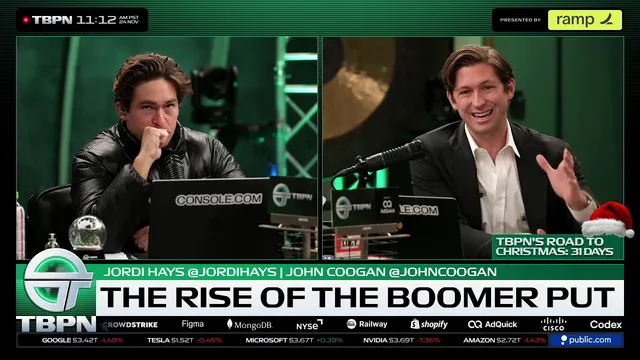
TBPN, hosted by John Coogan and Jordi Hays, with Dylan Patel.
From the transcript TBPN publishes with the episode.
And we have Dylan from semi analysis coming back on the show. Missed him. It's been over a week since we hung out with him later. Is that a And he's not a foldable? Not a duo. It's a Samsung. Oh, Samsung. Living in the future. How long have you had that?
I've had this for... I've had foldables for three or four years. Wow. Ahead of the curve. Ahead of the curve. Always.
What is your duo review? Is that gonna be enough to pull you over? Were you only in... IPhone Air. IPhone Air. Okay. IPhone Air. Okay.
Read the whole transcript
Foldable Samsung. This is the elite class. Oh, two phones. You're Priestly class. This is screaming a a a firewall between the investing arm and the research arm here.
One one one for one for work, you know, one for Okay. Okay. Okay. One for one for personal. Okay. There we go. There we go. Good. Well, I'm I'm afraid to say that both Jordy and and and and both of you guys, John and Jordy Yep. Only have this phone number, not this phone. Oh. Wow. We'll have to fix that. Wow. To be fair, only... Hey. I'm updating my priors. I'm updating our priors on our on our friendship. I thought I was texting the personal the whole time. Wow. I thought we were like that. Like that. Look. Only this... I accept this one. Okay. Okay. Stay safe out there. Do you guys keep a a... Do you guys try to predict black swans? It's effectively it's effectively impossible by definition, but I found myself two weeks ago thinking, like actually trying to like rack my brain on what is what is the most like unpredictable outlier scenario that could change the game on the field, and I think we I think we got it. Unfortunately, I didn't I didn't... I, of course...
What were your what were your guesses? I don't know. I think I think a lot of them were much more around individual players in the in the financial web of the entire trade.
But Well, the big one the big one that everyone's been, like, waiting for is is, like, some result from the next training run that shows there's not another leg up beyond coding. That is something that taste is the new mode. And for so many white collar jobs, it really does matter that you can sit across the table from someone, shake their hand. And so we're never going to replace the lawyer or the doctor or even augment them to the tune of because you don't even need to do the job displacement thing. It's just the fact that a software engineer can deploy $100,000 worth of AI in a year without people blinking.
That hasn't happened for the marketer, for the salesperson yet. And if that does happen, the revenues do go to a trillion dollars. But if it doesn't I don't know if it's a black swan, though. That's not No. It's not black swan. That's I think that's like something we can all debate. Right? Exactly.
No. But another another another thing I would say is like I was very confident that at least for the next year Jensen would not let a company, an AI company valued at north of $10,000,000,000 fail. Like, period. Like, he was like, I don't... I'm not gonna have that headline. I have the ability to give any company a meaningful up round and keep everyone in the game because a lot of people want the headline. Even though in the grand scheme of things right now, a $20,000,000,000 company could go to zero, wouldn't really have that much impact. But it didn't feel like Jensen would even tolerate that kind of headline just because the bears would sort of sink their teeth into it and and have a nice tasty meal.
Yeah. Yeah. I mean, it's it's... I think I think the black swan is this. Right? I think we we've all predicted all sorts of things. Totally. Even with all the knowledge and insight and, you know, rumors. I mean, I had even heard about like, you know, rumors which I didn't like Yeah. Put much credit to, but like people in the industry were like, oh, yeah. Jensen does this with someone at... I mean, at at NVIDIA. I was like, oh.
Woah. Palmer like No. But that's another Yeah. That's another thing we've asking. Right? No. You don't like, you know, you hear That's certainly not to this extreme degree. Like, there like, are plenty of this is so different than the Bezos story, so different than the Gates story, so different than the Elon story. Like, it is so entwined with the actual business and the business dealings and geopolitics and domestic Elon Elon has slept with employees. But not to this Not with a spy.
Yeah. Yeah. His get out of jail free card is that he has like 15 baby mamas. So it's you can't like pin that on Yeah. And and and he has a lot more control. I think the question that we've been We've been waiting control. We've been asking ourselves is like, we on 10/10/2025, we talked we specifically named Mega Speed, we specifically named Alice Huang, we talked about how the whole situation was suspect. Like a lot of the details were basically out Yeah. In the open. And there was even... There was... All these videos were public, you know, and you could read into the videos and be like, alright, this looks like at at the very least like a a pretty close relationship.
Mhmm. I mean, of these videos have his wife and his daughter in the same room. Right? That's the thing that's like...
Yeah. Yeah. Yeah. Yeah. Which which kind of meant the like the the basic analysis was like, okay. Well, if if the whole family is there, probably nothing's happening. Like, maybe this is purely... Maybe he's the purely rational economic actor. He's playing it as aggressively as you can to grow the business internationally. We don't like that from a chip export position. If you're a China hawk, you don't like that. But there is the letter of the law, and we rarely like CEOs don't get fired for pushing it right up to the letter of the law. And so if you're selling the the absolute max, like the h 20, which was designed to get around the the chip exports, like, a lot of China hawks didn't like that, but they were like, ah, like, that's the letter of the law. You found the loophole. You found the edge.
And so it it is it is just a complete black swan in that it's so much further than what what anyone...
Yeah. So so overall total lack of judgment just given that this guy as as for as many friends as he has, he has an equal seemingly an equal amount of enemies Mhmm.
“Open source in America would not exist without Jensen.”
Mhmm. How do you think about the technical role of of the CEO position at NVIDIA? You know, you see Jensen, you hear about the deal making, you see him at events and on podcasts and news hits. I think if there's some deep... Deeply technical work that's happening, that's behind the scenes. How how real is that?
“Who would have said, yeah, let's just push out the current thing. Let's add it into the current thing.”
Mhmm.
“hopefully, the focus is on how do you make America win.”
Yeah. No. I like it. I remember when you branded yourself not as a China hawk, but as a bald eagle. I thought that was a good way to put it. How are you reflecting The video you guys made is so good. We gotta repost that.
Yeah. We gotta repost that today. How are you reflecting on the predictions in AI 2027? When I look at the model capabilities, I feel like it's incredibly accurate. We're completely on track. Huge congratulations to the whole forecasting team there. I'm still a little uncertain about two predictions. One is they forecasted that there would be a 100,000 person anti AI pro... Protest. The midterms were kind of that, so I don't I don't... I think the midterms might kind of stave off a little bit of that. But the more interesting question is right around this time, AI twenty twenty twenty seven predicts that in around November 2026, China wakes up. And I've been sort of interrogating that. It's very hard to get accurate data. How do you feel we are progressing along the line of, like, China waking up?
Is this an example of China waking up because they're honey potting our most powerful AI CEO? Or are they asleep? Caught.
Yeah. We have to... There there there's always a possibility that they believe NVIDIA chips have backdoors in them and Oh, they don't want them there. Okay. And Jensen is Jensen's the Jensen's the asset. Yeah. There's a million to play hockey. It doesn't it doesn't seem like you're waking up if you're like, hey, there's a bunch of GPUs in Hong Kong, but keep them them there. We don't want them in here. That's a good point. Yeah. How can you process you think that there's some group that has much longer timelines.
Yeah. Totally. Right? Like, this is like... Yeah. We know us. I I think there's a lot more They story might have been having an affair. We don't know. Well, let's not jump in. I'm sure. I'm sure.
“all of these inference clouds, how can they secure compute without credit and without financing and without a backstop?”
Mhmm. Mhmm. I had one last question. Jordy, do you have anything? I think the What a... Yeah. Yeah. Sorry. I'll tell you my phone number. 789998212. Wait. What is that from? Is that Oh, come on. That that's a regional commercial from Georgia or something.
No. No. No. What is that? It's a Oh, look at that. Is it that song? There's a song about it.
Right? In LA we only know Dos Penta Dos Penta Dos Accidentes. 8212. Okay. I know 867... Soulja Boy. Soulja Boy. Oh, yeah. Yeah. Soulja Boy who's now an AI spokesperson. He signed with... And Soldier Boy is so cheap to hire. Really? I went on a boat, some startup for their, like, series, whatever, launched. They rented a boat, hired Soldier Boy 25 k. Wow. Maybe at the next time. And he performed. He performed, like like an hour long. He had his whole entourage, and his own DJ come.
We need him with semi analysis con 2027. Speaking... We're not a venture backed company that loses money.
“If you do not have unique data in environments in certain spaces, you will not scale quality of model in those places.”
Totally. Totally. Yeah. Well, we'll find out next time you're on the show. Thank you so much for coming on. We'll let you get back to work. Have a good one. What a week. Goodbye. Good luck, guys. What a week. One for the history books. Have a great