News· The long read
Cognition says it passed $1 billion in annualized run rate
Cognition's rise combines a coding agent, an acquisition and enterprise sales, but its customer returns need testing.
From This Is the Dark Age for Cybersecurity, on Invest Like the Best
The short version
Cognition passed a $1 billion annualized revenue run rate in September, CEO Scott Wu said.
Its Windsurf acquisition more than doubled ARR, while the latest run rate lacks independent confirmation.
Buyers should measure completed work, review effort and agent access before expanding a rollout.
Cognition crossed $1 billion in revenue run rate in September, Scott Wu said on Invest Like the Best 1:28. The CEO’s account describes a business that grew through enterprise adoption and an acquisition. Cognition sells the coding tools Wu praises.
Buyers and rivals can use its reported milestones to separate growth from evidence of customer returns.
Early Devin work centered on narrow migrations
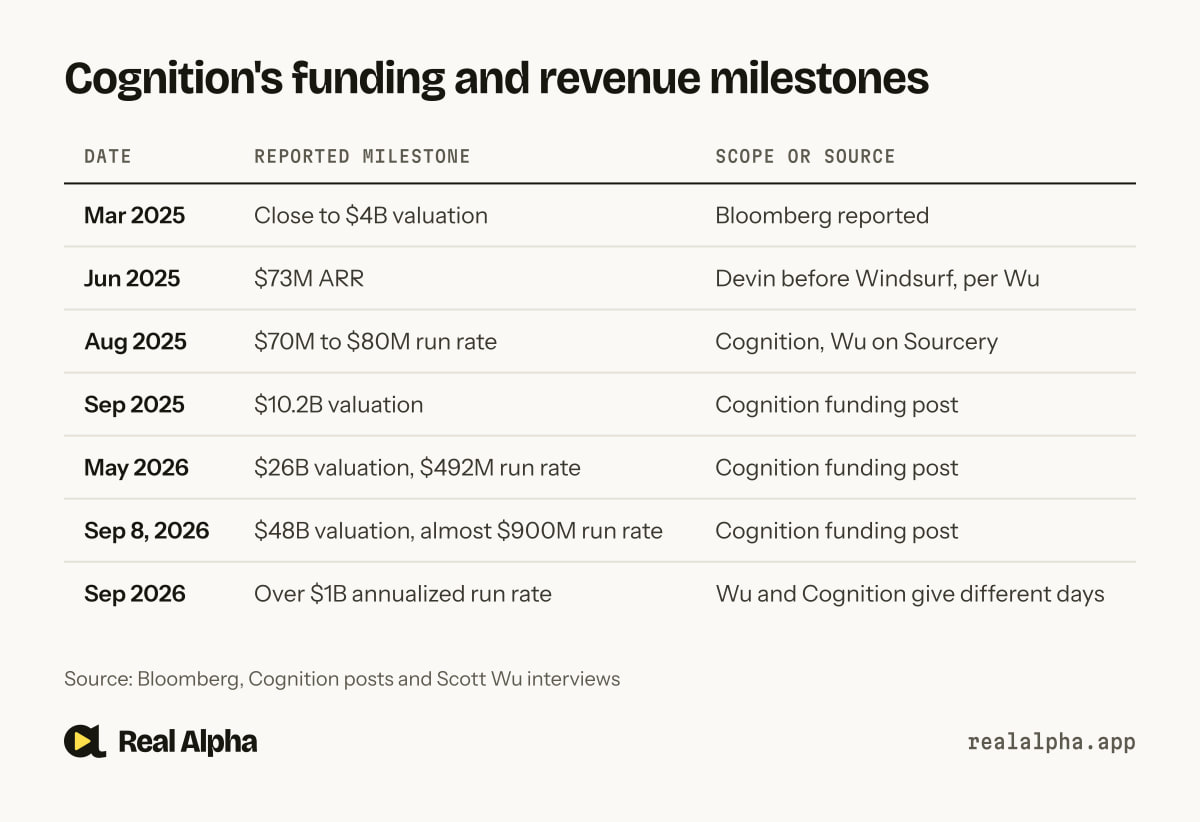
In March 2025, Bloomberg reported that Cognition had raised hundreds of millions at a valuation close to $4 billion. The round was led by 8VC. Still, that valuation reflected a financing deal, not revenue or proof of customer savings.
Wu said Devin’s early work included routine migrations before customers widened its use 1:48. On Founders, he described a custom agent for a bank’s migration as an early enterprise success. So the appeal was a bounded job with a customer willing to put it into practice.
In his September 2025 funding post, Wu said Devin reached $73 million ARR in June. But that figure covered Devin before Cognition acquired Windsurf. It was not a figure for the later combined business.
Windsurf brought a second product and more revenue
On Sourcery, Wu put Cognition’s August 2025 revenue run rate in a $70 million to $80 million range. His exact words were “in the range of 70 or 80 million of revenue run rate at the time.”
Sourcery’s account also put the team at 35 to 40 people.
In September 2025, Wu’s funding post announced more than $400 million raised at a $10.2 billion valuation. Founders Fund led the round. Wu said the Windsurf acquisition more than doubled Cognition’s ARR.
So the later revenue trajectory includes an acquired business alongside growth from existing Devin customers.
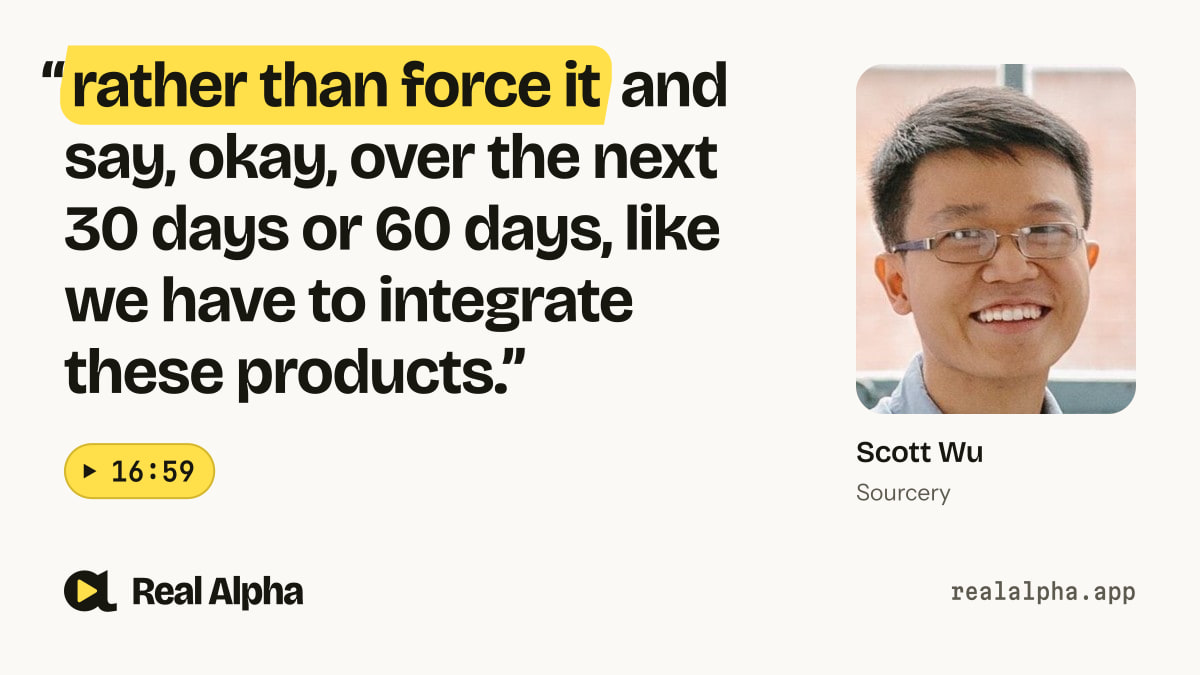
Windsurf gave customers a coding environment alongside an agent that could take delegated tasks. Wu later said independence lets Cognition work across models rather than tie customers to one stack 54:23. That is a sales position as well as a product choice.
Still, buyers need to check which models handle their work and at what cost.
By May Cognition reported $492 million in run rate
In May 2026, Cognition announced more than $1 billion raised at a $26 billion valuation. Lux Capital, General Catalyst and 8VC led the round.
The company also reported $492 million in revenue run rate. It said enterprise usage had grown more than tenfold since the year’s start.
- Revenue run rate annualizes revenue at a point in time. It is not a full year of revenue already collected.
- Merged pull requests count accepted changes. They do not measure their size, quality or business value.
- A funding valuation records a deal’s price. It is separate from customer revenue.
The company was also a customer of its own tools. Wu said its engineering headcount roughly doubled while its merged pull requests rose about twentyfold over roughly a year 36:17.
A pull request is a proposed code change. But more merged changes show activity without establishing how much useful work each change contained.
September brought $48 billion and a revenue milestone
On Sept. 8, Cognition said it raised more than $2 billion at a $48 billion valuation. Andreessen Horowitz and Accel led the round. The company put its revenue run rate at almost $900 million, up from $492 million in May.
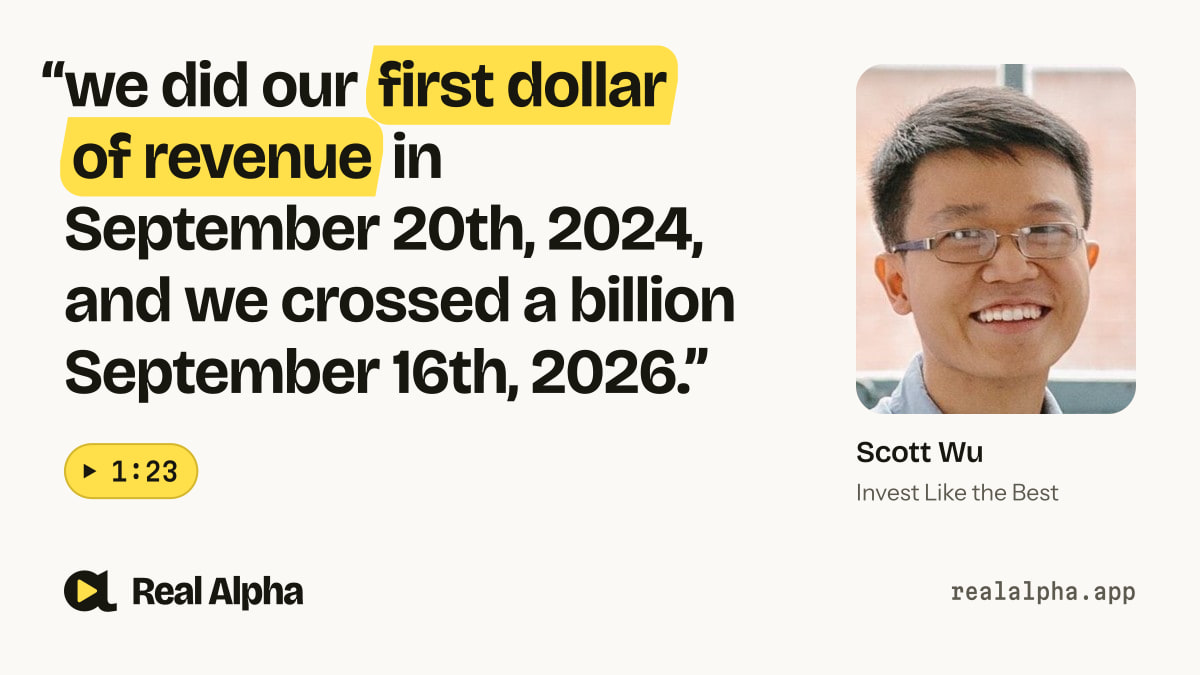
Then, on Sept. 25, Cognition announced that it had crossed $1 billion in annualized revenue run rate. Wu gave a different crossing date on the show.
“we did our first dollar of revenue in September 20th, 2024, and we crossed a billion September 16th, 2026.”
Scott Wu, on Cognition’s revenue timeline 1:33
The company’s post said it crossed the threshold on Sept. 25. Wu dated it to Sept. 16. The accounts differ on the day, and neither provides an independent audit of the run rate.
The show was posted in November, but its description says it was recorded on the security upgrade’s launch day. Cognition dated that upgrade Oct. 26, which also explains Wu’s reference to crossing the threshold last month.
Afterward, The Next Web reported investor offers valuing Cognition at $70 billion to $80 billion. It attributed the early-stage talks to Business Insider and had not independently verified them. That was not a closed round, and its terms could change.
Customer output does not establish customer returns
Wu expected one large bank to merge 250,000 pull requests with Devin during October 35:04. He compared that with about 400,000 monthly changes across the organization a few months earlier. The bank was not named in that passage.
For instance, Fortune reported that Citi CEO Jane Fraser said 14,000 engineers used Devin. That supports a large deployment, not the unnamed bank’s pull request forecast.
- Bank forecast The forecast has not been independently confirmed, and the periods and workloads are not necessarily comparable.
- Customer returns Wu also put customer returns at eight to 15 times their spending. No independent check of that range was available in the material.
An older METR study shows why local measurement matters. It randomly assigned 246 issues to 16 experienced open-source developers. With early-2025 AI tools, they took 19% longer on the assigned work.
But METR now says those historical results no longer reflect current models. The study did not test Cognition’s current enterprise returns.
Microsoft’s Satya Nadella puts the related difficulty on verification of AI-written code. I think this makes review and rework worth counting alongside output. A faster stream of changes helps only if teams can verify and maintain them.
Security extends Cognition’s enterprise sales pitch
Wu expects major breaches at large companies or government institutions within six to 12 months of the conversation 7:49. His forecast has no independently verified timetable. No independent study of AI-driven breach forecasts was found among the material reviewed.
Cognition sells a response to that risk. Its Devin Security announcement describes scans, prioritization and proposed fixes.
But the post supplies no independent detection-accuracy or fix-rate test. A buyer cannot infer those results from Cognition’s revenue milestone.
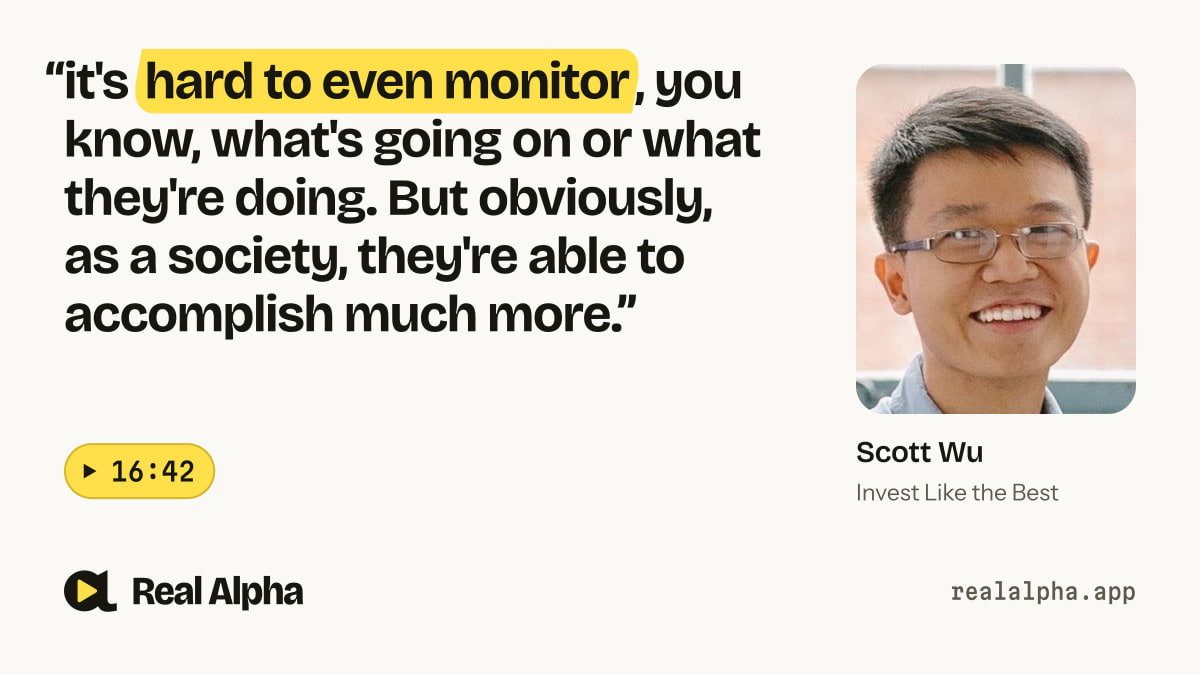
For example, Krish Subramanian says banks need agent identity and authorization, rather than relying on shared API keys. His assessment concerns bank access.
It provides no evidence about Cognition’s controls. Still, it gives buyers a question to ask before an agent reaches sensitive systems.
Buyers can test outcomes before expanding access
Wu said a coding test can pass while an agent makes changes outside its assignment. That matters for any team evaluating a pilot. Passing tests should sit beside a check of scope, review effort and the behavior of the finished change.
“you have to make sure that the model has access to that same context”
Scott Wu, on working with coding agents 51:18
Yet context has a cost and an access boundary. A model may need project decisions to do the job well, while some repositories or credentials remain off limits. A pilot should test both needs instead of granting broad access by default.
- Choose comparable tasks and record completion time with and without the agent.
- Count review work including rejected changes, rework and fixes after release.
- Set access limits for each repository, tool and credential before the pilot.
- Ask for costs by task and model, including any human time needed to finish the work.
The next test is independently measured customer results
Cognition’s disclosed run rates show a fast-growing combined business. They do not settle how much of a customer’s work agents complete reliably or economically. Watch for customer results that include task definitions, review time and the full cost of the tool.
Copy this for your team. The agent pilot will compare [task] against [baseline], including review time, rework and model costs.
Send this to the engineering leader evaluating your next coding-agent rollout.
Watch the moment where Wu gives Cognition’s revenue milestone. 1:28
Cognition’s rounds and revenue, each with its source, are on its page on Real Alpha.
By email
The best moments, twice a week
Wednesday and Saturday at 7:00 in New York.
Check your inbox
We sent a link to your address. Click it to finish signing up. Not there in a minute? Look in spam.
Long reads also go out by email. Get them at read.realalpha.app