The alpha, twice a week
That was 5 min.
Get the best new moments in your inbox every Wednesday and Saturday. It's free.
Check your inbox
We sent a link to your address. Click it to finish signing up. Not there in a minute? Look in spam.
or
MD MEETS · 5 min · Nov 25, 2026
A security framework could make Europe’s territorial talks easier
 Jared Kushner
 says Europe and Ukraine must approve any eventual deal, while arguing that postwar security can make territorial compromise easier.
In this episode
Full analysis- 14:57Putin rejects a ceasefire because he doubts a settlement will hold4 min
- 51:55Kushner says Gaza must be rebuilt under a new framework3 min
- 57:30Kushner negotiates by solving problems alongside his counterparts3 min
- 30:21A security framework could make Europe’s territorial talks easier5 min
- 5:29Article 5 language could offer Ukraine a guarantee outside NATO4 min
- 19:23Kushner denies pressuring Zelensky and explains the diesel deal4 min
- 38:24The Gaza deal returned 20 living hostages and recovered 28 bodies4 min
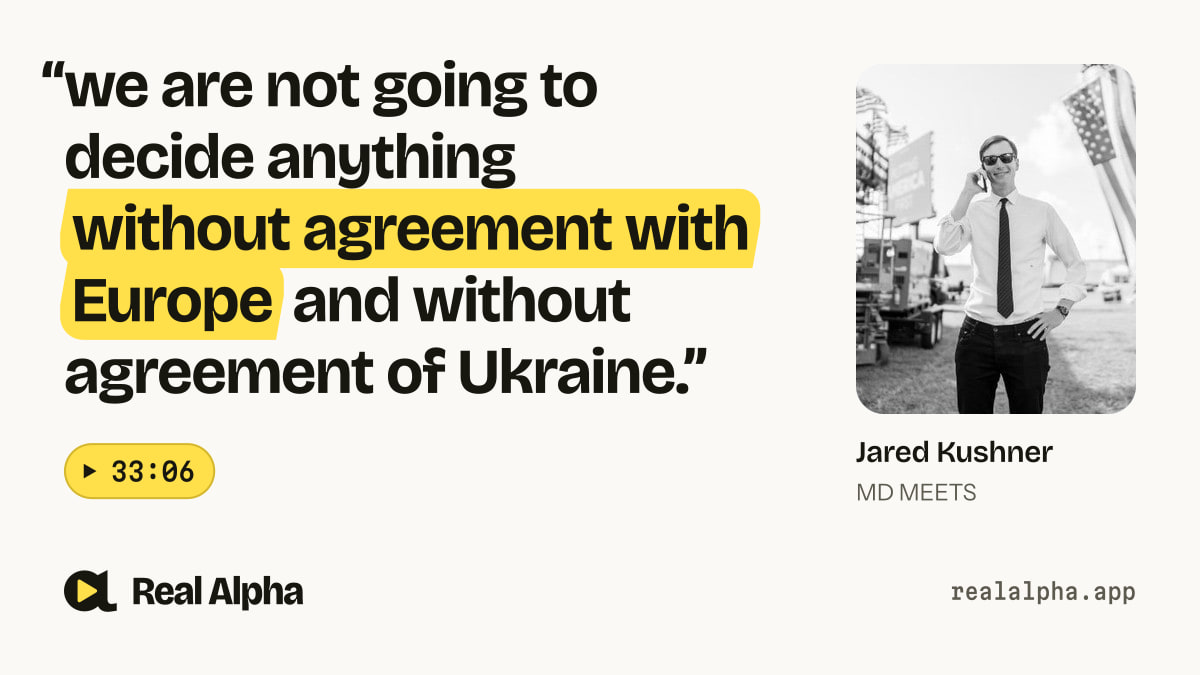
“we are not going to decide anything without agreement with Europe and without agreement of Ukraine.”
 Jared Kushnerat 33:06 · MD MEETS
Takeaways
- A group of eight European negotiators is working together.
- The U.S. says it will not settle terms without Europe and Ukraine.
- Kushner argues postwar security could ease talks over the territorial line.
About this segment
Jared Kushner says Europe and Ukraine must approve any eventual deal, while arguing that postwar security can make territorial compromise easier. It shows how he sees sequencing the negotiations.

Jared Kushner is a businessman, investor and negotiator for the Trump administration.
Led Middle East peace efforts that produced the Abraham Accords and co-led negotiations for the USMCA.
- MD
Mathias Döpfner, Host
From “Jared Kushner: Inside the Negotiations with Putin and Zelensky”, Nov 25, 2026. Watch the full episode
Thanks. We'll look at and fix what's off.
Transcript
Transcribed by machine (Whisper) from the episode’s audio, so a word may be off here and there.
- 30:28
Yeah, I think that's a very valid concern. And unfortunately, we can't wind back the clock, right? So I think about this as almost like a golf analogy. We have to play the ball where it lies, right? You know, whatever good or bad decisions were made by those who came before us, we just have to accept and learn from and try to be better. I will say that there's a lot of fear in Europe that's unfounded.
- 30:48
And I think it comes from the fact that in Europe, when people talk about bigger things, everyone's concerned. Number one, will I be at the table? And number two, will things be decided? that are against my interest. And so there's a natural, you know, there's a natural movement to fear. But that's why, again, Steve and I have been engaging very closely with the Europeans. That's why President Trump called into the Coalition of the Willing.
- 31:10
meeting in Berlin to send, you know, two very, very strong messages. The first one is, is we want to work together with you and we want to design what this outcome should be together. And Europe has responded to that very well by appointing a group of eight negotiators to join us. And I think we've done a lot of work to get Russia to see the marathon. Sorry, you said Europe responded well by nominating a group of eight negotiators. I thought we need one European voice, not eight or six. Is that correct?
- 31:35
If that could be accomplished, that'd be great. But actually, it's a pretty good group and they're working very well together. And it's fine. Like, we'll see. Maybe it becomes... So you are fine with a bigger group. I mean, I thought that was one of the reasons why Europe was not part of the meeting in Abu Dhabi, because we couldn't agree on one envoy. Europe was not included in Abu Dhabi because President Putin sees a lot of provocative statements out of Europe and a lot of provocative actions out of Europe. And so his view is he does not see that they are ready for peace. He thinks they want the strategic defeat of Russia.
- 32:09
Um, and, you know, Steve and I have worked hard to say that in a lot of our private discussions, we believe the leaders, uh, do want to have peace. And I think actually, you know, we were very encouraging of the call from, uh, you know, president Stubb and prime minister Gar, um, from Finland and Norway. And I think that call was very, very helpful in sending a message to Putin, uh, as well. And, um, and we're, we're encouraging a lot more interaction again. So, so, so number one is, um, look, if we could have one representative, that would be ideal.
- 32:34
Um, but I think the group of eight actually would be, do you have any idea who that, who that should be or could be? That's not for me to decide. But I will say, too, like we're working very well with Gunther from Germany, Jonathan Powell from the UK, Emanuel Bonn from France, Bjorn, the NSA from the EU is phenomenal, Jeffrey, the NSA from NATO is excellent. And then, you know, we just added three more to it from Italy, Poland, and then the EU Council. And it's working very well as a group. So I actually, again, maybe it won't work, but I'm actually cautiously optimistic that that will work. But if I could just go to the second point that we came to really convey, which is, which I think is actually the most important thing. Number one is we are not going to decide anything without agreement with Europe and without
- 33:17
agreement of Ukraine. So at the end of the day, you know, I think, you know, we've acted in a way that's different from the narrative. And that was another message we wanted to make sure we conveyed to a lot of these people individually, which is, you know, we are working hard to create an end to the war, which we think is in everyone's interest. We want to be very closely coordinated with you on what approaches we take. I think in terms of the strategy and in terms of the format, we've been driving that. But I think in terms of the substance and whatever is going to be agreed to, we will not agree to that without Europe and Ukraine agreeing to that as well. And I think that's probably one of the most important points because I think that's where a lot of the fear in Europe has come from. So you are saying, although Putin doesn't want Europe to sit at
- 33:59
the table, you want Europe to sit at the table in the future, and you want to strengthen the ties between the U.S. and Europe in that context? We want to strengthen ties between Europe and the U.S., and we also think it's important to strengthen the ties with Europe and Russia. And I wouldn't say Putin doesn't want them at the table. I think he doesn't think they have good intentions, just like Europe doesn't think Russia has good intentions. And so, you know, again, we're the mediator. We're talking to both sides, and everyone's assuming these intentions without talking to people. And so through building these links and having these discussions. And it will take a little bit of time. I wish there was a fast way to do this.
- 34:33
Hopefully, both parties will realize that they all want peace. There's a lot we agree on. We all want long-term peace. We should design things that are win-win, where everyone's better off because of it. And I think once we're able to define that post-war relationship, I think the issue of territory will become much easier to resolve, because right now there's no way to bridge that last issue. And again, this is the best approach we could think of. This is an impossible problem. Nobody's been able to solve this. But I do believe that when people see long-term durability and a pathway to peace, I think they'll be a little bit more flexible on where do you draw the line. I mean, after all, most lines in Europe are.
- 35:10
have changed over time and they're decided from wars or peace or compromise. So I do think we're going to need to decide on a line. And this isn't about fairness or who's right or wrong. It's about how do we end the killing and create, you know, better life for people going forward.