The alpha, twice a week
That was 4 min.
Get the best new moments in your inbox every Wednesday and Saturday. It's free.
Check your inbox
We sent a link to your address. Click it to finish signing up. Not there in a minute? Look in spam.
or
MD MEETS · 4 min · Nov 25, 2026
The Gaza deal returned 20 living hostages and recovered 28 bodies
 Jared Kushner
 recounts the hostage returns and recovery of 28 bodies, alongside changes to aid delivery intended to limit Hamas’s access.
In this episode
Full analysis- 14:57Putin rejects a ceasefire because he doubts a settlement will hold4 min
- 51:55Kushner says Gaza must be rebuilt under a new framework3 min
- 57:30Kushner negotiates by solving problems alongside his counterparts3 min
- 30:21A security framework could make Europe’s territorial talks easier5 min
- 5:29Article 5 language could offer Ukraine a guarantee outside NATO4 min
- 19:23Kushner denies pressuring Zelensky and explains the diesel deal4 min
- 38:24The Gaza deal returned 20 living hostages and recovered 28 bodies4 min
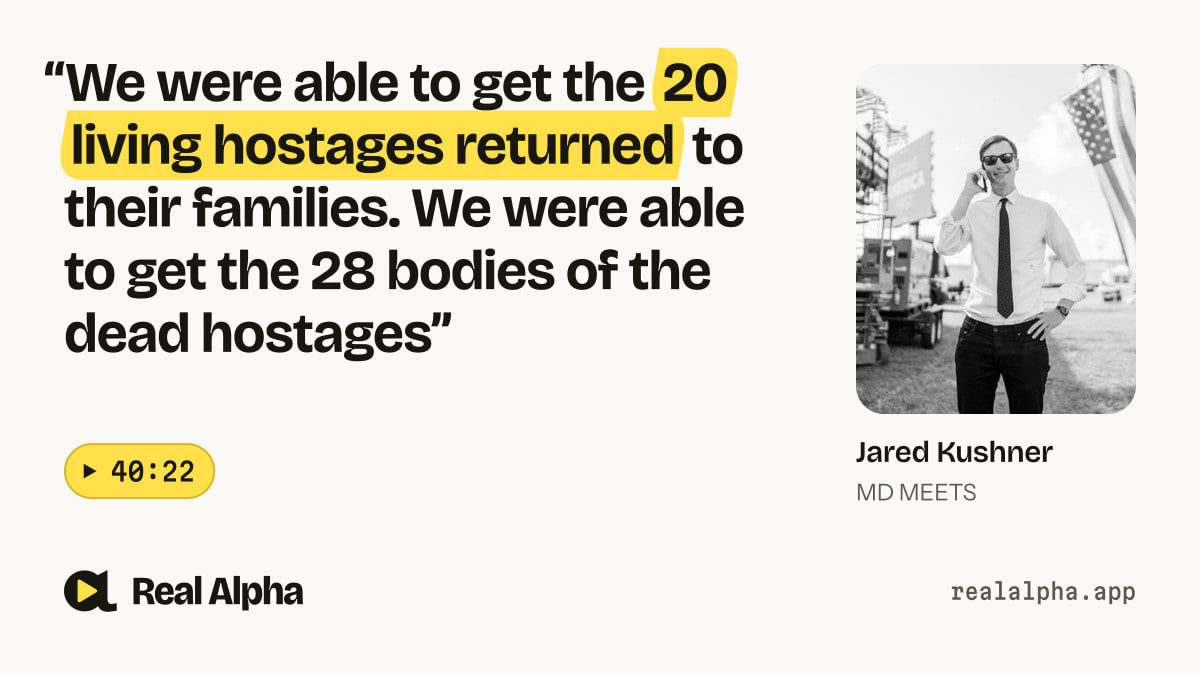
“We were able to get the 20 living hostages returned to their families. We were able to get the 28 bodies of the dead hostages”
 Jared Kushnerat 40:22 · MD MEETS
Takeaways
- 20 living hostages were returned to their families.
- Recovering 28 dead hostages’ bodies took months and coordination.
- Aid delivery was changed to limit Hamas’s access to supplies.
About this segment
Jared Kushner recounts the hostage returns and recovery of 28 bodies, alongside changes to aid delivery intended to limit Hamas’s access. The numbers and logistics make this a concrete account of the deal.

Jared Kushner is a businessman, investor and negotiator for the Trump administration.
Led Middle East peace efforts that produced the Abraham Accords and co-led negotiations for the USMCA.
- MD
Mathias Döpfner, Host
From “Jared Kushner: Inside the Negotiations with Putin and Zelensky”, Nov 25, 2026. Watch the full episode
Thanks. We'll look at and fix what's off.
Transcript
Transcribed by machine (Whisper) from the episode’s audio, so a word may be off here and there.
- 38:32
solution, stability, peace in the Middle East? I mean, that's a very amorphous question. Peace in the Middle East is something people have been chasing and never been able to achieve. Is it unrealistic? Should we strive for stability instead of peace? Is peace too much of a wish? No, I think you always have to aim for the most ambitious, first principled outcome possible. And I think, you know, what the Abraham Accords proved is that if you can start creating the framework for, you know, Jews and Muslims, you know, to start living together, working together, doing business together, you know, getting to know each other, sharing life experiences, friendships, that's the foundation of peace. At the end of the day, peace is really about human beings coming together and doing that and figuring out how do you work against sometimes
- 39:19
politicians who it's beneficial for them to push division. How do you work against misinformation? How do you work against old ideas and push forward new ideas? And I think the idea we pursued in the first term, and it's really not that different from the idea we're pushing now, is that people are so much better off when they're together. War is negative some, conflict is negative sum, you know, peace and economics, integration and doing business together. That's just positive sum. People's lives are better. I'm very pro-capitalism. And I think that that's one of the most important driving forces in history. And I think that that's the basic foundation. Now, if we go to Gaza, you know, Gaza was a raging war for two years, very similar to Russia, Ukraine. It was, you know, probably one of the hottest topics in
- 40:01
the world, very emotional, causing division all over. And we were able to get that done. And again, Kind of like, you know, with this war, it looked impossible up until about, you know, a couple days before we really, you know, were able to kind of create a breakthrough and it wasn't the first thing we tried that got it done. We just kept trying new things until we found a way. We were speaking to people that, you know, we got a lot of criticism in Israel for speaking with Hamas directly, but we said, how are you going to end this war without speaking with Hamas?
- 40:27
And so we were able to get the war completed. We were able to get the 20 living hostages returned to their families. We were able to get the 28 bodies of the dead hostages, which quite frankly, we thought was impossible. It took us many months to do that. And we had to locate that and build good coordination. That was a good trust builder. We were also able to surge a huge amount of humanitarian aid into Gaza. So the famine numbers in Gaza went down to almost nothing.
- 40:52
And we also worked with the United Nations, which, again, was very hated by Israel and whatnot as well, because they also couldn't coordinate together. And we changed the way they delivered aid. So what happened was is most of the aid was actually going to stolen by Hamas and then they would sell it. So think about them like running a store, but with no inventory cost. And so the UN would basically supply the goods and then they would use that to basically fund their existence.
- 41:16
And so we changed the way the aid was delivered so that it went to the people without allowing Hamas to kind of use it to sustain themselves. And then we worked very hard with the Arabs and with Hamas in that we were able to get to a framework agreement where Hamas actually agreed to follow President Trump's 20-point plan to demilitarize and give up their weapons, which is a critical step before it could rebuild.
- 41:37
And then now we're working with the Israelis. Obviously, their elections caused a little bit of a step back for us, but we're hopeful we can push forward and really try to demilitarize Gaza and then build it in a way where it could be peaceful and help the people of Gaza achieve a life that they deserve.