The alpha, twice a week
That was 3 min.
Get the best new moments in your inbox every Wednesday and Saturday. It's free.
Check your inbox
We sent a link to your address. Click it to finish signing up. Not there in a minute? Look in spam.
or
Founders · 3 min · Nov 4, 2026
a16z marketed because it lacked a long track record
 Scott Kupor
 says venture firms once relied on scarce capital rather than marketing, but a new firm couldn’t compete on legacy wins. a16z promoted its service model to establish a different category.
In this episode
Full analysis- 30:27Government needs permission to take measured risks7 min
- 38:25Government can attract young talent with skills-based hiring7 min
- 48:48Digitizing retirement records is transforming a paper process6 min
- 13:42Skype returned half of a16z’s first fund in 18 months4 min
- 3:53a16z adapted CAA’s team model to venture capital4 min
- 18:31a16z marketed because it lacked a long track record3 min
- 21:42a16z decentralized as its investing areas multiplied4 min
- 46:33Changing a large bureaucracy may require a big-bang reset2 min
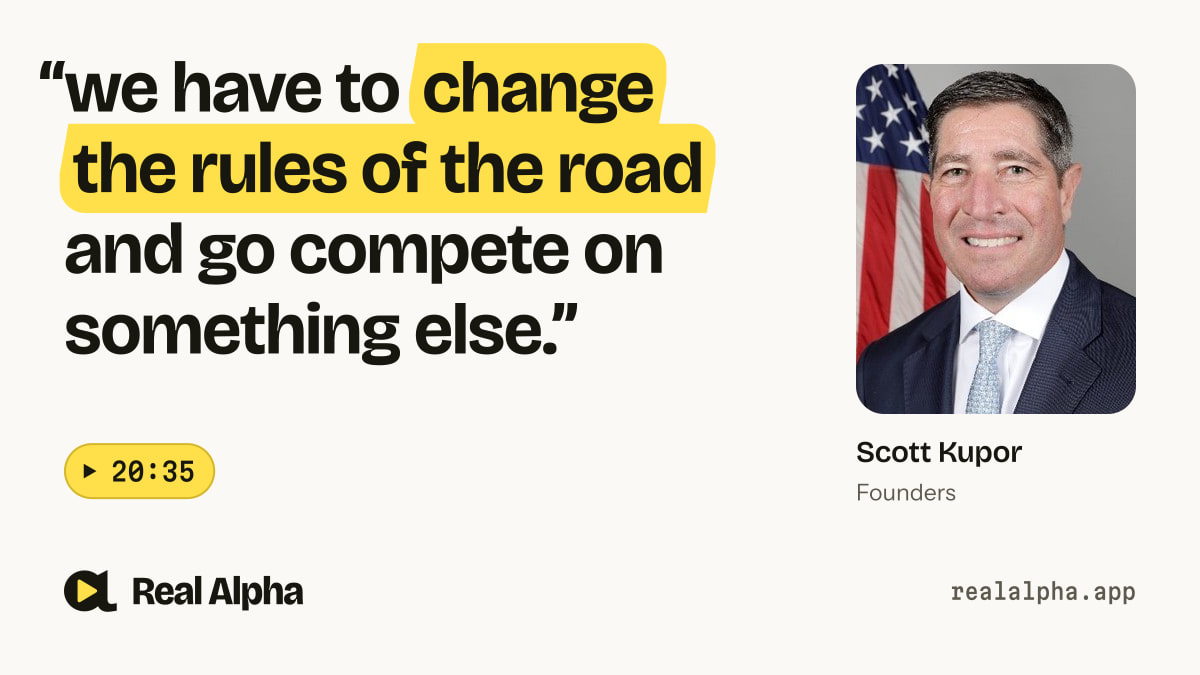
“we have to change the rules of the road and go compete on something else.”
 Scott Kuporat 20:35 · Founders
Takeaways
- Older firms had little need to market when capital was scarce.
- a16z had no long track record to compete on.
- The firm positioned itself as capital plus founder support.
About this segment
Scott Kupor says venture firms once relied on scarce capital rather than marketing, but a new firm couldn’t compete on legacy wins. a16z promoted its service model to establish a different category.

Scott Kupor is a director of the U.S. Office of Personnel Management.
Built Andreessen Horowitz from its 2009 inception into a major venture firm before leading the federal government's HR agency.

David Senra, Host · Host, Founders
Has read an entrepreneur's biography every week for Founders since 2016.
From “He Helped Build a16z & Is Now Rebuilding the Government | Scott Kupor”, Nov 4, 2026. Watch the full episode
Thanks. We'll look at and fix what's off.
Transcript
Transcribed by machine (Whisper) from the episode’s audio, so a word may be off here and there.
- 18:37
And look, as you know, look, the guy is encyclopedic on so many things. And that's the other thing, by the way, that he and Ben both were really, really smart about, which was, and I know he talked about this on your show, but just double down on it, this concept of marketing generally in the venture business, right? So it was considered verboten to market in the venture capital business. I don't know why that was, and it was, I don't know, it was probably just, I think it's mostly historical reason, which was you didn't need to market because there was, in the old days, capital was scarce, right?
- 19:03
So the source, the derivation of power for venture capital firms in like late 70s, you know, late 60s, early 70s until like probably like close to 2000s was money was scarce. The VCs had the money. And so therefore, if you look at the balance of power, the VCs were up here and the entrepreneurs were down here. And that was sufficient, right? And a lot of great firms and many of which still exist today were incredible in that era, right?
- 19:23
Right. That's, you know, obviously Sequoia, you know, has been and continues to be incredible. But all the existing firms that you see there at the top of the game, like Sequoia, Excel, Greylock, even Benchmark, right, which was a spin out of Merrill Pickard. All these guys lived in that era, right, where nobody marketed, I believe, just in part because they didn't have to market. Like you went to them because they had the money. You needed the money. That was what the marketing was.
- 19:44
When we came along board, look, we didn't know anything and we didn't know anybody. And so part of like what Mark and Ben rightly said was just like we came out of the enterprise software business and we know like in the enterprise software business, just because you have a good product, nobody gives a shit if you don't actually tell them. what it is, right? And so they're like, look, we got to go tell people who we are, what we stand for. And so we did. We told the story, which is, look, we're going to do things differently. We're going to build this whole service as part of our business. And we're going to market on that basis because what we didn't have to market on was we didn't have the long history of a track record in the business, right? So to this day, right, if you go to Sequoia, who's an amazing player in the
- 20:22
space, if you go to their conference rooms, you'll see a poster of Cisco and Apple and Google and all these other things. We had none of that. We had Mark and Bennett done their own angel investing. And of course, the two of them had had success as entrepreneurs, but we couldn't compete against that. So what they rightly did was they said, look, if we can't compete on what people are competing on today, we have to change the rules of the road and go compete on something else. And so they created this category was, okay, the new venture capital firm is going to be not just capital, but it's going to be capital plus plus, right? It's going to be plus this whole network of people whose job it is to help the entrepreneur. It's in service of the entrepreneur.
- 20:57
That's exactly right. And so that was a huge, major, major difference, you know, that they did, which also played out really well. And we got a lot of shit from all the other VCs on Sandhill. They're like, look, it's, you know, for Moten to market and all this other stuff. I remember because I was talking about all of our LPs every day, and they're like, oh, so-and-so, you know, we heard this from, you know, one of your competitors.
- 21:18
And it was always, look, these guys talk a big game, and they, you know, tell people stuff before they've done it. And we're like, you know, we're doing exactly— It sounds like an entrepreneur to me. Yeah, we're doing exactly what any entrepreneur would do, which is like we were trying to create a category. You have to tell the category. You have to actually tell your narrative. And look, we had to deliver on it at the end of the day, which we did.