The alpha, twice a week
That was 2 min.
Get the best new moments in your inbox every Wednesday and Saturday. It's free.
Check your inbox
We sent a link to your address. Click it to finish signing up. Not there in a minute? Look in spam.
or
Founders · 2 min · Nov 4, 2026
Changing a large bureaucracy may require a big-bang reset
 Scott Kupor
 says federal budgets and headcount had grown for decades, so gradual changes might not reverse the direction.
In this episode
Full analysis- 30:27Government needs permission to take measured risks7 min
- 38:25Government can attract young talent with skills-based hiring7 min
- 48:48Digitizing retirement records is transforming a paper process6 min
- 13:42Skype returned half of a16z’s first fund in 18 months4 min
- 3:53a16z adapted CAA’s team model to venture capital4 min
- 18:31a16z marketed because it lacked a long track record3 min
- 21:42a16z decentralized as its investing areas multiplied4 min
- 46:33Changing a large bureaucracy may require a big-bang reset2 min
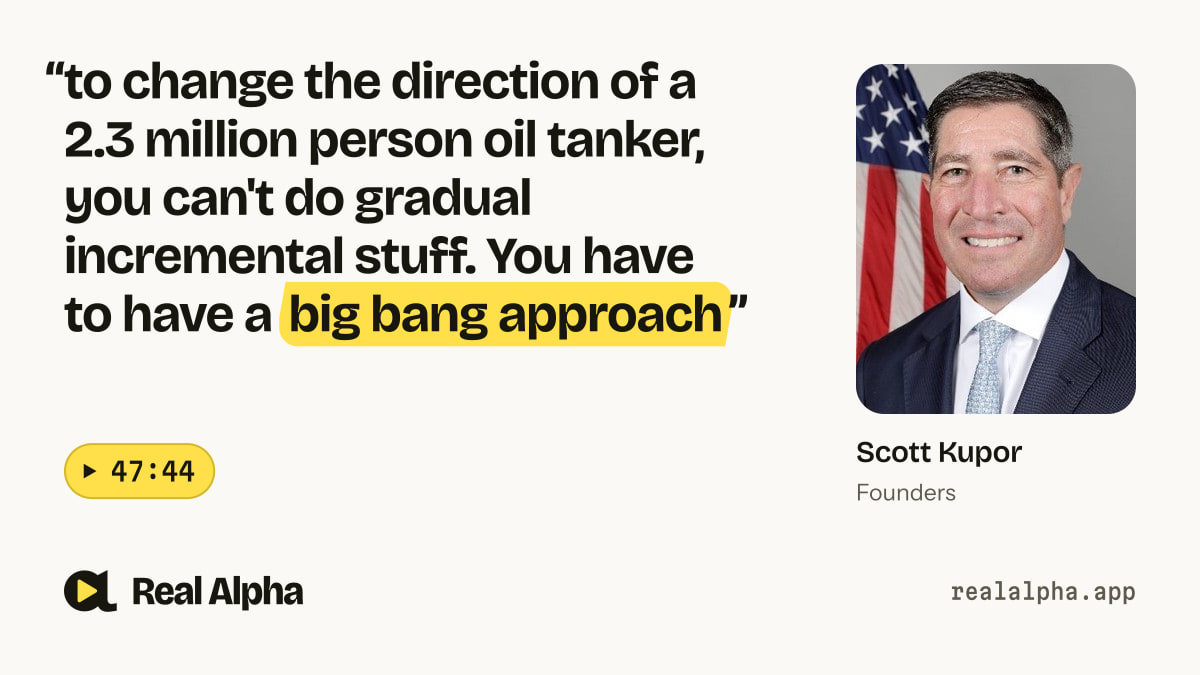
“to change the direction of a 2.3 million person oil tanker, you can't do gradual incremental stuff. You have to have a big bang approach”
 Scott Kuporat 47:44 · Founders
Takeaways
- The federal workforce fell from about 2.3 million to about 2 million.
- Kupor says agencies had kept adding work and headcount over time.
- He describes his role as institutionalizing the changes that followed.
About this segment
Scott Kupor says federal budgets and headcount had grown for decades, so gradual changes might not reverse the direction. He frames DOGE’s abrupt approach as a break before longer-term institutional changes.

Scott Kupor is a director of the U.S. Office of Personnel Management.
Built Andreessen Horowitz from its 2009 inception into a major venture firm before leading the federal government's HR agency.

David Senra, Host · Host, Founders
Has read an entrepreneur's biography every week for Founders since 2016.
From “He Helped Build a16z & Is Now Rebuilding the Government | Scott Kupor”, Nov 4, 2026. Watch the full episode
Thanks. We'll look at and fix what's off.
Transcript
Transcribed by machine (Whisper) from the episode’s audio, so a word may be off here and there.
- 46:39
So regardless of controversy over anything that happened there, I'm not even interested in that. I'm interested, is there any ideas that you saw coming out of that that you thought were good and valuable and should be spread further? Yeah, here's my view overall on it is part of the issue is – just to give you a sense of the numbers, right? So there were roughly 2.3 million federal civilian employees on day one when President Trump took office.
- 47:06
Today, we're just about 2 million. So we've reduced by close to 300,000 people the size of federal government, which puts the federal government at the lowest level it's been as a percentage of the workforce since, like, 1960. And you literally have to go back to, like, Clinton-Gore before you have anywhere even close to that. The numbers that the president has is much higher, but still, like, that's the last time he had any serious effort.
- 47:26
So part of it is, look, the entire apparatus of government travels in one. direction only, which is budgets just get bigger every year. Every time an agency wants to do something new, they go back to Congress and they say, great, you want to do that thing? Give us more headcount to do it. So that's been the path of travel basically for the last 50 years probably or something like that. So the way I think about what Elon did was Elon had to come in and to change the direction of a 2.3 million person oil tanker, you can't do gradual incremental stuff. You have to have a big bang approach, right? Now, people can argue and debate about his tactics. And it's fair. I think there's, you know, there's fair arguments to have on both sides. But like the idea that you had to have someone come in with a mission and actually try
- 48:08
to like do some serious change, like I don't think there's any argument that you could ever make the change that we did without effectively like a big bang strategy. Look, he got a lot of shit for it. Lots of people got a lot of shit for it. And, you know, look, history will write the story about that one. What we're trying to do now, like what I came in was I was like, great, they did all this work. Now we have to institutionalize this. That's kind of how I think about my role, which is, okay, like Elon, Steve Davis, all these guys did an amazing job of like breaking glass, basically, and saying like, this is how things are going to be.
- 48:37
Now we have to like do the long-term institutionalization of it, which means we have to now go through and say, great, what are you actually working on? Tell me the 20 things you're working on. Like, which ones are really important? Which ones should we not be doing? We never take stuff off the plate in government. We just keep adding. It's like inertia. It is. It's insane. It's crazy.