The alpha, twice a week
That was 4 min.
Get the best new moments in your inbox every Wednesday and Saturday. It's free.
Check your inbox
We sent a link to your address. Click it to finish signing up. Not there in a minute? Look in spam.
or
Founders · 4 min · Nov 4, 2026
Skype returned half of a16z’s first fund in 18 months
 Scott Kupor
 recounts how a16z joined a buyout of neglected Skype despite an unresolved IP dispute.
In this episode
Full analysis- 30:27Government needs permission to take measured risks7 min
- 38:25Government can attract young talent with skills-based hiring7 min
- 48:48Digitizing retirement records is transforming a paper process6 min
- 13:42Skype returned half of a16z’s first fund in 18 months4 min
- 3:53a16z adapted CAA’s team model to venture capital4 min
- 18:31a16z marketed because it lacked a long track record3 min
- 21:42a16z decentralized as its investing areas multiplied4 min
- 46:33Changing a large bureaucracy may require a big-bang reset2 min
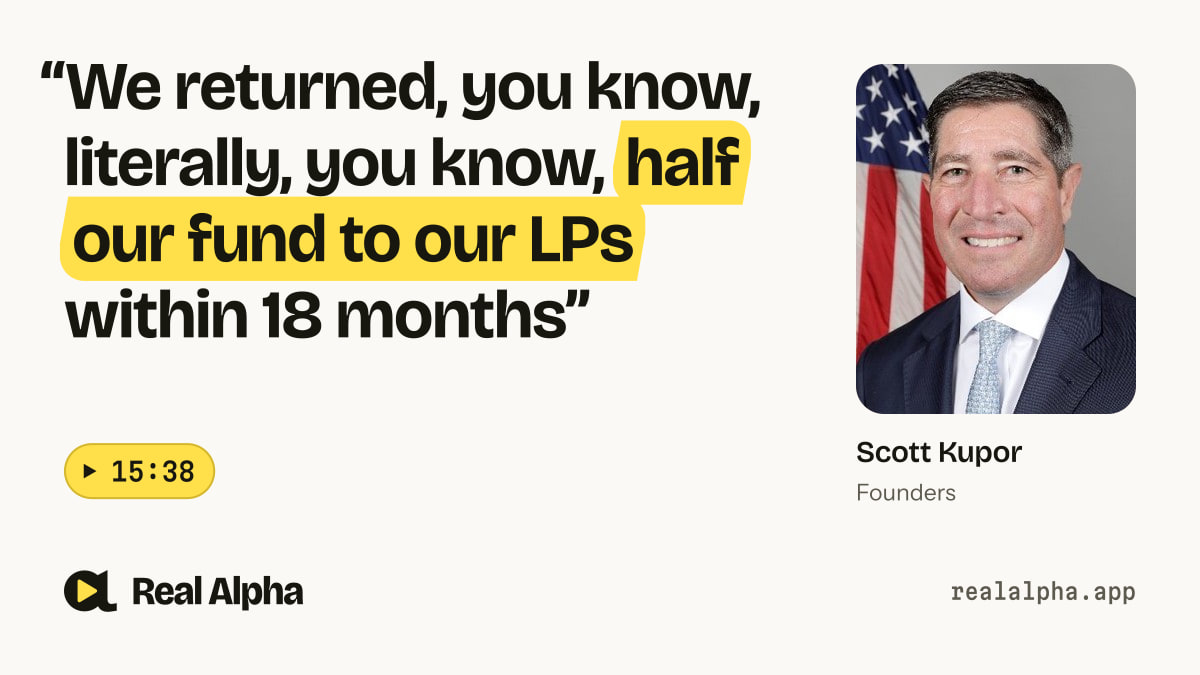
“We returned, you know, literally, you know, half our fund to our LPs within 18 months”
 Scott Kuporat 15:38 · Founders
Takeaways
- a16z partnered with Silver Lake and Michael Dell on the buyout.
- The team addressed the IP dispute by working with Skype’s founders.
- The sale helped a16z raise its second fund and build out services.
About this segment
Scott Kupor recounts how a16z joined a buyout of neglected Skype despite an unresolved IP dispute. The quick sale helped return half the fund and finance the firm’s service strategy.

Scott Kupor is a director of the U.S. Office of Personnel Management.
Built Andreessen Horowitz from its 2009 inception into a major venture firm before leading the federal government's HR agency.

David Senra, Host · Host, Founders
Has read an entrepreneur's biography every week for Founders since 2016.
From “He Helped Build a16z & Is Now Rebuilding the Government | Scott Kupor”, Nov 4, 2026. Watch the full episode
Thanks. We'll look at and fix what's off.
Transcript
Transcribed by machine (Whisper) from the episode’s audio, so a word may be off here and there.
- 13:49
Mark's talked about this, but in literally like the first couple of months after we closed the first fund, we invested in Skype. And yeah, if you remember, Skype was part of eBay, right? Skype was bought by eBay. And it was like, completely neglected inside of eBay. And yet, amazingly, it had this incredible network effect. If you look at the numbers, like the numbers of subscribers just kept growing and growing. So we joined with Silverlake at the time. If you know Egon Durbin, who runs Silverlake. Michael Dell, I just saw him a few nights ago. He speaks very highly of him.
- 14:16
He actually brought him up the other night. Exactly. Yeah. And Michael Dell was part of that too, but it was literally like we did essentially a buyout. Like it was like a crazy thing to do. We had just gone on the road and told all our investors we're doing early stage venture investing. And we hinted, by the way, this Skype thing was going. So like we pretty much said it was going to happen, but we couldn't say it was going to happen because, you know, it hadn't been done yet. But so it wasn't actually a surprise for LPs, but it was clearly very different than the strategy we had laid out. And so we did this thing. And immediately, of course, everybody attacks us and says, these guys are crazy. What the hell are they doing? Doing a buyout. It'll never work. And there was all kinds of stuff at the time. If you go back and read the stuff,
- 14:51
you'll see it. There was this big IP dispute with the original founders like Giannis and Nicholas and eBay about who actually owned the fundamental underlying IP. And so A bunch of people looked at buying Skype, but nobody could get comfortable because they're like, gee, if we buy it, what if Yannis and Nicholas come out of the woodwork and say they own it, and so do you really own the IP? You know, Egon's genius was, let's actually figure out a way to work with these guys.
- 15:13
So we actually, you know, our bids came together, and we actually worked collaboratively with these guys as a way to moderate this IP question. But anyways, everyone's like, look, this is crazy. But the beauty of it, literally 18 months later, we sold to Microsoft for four times what we paid, like 18 months before. And so the news cycles were just unbelievable. And look, part of this business is momentum against momentum, right?
- 15:34
Which is true of so many businesses. And so we were able to actually like raise our second fund well ahead of what we had planned doing, in part because the Skype thing just worked out so well. We returned, you know, literally, you know, half our fund to our LPs within 18 months, which, you know, these days is obviously completely unheard of. And even back then was unheard of. And it just completely changed the narrative.
- 15:54
We also had a company called Nasira, which was in the networking space. Martin Casado, if you know Martín, he's one of the partners there today. His company got sold to Cisco early on in the first fund. So we had these like very quick early wins, which basically, you know, potentially could have gone the other way, but they didn't. They went in our favor and they basically just dramatically accelerated the progress.
- 16:13
And key to our business model, right, to do the Michael Lovins business model, we had to have enough of a fee stream to be able to hire all these other non-investing people, right? And, you know, Mark's talked about this before, but like, you know, what Mark and Ben did, they were very magnanimous. The two of them didn't take, they took no salary right at the beginning of the company because they wanted to basically take, you know, as much of the fees as they could to give it to me to go hire other people, you know, to build this thing out.
- 16:37
But, you know, we needed another, you know, in order to kind of continue that build out, the second fund gave us, you know, a, you know, stacking fee stream that allows us then to say, okay, now we can actually double down on the strategy. So it was one of these things where like, you know, we had early success. Yes. It was also 2009, right? So again, middle of the global financial crisis, you know, you know this, but like, you know, the Sequoia guys put out this, you know, RIP presentation. Have you seen RIP Good Times?
- 17:02
RIP Good Times, right. It's literally like the world's coming to an end. We're all going to die. Sounds a little bit like today, actually. No one will ever raise any money, like put all your money under your mattress. And so like we were this shiny gold, you know, like object in 2009 when everyone else was hunkered down and worried about their portfolio company. So we had this enormous advantage, which is we put a shingle out and we say, hey, like we're open for business and every other venture firm. And rightly so, I understand it. Like they have these enormous amount of portfolio companies that they were very worried about whether they would survive or not. So, so much of like all that early momentum accrued to our benefit, which enabled us then to go raise the second fund, which gave us the funding to build out
- 17:38
the services strategy. And that really kind of compounded in a way that I don't think we expect to know. Mark and Ben may tell the story differently, which is they always knew it would be a success. And I'm certain, I believe that, right? I mean, these guys are entrepreneurs for a reason. Obviously, entrepreneurs are going to be self-confident and they don't wake up