The alpha, twice a week
That was 7 min.
Get the best new moments in your inbox every Wednesday and Saturday. It's free.
Check your inbox
We sent a link to your address. Click it to finish signing up. Not there in a minute? Look in spam.
or
Silicon Valley Girl · 7 min · Oct 30, 2026
AI usage can differ 10–20x between top users and the average
 Karim R. Lakhani
 says leading users in large companies engage with AI 10–20x more than average users.
In this episode
Full analysis- 9:02Challenge AI instead of accepting its first answer7 min
- 15:46Juniors need fundamentals to learn from AI7 min
- 43:26Middle managers may face more AI risk than juniorsPro pick 7 min
- 25:32AI usage can differ 10–20x between top users and the average7 min
- 2:28AI users learn more when they stay involved in the work4 min
- 23:16Executives learn AI's impact by building with it themselves2 min
- 34:28AI shifts the expertise curve, but people still need to add value4 min
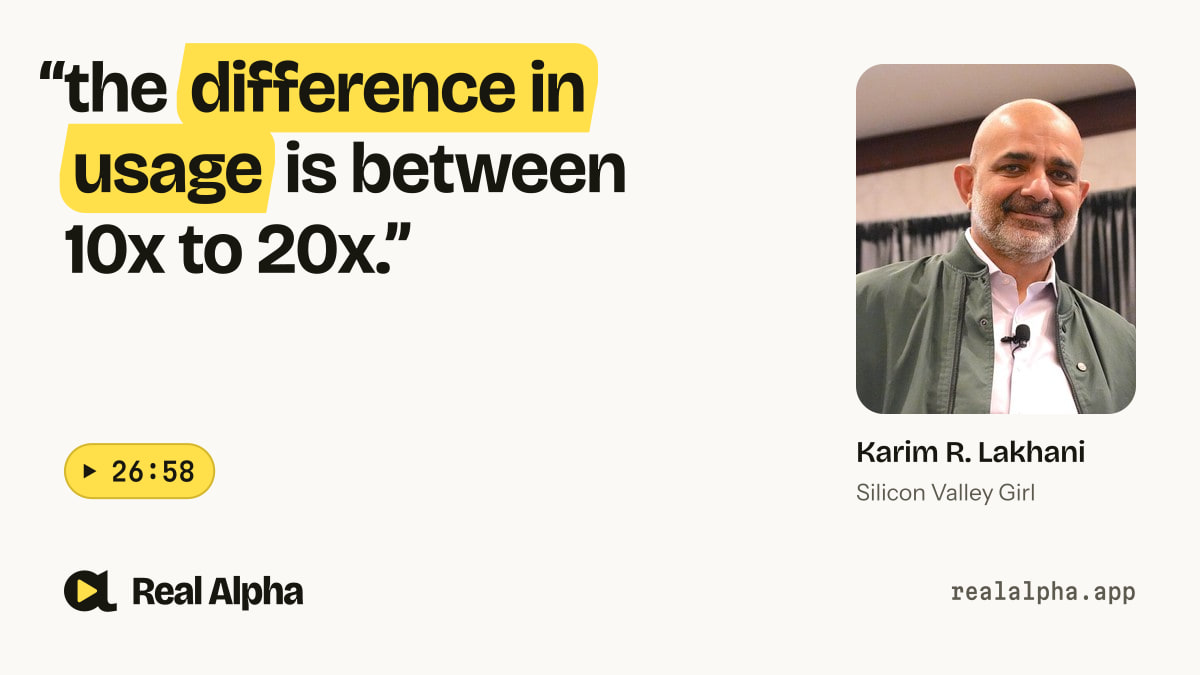
“the difference in usage is between 10x to 20x.”
 Karim R. Lakhaniat 26:58 · Silicon Valley Girl
Takeaways
- Top users’ AI usage is 10–20x the organizational average.
- Individuals need to build their skills through repeated use.
- Leaders should set business targets, then work backward to AI.
About this segment
Karim R. Lakhani says leading users in large companies engage with AI 10–20x more than average users. He urges individuals to build skill and leaders to tie AI work to business and customer targets.

Karim R. Lakhani is a Harvard Business School professor.
Pioneered field experiments on open innovation and AI’s impact on business; co-authored Competing in the Age of AI.

Marina Mogilko, Host · Host, Silicon Valley Girl
Co-founded LinguaTrip and built Linguamarina, an English-learning YouTube channel with almost 9M subscribers.
From “Harvard AI Professor: The People Most at Risk From AI Aren’t Who You Think”, Oct 30, 2026. Watch the full episode
Thanks. We'll look at and fix what's off.
Transcript
Transcribed by machine (Whisper) from the episode’s audio, so a word may be off here and there.
- 25:36
From what you're seeing, how far behind are these companies in terms of AI? Because I'm in Silicon Valley bubble. Everyone is white coding, everyone's building. But I'm talking to my friends who are building AI companies, and they say we hold conferences on very basic things, and people are so excited. How far behind are those executives and corporations? I think, you know, there's a billion Gibson saying the future is already here.
- 25:58
It's just not evenly distributed. It's the case here for sure. I think Silicon Valley and other pockets in the world are living in a very different future than most companies. To be quite honest, I would say there are two things to pay attention to. Most companies are probably at GPT 4.5. It's basically search, advanced search. But secondly, and this is where it's becoming a problem, is we've been able to get...
- 26:25
Again, because we build these close research relationships with companies, get access to prompting-level data and AI use data in many large organizations, hundreds of thousands of people. And we observe usage day by day, week by week, usage and model evolution. And what we see actually – and this is, again, one of my other postdocs that has done this research – has shown like there's a real K-curve inside of organizations where basically there's a set of people – if you look at the 95 percentile and the 90 percentile of users' usage versus the average, the difference in usage is between 10x to 20x.
- 27:05
50th percentile, let's not even forget about the rest of the, there's that big a gap and the rich get richer. So as the models improve in intelligence, those that have figured it out just skyrocket. And those that don't actually are saying like, just imagine there's an escalator that keeps going up and up. And then there's a airport travel leader that's just going straight. The 50th percentile is just staying straight.
- 27:30
And these guys are just like, we hope to release some studies on this soon enough to show this. And so that's a problem. In our data so far, we don't have correlations to performance. But we've seen other data, especially in software, where we see this transformation of software. And what I would say is that what we've seen in, again, data in software and data from other companies is that the productivity differences are 10x to 20x for those that are the top of the game.
- 28:01
And I just don't think we can run companies where the 50th percentile of an occupation is 20x less productive than the top people. It's just not sustainable. And I think the software world where Silicon Valley has seen this and is figuring this out, but this is going to hit every company along the way. And this is where, again, we find that the C-suites are blind to these questions and aren't seeing it thoroughly and not moving ahead faster on the change side.
- 28:32
What's the way to solve it? Does it have to come from C-suite or is there something an individual can do? No, I think the individual responsibility is like, gosh, if you're in the travel leader, you better figure out what practices you need to be doing to get up on the thing. As soon as possible. And it's not an escalator, as you probably learned, like just because Agentic is available to you today, if you haven't been through the cycles of prompting and learning the models and knowing where it breaks and the tastes you've built and the heuristics you've built on how to use these models, you have to go on this journey yourself.
- 29:03
So accelerating that journey will matter a ton personally. But from the large company perspective, it actually has to be top down. They have to set targets around this, not performative targets of AI. I often say that what you have to do is you have to reimagine your business, value creation and value capture for your business and your operating model. But the main thing is to targets that are actually about business results, how more effective you want to be in terms of serving your customers, how more effective you want to be in terms of your R&D productivity, in terms of new product launches, how more effective you want to be in your operation side, for example.
- 29:44
and set almost unreasonable targets in short amounts of time and make those targets business targets and customer targets and then say, how does AI help us get there? Because then that enables the company to actually be able to then align around of all the million things I could be doing with AI, where should I be focusing my attention? This is such a great question when it comes to targets and KPIs and AI impact on those Because sometimes the target that you said doesn't really reflect the AI's input alone.
- 30:17
Maybe there are other factors happening. Do you have any frameworks around that, even like for a small organization? So, look, I think... I almost feel like we need to take a step back and imagine this world of exponential improvement in model capability. The trick for us is to say, how do I keep up with the new capabilities being unlocked on almost a daily basis now or weekly basis now to my essential business, right?
- 30:45
And so in a business perspective, even in a small business, one of the things I've learned in studying business and teaching about business and doing research is that targets are sort of acts of imagination. And we can have little imagination or we can have a lot of imagination. One of the enduring facts is that when leaders set outlandish targets, which seem ridiculous, which seem kind of scary, which seem unachievable, most of the times they actually come true.
- 31:13
Because if you just set an average target for yourself, guess what? You'll probably be below average by the time you achieve it. And there'll be many excuses to get there. But if you set like a target of like 10x and you achieve 7x instead of 10x, but you achieve 7x versus achieving only 2x, that changes the world. So I think obligation for leaders to use their imaginations and push the organizations.
- 31:40
People are looking for leaders to set the goalposts and then create the atmosphere to get there. And I really feel today with what AIs can do. The point is the models keep getting better and better and better. You can use these targets. Again, these are not AI targets. These are business results targets, revenue increase and so forth. And then work your way backwards. If this was going to be true, what else needs to be true?
- 32:03
What else do we need to be true? And what else needs to be true? Before we keep going, I'd love to get to know you a little better.