The alpha, twice a week
That was 4 min.
Get the best new moments in your inbox every Wednesday and Saturday. It's free.
Check your inbox
We sent a link to your address. Click it to finish signing up. Not there in a minute? Look in spam.
or
Silicon Valley Girl · 4 min · Oct 30, 2026
AI users learn more when they stay involved in the work
 Karim R. Lakhani
 distinguishes people who work alongside AI from those who delegate whole tasks, and says self-automators learn least.
In this episode
Full analysis- 9:02Challenge AI instead of accepting its first answer7 min
- 15:46Juniors need fundamentals to learn from AI7 min
- 43:26Middle managers may face more AI risk than juniorsPro pick 7 min
- 25:32AI usage can differ 10–20x between top users and the average7 min
- 2:28AI users learn more when they stay involved in the work4 min
- 23:16Executives learn AI's impact by building with it themselves2 min
- 34:28AI shifts the expertise curve, but people still need to add value4 min
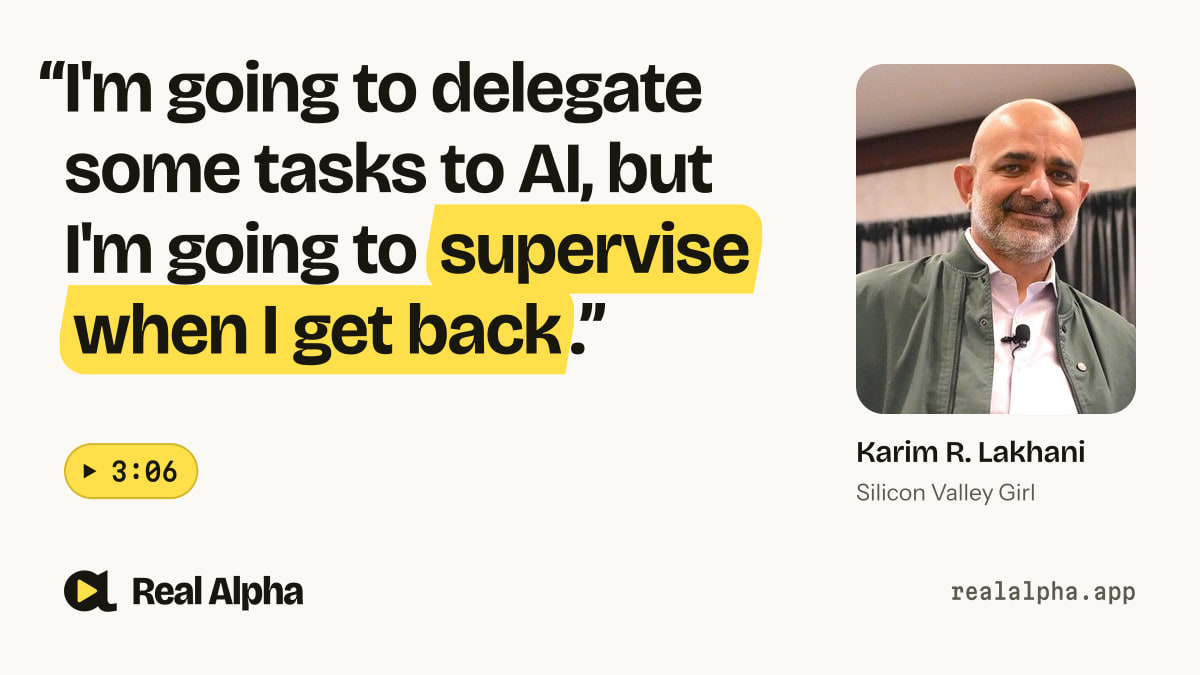
“I'm going to delegate some tasks to AI, but I'm going to supervise when I get back.”
 Karim R. Lakhaniat 3:06 · Silicon Valley Girl
Takeaways
- Self-automators learn least when they stop engaging with the work.
- Cyborgs work closely with AI; centaurs divide and supervise tasks.
- Centaurs must update the division as model abilities change.
About this segment
Karim R. Lakhani distinguishes people who work alongside AI from those who delegate whole tasks, and says self-automators learn least. As models improve, even people who split tasks need to revisit what they delegate.

Karim R. Lakhani is a Harvard Business School professor.
Pioneered field experiments on open innovation and AI’s impact on business; co-authored Competing in the Age of AI.

Marina Mogilko, Host · Host, Silicon Valley Girl
Co-founded LinguaTrip and built Linguamarina, an English-learning YouTube channel with almost 9M subscribers.
From “Harvard AI Professor: The People Most at Risk From AI Aren’t Who You Think”, Oct 30, 2026. Watch the full episode
Thanks. We'll look at and fix what's off.
Transcript
Transcribed by machine (Whisper) from the episode’s audio, so a word may be off here and there.
- 2:40
Can you talk to me about prompting? Because I know a lot of people are worried they might be delegating too much and some people are worried they're not delegating enough. What was the difference in prompting in these three groups? So this was part of a larger experiment at BCG where we were able to get access to about 800 consultants and randomize them into different types of tasks and access to AI or not AI. What we observed very clearly was that those that got access to AI had three different genres of working.
- 3:08
So cyborgs, they were intimately working with the AI and doing code. going problem-solving. Centaurs that separated themselves and said, I'm good at X, the A's good at Y. I'm going to delegate some tasks to AI, but I'm going to supervise when I get back. And then self-automators who press play. In terms of learning, the self-automators do the worst because they have stopped thinking. They've stopped engaging in the activities. And they are just basically, I can be harsh sometimes with my students. Like if all you are is a meat interface to the silicon, what's your value, right? And so it's easy to fall into that trap.
- 3:43
One of my former postdocs is a professor at Michigan now, Fabrizio Delacqua, did this great study showing people can fall asleep at the wheel with AI. Good people with good AI fall asleep. So I think soft automation is actually places where things can go bad quickly. I think the interesting part is going to be one about cyborg and centaurs. And so cyborgs are the folks that are intimately figuring out what AI is good at and what they're good at, and they work this way.
- 4:09
What I observe in R&D tasks and sales tasks and marketing tasks is that the cyborgs actually have a lot to learn and a lot to figure out. And then the centaurs who divide the work, the worry you would have is that they stay static in terms of the capabilities of the AI and what they can do. And because the AI capabilities are improving exponentially, we have to be paying attention to the fact that are you updating the separation between yourselves and the machine as well?
- 4:37
And it gets really complicated, right? Because you have this study about jagged frontier, right? And I have the graph here where sometimes you think the frontier is fully capable of doing the task because it's inside, but then there is a similar task that seems as hard and then suddenly it's outside the frontier. Is there a way for a normal human to differentiate these tasks? So I think this is such a great question. And by the way, this came from this deep study we did actually on BCG as well. And what was fun about it was that we had a bunch of hypotheses that AI is going to be good at everything. And then we launched it and we discovered that, in fact, no, for the job of a consultant, there are some things it's good at and some things it's not good at.
- 5:19
The challenge for us now is we have this intelligence available to us, but the intelligence is not perfect, but it talks really well and it can be very persuasive. And so the question is, how do you apply your skeptical thinking and high standards on the things that the AI is actually doing and not fall asleep at the wheel, not fall into the trap of just believing what the AI says? This is going to be an ever-growing edge that I think humans will have to keep developing because the AI will keep getting better and better and better, at least for the foreseeable future.
- 5:51
And we have to keep saying, under what circumstances does it break? And the only way that actually happens, even in my own personal practice, is to be using the most frontier tasks and doing the most frontier models along the way. That's the only way you'll actually discover. And not to sort of say, I expect magic and rainbows and unicorns the first day. Engage with it and be critical about it along the way.
- 6:13
Yeah, the problem is once you come to a conclusion like, oh, this task is good, this one is not, the next day the new model comes out and you have to re-evaluate again. Yeah, and so that's why this constant change and the constant upgrading is something that we all just have to get comfortable with if we're going to be living in this world with AIs. And it's so damn difficult for all of us. It is.
- 6:30
It is. Yeah, it is very difficult. We're so used to workflows and we thrive on routines, but it's every day. No, I think that's out the window now, unfortunately.