The alpha, twice a week
That was 6 min.
Get the best new moments in your inbox every Wednesday and Saturday. It's free.
Check your inbox
We sent a link to your address. Click it to finish signing up. Not there in a minute? Look in spam.
or
Big Technology Podcast · 6 min · Nov 17, 2026
Anthropic may be forced to sell before it can pay its bills
 Gary Marcus
Five customers account for 90% of revenue, and some are limiting use.
In this episode
Full analysis- 6:43Anthropic’s growth depends on a market that may commoditize8 min
- 32:03Efficiency gains may not protect Anthropic’s marginsPro pick 2 min
- 46:41AI reasoning works best when answers can be verifiedPro pick 3 min
- 18:23Anthropic may be forced to sell before it can pay its bills6 min
- 25:23IPO demand can reflect momentum, not belief in long-term returns4 min
- 40:42Anthropic needs reliable products rivals cannot quickly copy4 min
- 53:34Marcus puts AGI beyond this decade4 min
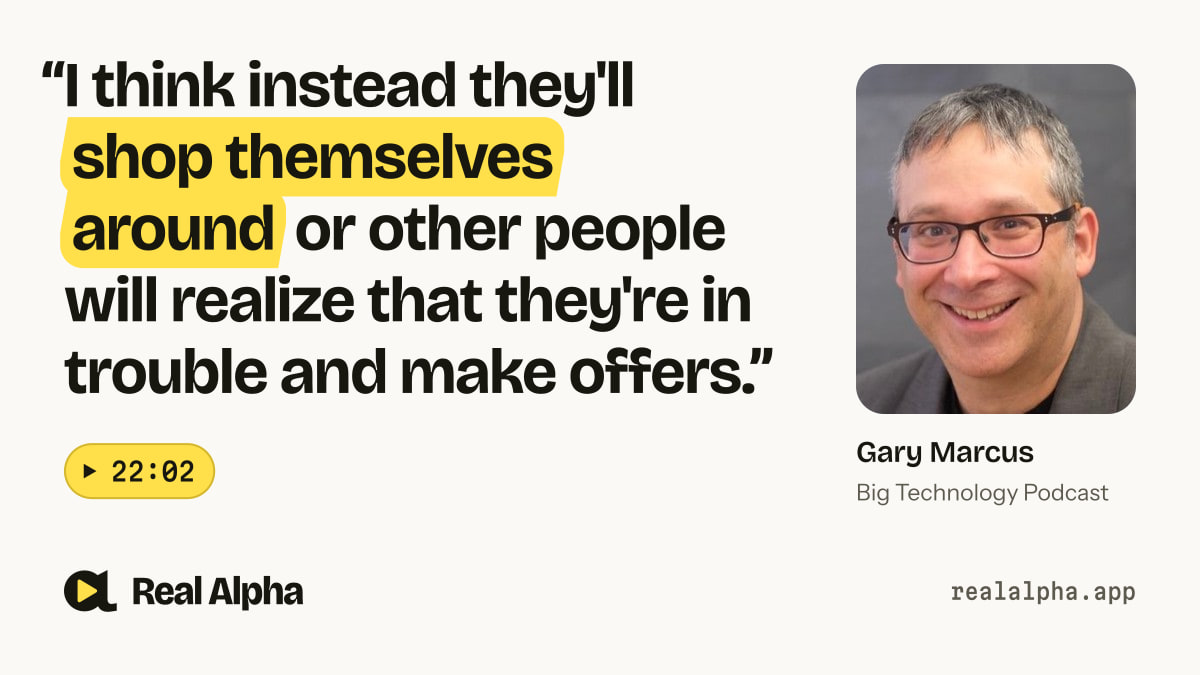
“I think instead they'll shop themselves around or other people will realize that they're in trouble and make offers.”
 Gary Marcusat 22:02 · Big Technology Podcast
Takeaways
- Five customers now make up 90% of revenue.
- Limits on customer use reduce the odds of sustaining rapid growth.
- Marcus imagines a sale at $200B–$$400B rather than Chapter 11.
About this segment
Five customers account for 90% of revenue, and some are limiting use. Gary Marcus expects Anthropic to seek a buyer at a steep discount rather than file for bankruptcy.

Gary Marcus is a professor emeritus at NYU and author of Marcus on AI.
Founded Geometric Intelligence, acquired by Uber, and researches human language development and cognitive neuroscience.

Alex Kantrowitz, Host · Founder, Big Technology
Former BuzzFeed News senior tech reporter and author of Always Day One.
From “Why The Anthropic IPO Will Fail — With Gary Marcus”, Nov 17, 2026. Watch the full episode
Thanks. We'll look at and fix what's off.
Transcript
Transcribed by machine (Whisper) from the episode’s audio, so a word may be off here and there.
- 18:33
get into um the the other part when you think about anthropics business is now it was two in last year there were two of their customers that made up 25 percent of their revenue now they have five customers that make up 90 percent of their revenue which is a little bit better than it was previously um but then you look at the action that's happening and some of those big customers are starting to try to move off of Anthropics tools.
- 18:57
You cite Microsoft, Meta, which have competing tools, but they are moving off Anthropics. I think Goldman Sachs was also... Yeah, so Goldman, not everybody left, but they basically told their bankers and traders don't use this. They said, the coder's fine, keep using CloudCode, but the rest of you, like, cut it out. Yeah, and so if they lose these customers, the business doesn't, you know, implode, but it could be very difficult for them to continue to grow the way they're growing.
- 19:22
Yeah. I mean, the problem again is that they need to be a rocket. Like they can't just steadily sell at the current levels because they're losing money at the current levels and they have these liabilities. It needs to stay a rocket. And so every time somebody gets off, my metaphors are getting a little complicated here, but every time somebody pulls back and then it becomes harder to maintain the rocket pace that they would need.
- 19:48
It's like getting escape velocity. You have to get the escape velocity. And each time a customer says no or limits who can use it internally, the chance that they're going to get that escape velocity diminishes. Yeah. And then you look at the market cap that Anthropoc. was anticipated to go public with and it's nowhere near what they were anticipating so the talk was two trillion dollars or even a little higher two trillion and now it's looking like it'll be 1.3 1.4 although who knows what will happen on the first day of trading it could pop but um totally when you speak about momentum um that is you want you don't really want the valuation to be going in the down direction as opposed to as you ipo right you don't want to be ipoing as your valuation goes down. But that is what's happening. I mean, it's still a very impressive valuation if they
- 20:41
achieve it. And they may sell out the IPO. The real question is if people buy at the IPO, are they going to get screwed because it's not really sustainable? The IPO day is a little bit of almost like a meme stock thing. Yes. What's the vibe here? We saw that with SpaceX. We saw that with SpaceX. The long term is like, is there value in the company? Is it returning on the investment? And so the real test here is time. Your bottom line, I would not be shocked to see anthropic go out of business nor would I be shocked to see if the IPO fails go out of business yeah I mean I think the most likely outcome actually is that they will have to sell to somebody else in video the video's got its own troubles right now or but I used to say in video or Amazon or Elon Musk you know SpaceX Apple something like that for you know a lot less than a trillion
- 21:33
dollars why because they're at some point they're not gonna be able to pay pay their bills. And I mean, they're going to have options at that point when they can't pay their bills. They have a lot of talent that has value. They have a lot of customers that have value. But at some point, well, I should say this more carefully. At some point, it's possible that they won't be able to pay their bills. That's what I'm projecting. My guess is at some point, they won't be able to pay the bills. This is 100 billion something a year in bills. And I think that it rises. I don't quite know the shape of the curve. At some point, if they're not making profits, that's going to be a problem, right? And at that point, they could file chapter 11.
- 22:12
I don't think they'll do that. I think instead they'll shop themselves around or other people will realize that they're in trouble and make offers. That's how these things go. And so somebody will approach them and say, we'd like to buy you for $200 billion. They'll say, no way, there'll be some back and forth. And in the end, they'll be like, $400 billion. It won't be great. But the alternative will be they actually can't pay the bills.
- 22:34
You know, that's a problem. Right. The underappreciated part, everyone's been looking at the revenue escalate, like growing and all this stuff, but the underappreciated part of the AI moment is that the only reason why these companies, I mean, it happens with a lot of startups, but the scale is greater. The only reason why these companies have gotten to this point has been their ability, not the only, but the companies would not be able to get to this point without their ability to raise gobs of money.
- 23:00
Enormous gobs of money. The IPO is not the final. They're not standing on their own feet. They're standing on investors. VC and big tech and NVIDIA money. And the IPO is not the final fundraising event. Like they could end up selling more shares or raising more debt. Yeah, and then they may do those things before they do what I think is going to be the outcome. Now, at a certain point, and you're in the life of any company, you have to be able to make a profit.
- 23:23
It's one of those things about business. The lemonade needs to cost more than the ingredients and labor. You got to sell it for more than it costs you to make it. And, you know, the costs are going up, too, for a whole bunch of different reasons. Like the resistance to data centers, we can argue about that, but it makes data centers more expensive, right? And that raises their costs. The fact that they need to make a bigger model to get the same improvement on a benchmark or whatever, that raises their cost.
- 23:49
So they have a bunch of things that are actually raising the cost.