The alpha, twice a week
That was 4 min.
Get the best new moments in your inbox every Wednesday and Saturday. It's free.
Check your inbox
We sent a link to your address. Click it to finish signing up. Not there in a minute? Look in spam.
or
Big Technology Podcast · 4 min · Nov 17, 2026
Anthropic needs reliable products rivals cannot quickly copy
 Gary Marcus
 sees product expansion as a possible moat, but only if tools like spreadsheets work reliably and competitors cannot copy them quickly.
In this episode
Full analysis- 6:43Anthropic’s growth depends on a market that may commoditize8 min
- 32:03Efficiency gains may not protect Anthropic’s marginsPro pick 2 min
- 46:41AI reasoning works best when answers can be verifiedPro pick 3 min
- 18:23Anthropic may be forced to sell before it can pay its bills6 min
- 25:23IPO demand can reflect momentum, not belief in long-term returns4 min
- 40:42Anthropic needs reliable products rivals cannot quickly copy4 min
- 53:34Marcus puts AGI beyond this decade4 min
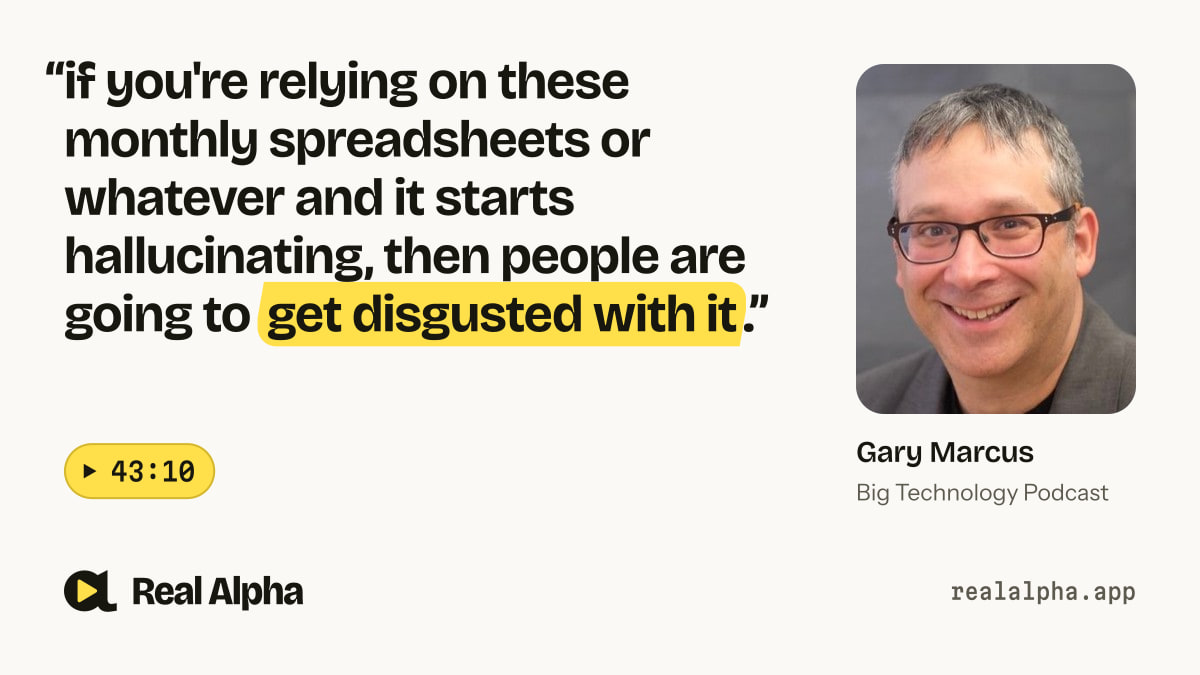
“if you're relying on these monthly spreadsheets or whatever and it starts hallucinating, then people are going to get disgusted with it.”
 Gary Marcusat 43:10 · Big Technology Podcast
Takeaways
- Products could give Anthropic a moat beyond model access.
- Spreadsheet errors could quickly erode user trust.
- A feature rivals replicate in months is not a durable advantage.
About this segment
Gary Marcus sees product expansion as a possible moat, but only if tools like spreadsheets work reliably and competitors cannot copy them quickly. Hallucinations could sour users fast.

Gary Marcus is a professor emeritus at NYU and author of Marcus on AI.
Founded Geometric Intelligence, acquired by Uber, and researches human language development and cognitive neuroscience.

Alex Kantrowitz, Host · Founder, Big Technology
Former BuzzFeed News senior tech reporter and author of Always Day One.
From “Why The Anthropic IPO Will Fail — With Gary Marcus”, Nov 17, 2026. Watch the full episode
Thanks. We'll look at and fix what's off.
Transcript
Transcribed by machine (Whisper) from the episode’s audio, so a word may be off here and there.
- 40:52
OK, here's here's I have two more points to make. One is, you know, in terms of what the arguments would be against against your position about just say no to the anthropic IPO. So one is that like up until this point in the discussion, we've largely been talking about Anthropik as a model company. And I wrote down a note, they're not a model company. They are a product company that has models. Cloud Code, Cloud Cowork, Cloud Design.
- 41:16
Just this week, Anthropik, this is from Bloomberg, Anthropik unveiled a suite of tools that weave the company's artificial intelligence capabilities into more everyday office work. a move that puts it into sharper competition with Microsoft and Alphabet. It has something called Cloud Sheets that resembles Microsoft Excel and Google Sheets. Now, I don't know if this is good for the world because you have this possibility that AI is just going to ingest everything.
- 41:44
But they have shown an ability to build their own products and they become competitive with software today. And so someone within there might say, well, who cares if some of these model advantages are competed away? We're going to have the users, we're going to have the native integrations, and we will be able to build AI products. Basically, upend a world of legacy software that's trying to bolt on AI, and we're going to build it natively.
- 42:15
If they can do that in a distinctive way, then that helps a lot, right? I mean, a lot of the argument that I've made is that so far, they don't have a lot of moat. You know, the only moat they have is around these very high-end models. And even there, like the lead goes back and forth with OpenAI. And, you know, one week, they're getting the revenue growth, and another week, OpenAI is. So I think it's smart to try to find products that other people can't build or you've got enough lead.
- 42:42
We saw with Cloud Code they actually did have an amazing product and then their cybersecurity sucked and the code leaked and then Codex replicated it and so forth. I don't know if Codex replicated with the leaked code or not, but OpenAI wasn't very far behind. So you can ask the same kind of, well, around the thing that you just brought up, you can ask a couple of questions. One is like a spreadsheet really needs to work.
- 43:08
So, you know, the problems of hallucinations and so forth are a problem. I can see some or a potential issue, I should say. I can see some ways that they might do this to make it work, but it really has to work. Like, you know, if you're relying on these monthly spreadsheets or whatever and it starts hallucinating, then people are going to get disgusted with it. And you can think about things like Copilot with Microsoft tried to do stuff a little bit like that and didn't work very well, right?
- 43:32
And so people mostly got disgusted with it and didn't use it very much. That was either a technology problem or a Microsoft problem. I would argue it probably is the latter. I will refrain from comment on that. But, yeah, those are the possibilities. And I'm refraining because I don't really know. If Anthropa can do that better and uniquely better, then for sure that helps them. There's no question.
- 43:54
If they can do it better and OpenAI and Google can replicate whatever it is that they do in three months, then it's, again, not a sustainable mode. So we have to see if it works well, and then we have to see whether other people are able to replicate it quickly or not. Okay. Here's my last point, and don't hate me for this one, but I titled it, They've Proved the Doubters Wrong. Now, there's nuance here, but – Yeah, which doubt?