The alpha, twice a week
That was 4 min.
Get the best new moments in your inbox every Wednesday and Saturday. It's free.
Check your inbox
We sent a link to your address. Click it to finish signing up. Not there in a minute? Look in spam.
or
TBPN · 4 min · Nov 19, 2026
Biotech exits can stop startups from building full businesses
 Hemant Taneja
 says pharma companies often buy life-sciences startups once they show product-market fit.
In this episode
Full analysis- 46:50Strauss explains why he bet against VR entertainment4 min
- 1:04:40AI scale demands new ways to finance companies4 min
- 1:16:35Anthropic made Taneja rethink what venture scale means4 min
- 13:45Take-Two budgets creative bets but leaves room for creators3 min
- 21:11Take-Two screens acquisitions for fit, returns and culture3 min
- 16:21Recurring spending now drives 80% of Take-Two net bookings3 min
- 1:11:12AI startups should prove demand before asking for more compute3 min
- 1:20:50Biotech exits can stop startups from building full businesses4 min
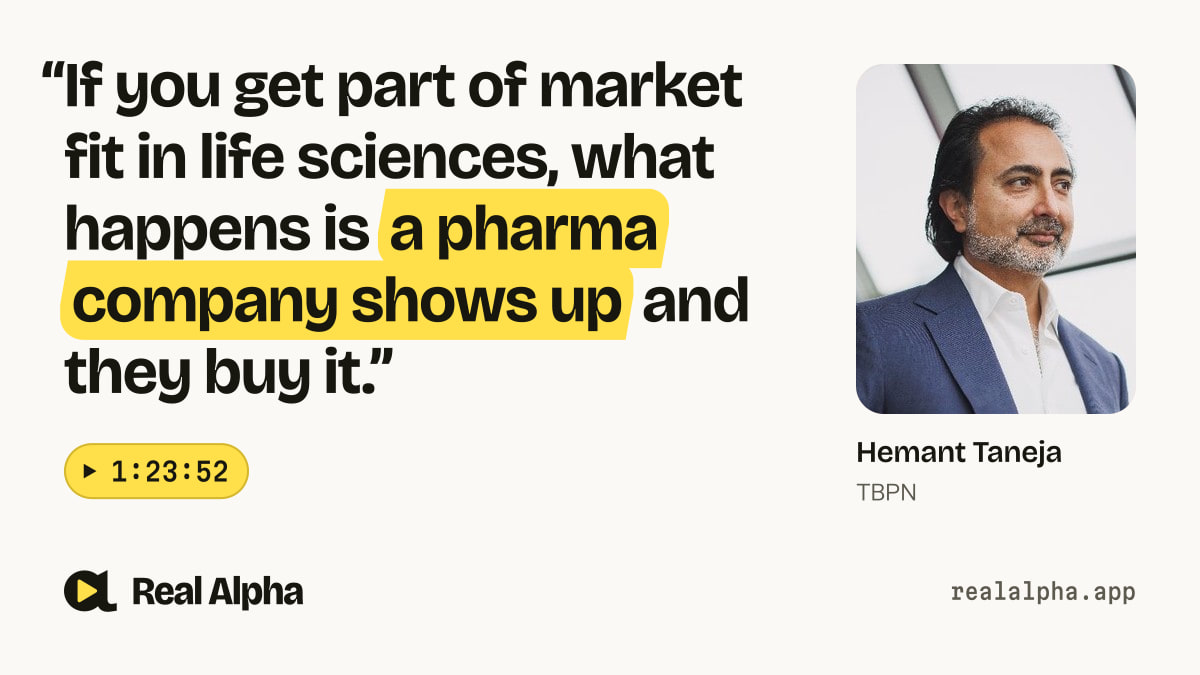
“If you get part of market fit in life sciences, what happens is a pharma company shows up and they buy it.”
 Hemant Tanejaat 1:23:52 · TBPN
Takeaways
- Pharma companies often buy biotech startups after product-market fit.
- Few life-sciences platforms grow into large independent businesses.
- Taneja says current market incentives need to change.
About this segment
Hemant Taneja says pharma companies often buy life-sciences startups once they show product-market fit. He argues this can prevent new platforms from growing into large businesses.

CEO, General Catalyst
Backed generational founders at Anthropic, Anduril and Stripe, and co-founded healthcare companies including Livongo and Commure.

John Coogan, Host · Co-host, TBPN
Co-founded Soylent and Lucy; OpenAI bought his show TBPN in April 2026.

Jordi Hays, Host · Co-host, TBPN
Founded Branded Native; co-founded fintech Capital, which Rho bought.
From “Ant IPO (Hemant Joins), GTA 6 Launch (Strauss Zelnick Joins Live)”, Nov 19, 2026. Watch the full episode
Thanks. We'll look at and fix what's off.
Transcript
From the transcript TBPN publishes with the episode.
- 1:21:01
How are you balancing the team? How do you think about even the payback period because the acceleration, if you have to test a drug in a human, it might take that might be a little bit slower, so you might not see these 10 x's that quickly. But what's your overall thinking around biotech as an opportunity?
- 1:21:17
I think you guys know, like, transforming health care has kind of been a big part of my life's work. Yeah. And I feel like... So I'd written a book in 2019 about it, and then COVID happened. Yeah. Which I thought was like the, you know, the powers to hire up sort of come and blow up the system. Yeah. Then two years later, chat GBD happens, and we were given a tool. To do something about it, and my whole thesis was around proactive, portable, accessible care.
- 1:21:42
Yeah. So part of the work around adopting AI to transform the work and the clinical experience and the payments experience in a hospital, the health systems have been some of the fastest deployed of that AI. Yeah. Now what's really exciting is you've got like a a second tool coming in, Roy, which is to actually rethink how to build mass personalized life sciences solutions, pharmaceutical solutions. You have to downscale the cost, and that's really exciting. I I I will, a caution, also say that diffusion of that Yeah.
- 1:22:15
Into the real world will have a lot of challenges because you do have to go through the FDA process in The US to really access this market, for example. And so we have to work very closely with the policymakers to rethink how the FDA has to evolve and the governance of surround safety and efficacy for how we do do sort of AI AI driven targets and drugs needs to kind of rethought. So somehow we have to do that work in parallel so that we don't have this great frontier intelligence applied to biology, a theory on a lot of targets, but we can't really go in the real world and and prove it out and bring it to the world. Yeah. So that to me is gonna be where the challenges will be, and and I think, you know, we're thinking through a lot of ideas of how do we accelerate that so that the impact when comes to abundance that AI can deliver in this area can be felt, you know, sooner than it would be otherwise.
- 1:23:11
Are the capital markets more equipped to deal with biotech innovation because they underwrite pre IPO, preclinical drugs more regularly? I feel like the GLP-one companies, once they had product market fit, the stocks really went up and there was plenty of liquidity there, there's plenty of capital there. It feels like I I don't I don't know if the biotech community is more risk on or something, but it just feels like the biotech community is very much set up for success here in the next era if things go as we expect them to.
- 1:23:44
Yes and no. Okay. I would actually say the the capital markets part of it is interesting in life science and biotech because when a software founder finds product market fit Yeah. People like me show up with lots of money Yeah. And say, put fill on the flyer, let's steal the crap out of Yeah. Totally. If you get part of market fit in life sciences, what happens is a pharma company shows up and they buy it. Yeah. Yeah. You actually never get to act... Have a go to market and build a business in life sciences.
- 1:24:13
Shops. Yeah. For for existing platforms. Are very few that have become large, and and we do need to break through that. So I think a lot of what we're thinking is, how do you build new businesses, not new or therapies or drugs with this innovation sector. So I don't... I actually don't think the incentive structures and markets are set up the right way to go to that.