The alpha, twice a week
That was 3 min.
Get the best new moments in your inbox every Wednesday and Saturday. It's free.
Check your inbox
We sent a link to your address. Click it to finish signing up. Not there in a minute? Look in spam.
or
TBPN · 3 min · Nov 19, 2026
Take-Two screens acquisitions for fit, returns and culture
 Strauss Zelnick
 lays out three tests for acquisitions: strategic fit, shareholder returns and cultural fit.
In this episode
Full analysis- 46:50Strauss explains why he bet against VR entertainment4 min
- 1:04:40AI scale demands new ways to finance companies4 min
- 1:16:35Anthropic made Taneja rethink what venture scale means4 min
- 13:45Take-Two budgets creative bets but leaves room for creators3 min
- 21:11Take-Two screens acquisitions for fit, returns and culture3 min
- 16:21Recurring spending now drives 80% of Take-Two net bookings3 min
- 1:11:12AI startups should prove demand before asking for more compute3 min
- 1:20:50Biotech exits can stop startups from building full businesses4 min
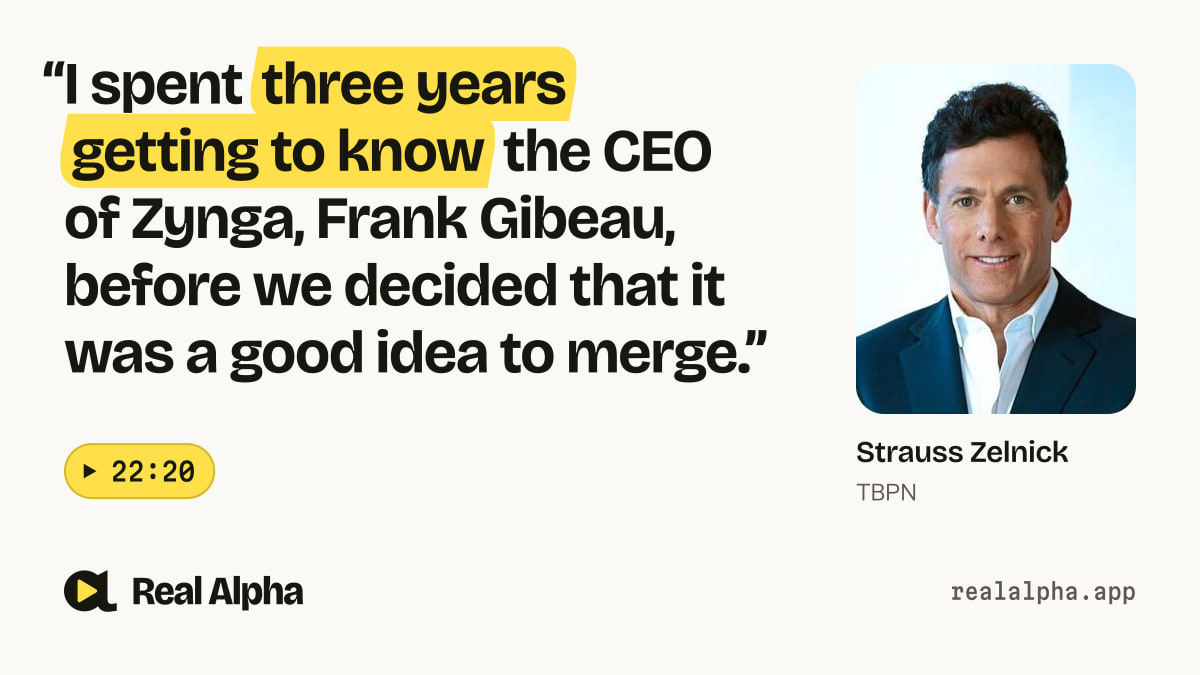
“I spent three years getting to know the CEO of Zynga, Frank Gibeau, before we decided that it was a good idea to merge.”
 Strauss Zelnickat 22:20 · TBPN
Takeaways
- The companies need a clear strategic fit.
- The deal should make shareholders better off.
- Zelnick spent three years getting to know Zynga’s CEO.
About this segment
Strauss Zelnick lays out three tests for acquisitions: strategic fit, shareholder returns and cultural fit. He says he spent three years getting to know Zynga’s CEO before the deal.

Chairman & CEO, Take-Two Interactive
Led Take-Two’s growth by backing creative talent behind Grand Theft Auto, NBA 2K and other global entertainment franchises.

John Coogan, Host · Co-host, TBPN
Co-founded Soylent and Lucy; OpenAI bought his show TBPN in April 2026.

Jordi Hays, Host · Co-host, TBPN
Founded Branded Native; co-founded fintech Capital, which Rho bought.
From “Ant IPO (Hemant Joins), GTA 6 Launch (Strauss Zelnick Joins Live)”, Nov 19, 2026. Watch the full episode
Thanks. We'll look at and fix what's off.
Transcript
From the transcript TBPN publishes with the episode.
- 21:22
Our teams are true to themselves and their properties and can collaborate. Now going to the broader question about mergers, you know, mergers succeed or fail based on a couple of key metrics. The first is, is there a strict... True strategic fit? Like, do these companies belong together? The second is, do the numbers make sense? In our case, we wanna know, is deal accretive? Are our shareholders gonna do better for having done this deal than for not having done the deal? Amazingly enough, many people don't think about an accretion dilution analysis before they do a transaction. And then the third metric is, is there a cultural fit?
- 21:56
So in the case of our acquisition of Zynga in mid twenty two, we knew there was a sound strategic benefit to being in the mobile business. We had already bought a couple of smaller mobile companies. We knew mobile was the fastest growing part of the interactive entertainment business. We felt pretty strongly that would continue to be the case. We knew that mobile served an audience that we didn't primarily serve, which is to say an audience skewing somewhat older, an audience skewing somewhat more female.
- 22:20
Mhmm. So we knew we wanted to be in mobile. Okay. Strategic fit. Secondly, we made sure that the economics made sense, that the deal would be immediately accretive financially, which which it was in the fullness of time. And third, I spent three years getting to know the CEO of Zynga, Frank Gibeau, before we decided that it was a good idea to merge. Yeah. And at that point, we understood, you know, where our cultures aligned and where they might not align as much. It's also the truth that we we have enormous respect for divisional autonomy, as long as everyone understands they're part of a federation with with a common mission.
- 22:55
Yeah. Make the best entertainment on earth. Be the number one entertainment company on earth. By the way, trying on number one. Number two, we're not there yet. Not even close, but but that's our aspiration. Yeah. You know, common strategy, be the most creative. Really mean it, really try to do it, be the most innovative, and be the most efficient, and we we fall short, we try, and then we have a common culture. Seek excellence in everything we do. Act as a team. Be kind.
- 23:22
Mhmm. And we fall short there as well, but it's not for want of trying. And every one of my colleagues across all of my divisions would and can tell you exactly what I just said because we're all pulling in that same direction. And because we're able to tick that third box, like, we're we're on on the same page with the same culture, you know, for those reasons, our acquisitions have all succeeded, which is unusual for a big corporation, actually.