The alpha, twice a week
That was 3 min.
Get the best new moments in your inbox every Wednesday and Saturday. It's free.
Check your inbox
We sent a link to your address. Click it to finish signing up. Not there in a minute? Look in spam.
or
Lightcone · 3 min · Nov 7, 2026
Early users paid $1,000 instead of $100,000 for an app
 Amjad Masad
 says early customers otherwise hired outsourced developers, even though the beta sometimes failed.
In this episode
Full analysis- 22:32Replit is replacing some $10 million software projects for $250,0006 min
- 1:53Replit automated the copy-paste loop between ChatGPT and codePro pick 4 min
- 14:44Replit’s infrastructure gave its agent a head start4 min
- 32:50Masad expects agent use to move work into the cloud3 min
- 40:13Masad uses exponential compute trends to predict what comes next4 min
- 6:18Replit's original deck proposed learning from coding sessions3 min
- 20:03Early users paid $1,000 instead of $100,000 for an app3 min
- 30:21Replit advances its strategy through customer-led increments3 min
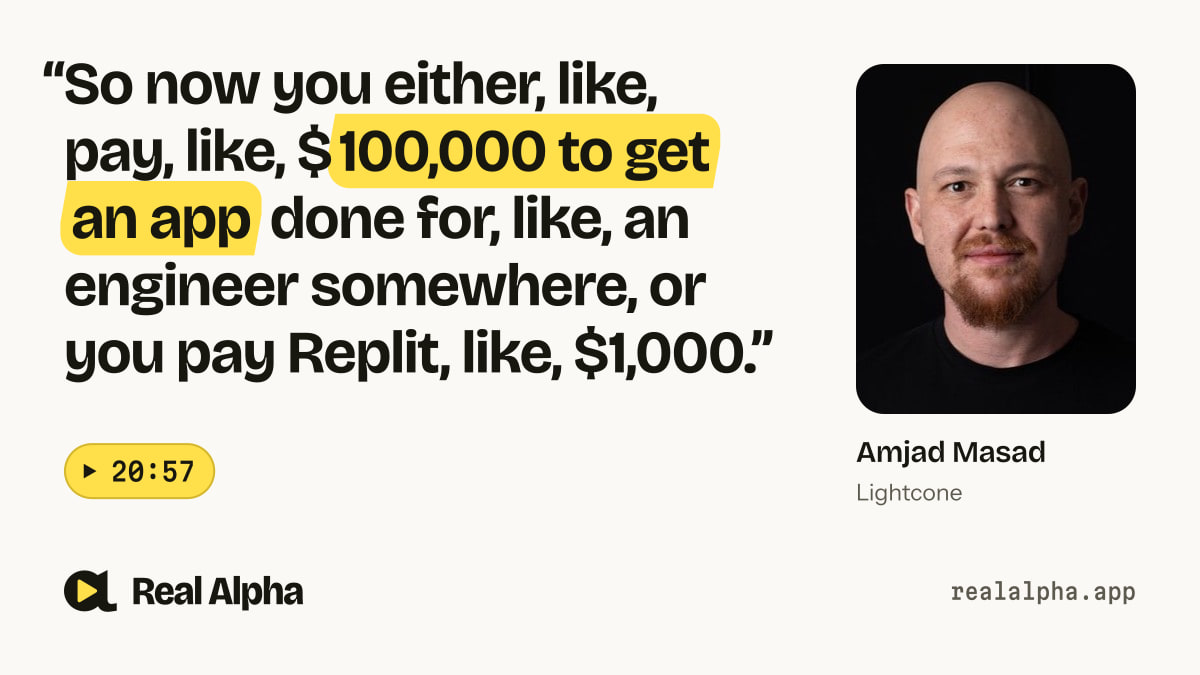
“So now you either, like, pay, like, $100,000 to get an app done for, like, an engineer somewhere, or you pay Replit, like, $1,000.”
 Amjad Masadat 20:57 · Lightcone
Takeaways
- Some early customers would otherwise hire outsourced developers.
- Graham recalled the beta failing about 30% of the time.
- Masad contrasts a $1,000 app with a $100,000 hire.
About this segment
Amjad Masad says early customers otherwise hired outsourced developers, even though the beta sometimes failed. A much lower price made an imperfect tool useful to people who could not code.

Amjad Masad is co-founder and CEO of Replit.
Co-founded and leads Replit, a browser-based coding platform letting anyone write and deploy code.
- PG
Paul Graham, Host
From “How To Build The Future: Paul Graham & Amjad Masad”, Nov 7, 2026. Watch the full episode
Answers “Which jobs will AI replace, and which are safe?” See all 132 answers
Thanks. We'll look at and fix what's off.
Transcript
Transcribed by machine (Whisper) from the episode’s audio, so a word may be off here and there.
- 20:15
No. Because you got it just at the point where it barely worked at all. Yeah. And it barely worked. And like when we launched it, it was in beta. And I would say 50%. I remember I would go over to your house and you would show me things and they would not work. Yeah. Maybe 50% is too harsh. I would say like, yeah, 30% of the time it would not work. Okay. So why would users tolerate that? Because it was such a magical experience.
- 20:44
Oh, and also presumably when they were cutting and pasting stuff back and forth between chat GPT, that also wouldn't work either, right? But if they couldn't program at all, then programming 70% of the time was a huge improvement. Well, the initial set of customers that started paying us a lot of money were people who would otherwise, like, go on outsourcing sites and go, like, get outsourced programmers.
- 21:09
So now you either, like, pay, like, $100,000 to get an app done for, like, an engineer somewhere, or you pay Replit, like, $1,000. So it was, like, this two-order magnitude difference. It still is today between, like, getting an engineer and, like, having Replit do it. Yeah. Arguably, the whole existence of the outsourcing shops was evidence of a market there. Yes. Because I thought of them as just terrible.
- 21:36
Like, who would ever want this? Who would pay money to these people to make vast amounts of money to make this terrible software? Yes. But instead, I should have thought, wow, that's a sign of demand. Yes. Yeah. I never thought. I looked at it like a program. We try to satisfy this demand in a few ways. Initially, when we had all these teenage hackers on the platform, we built something called the Replit Bounties.
- 21:57
I don't know if you remember that. I remember. I remember Replit Bounties. And it was trying to get at that. I was like, okay, AI is not there yet. They were going to become the new outsourcing shops, just like piecemeal as a bunch of teenagers. Yeah, but like the insight there was that they're powered by the rudimentary AI we had on Replit back then. But that in itself was enough of an edge that they have.
- 22:18
The people doing the Replit Bounties were already using AI to write the stuff. Yeah, exactly. Oh, man. Exactly. And it grew really fast. But then I looked at it and I was like, okay, if this is where the future is at, that's like a dead business. So like we shut it down. Why would it be dead?