The alpha, twice a week
That was 5 min.
Get the best new moments in your inbox every Wednesday and Saturday. It's free.
Check your inbox
We sent a link to your address. Click it to finish signing up. Not there in a minute? Look in spam.
or
No Priors · 5 min · Sep 3, 2026
Factories and distribution may lead robotics adoption
 Rene Haas
 expects robots to take on human labor tasks, with factory automation, delivery and distribution among the first uses.
In this episode
Full analysis- 7:18AI speeds up chip verification more than chip design3 min
- 12:02Chip supply constraints may last three to five years3 min
- 34:26CPUs orchestrate AI workloads alongside acceleratorsPro pick 2 min
- 2:29Meta's request pushed Arm into physical CPUs3 min
- 15:09Chip startups need ecosystem partners early3 min
- 20:09Factories and distribution may lead robotics adoption5 min
- 24:44Haas backs more US fabs for security and supply diversity4 min
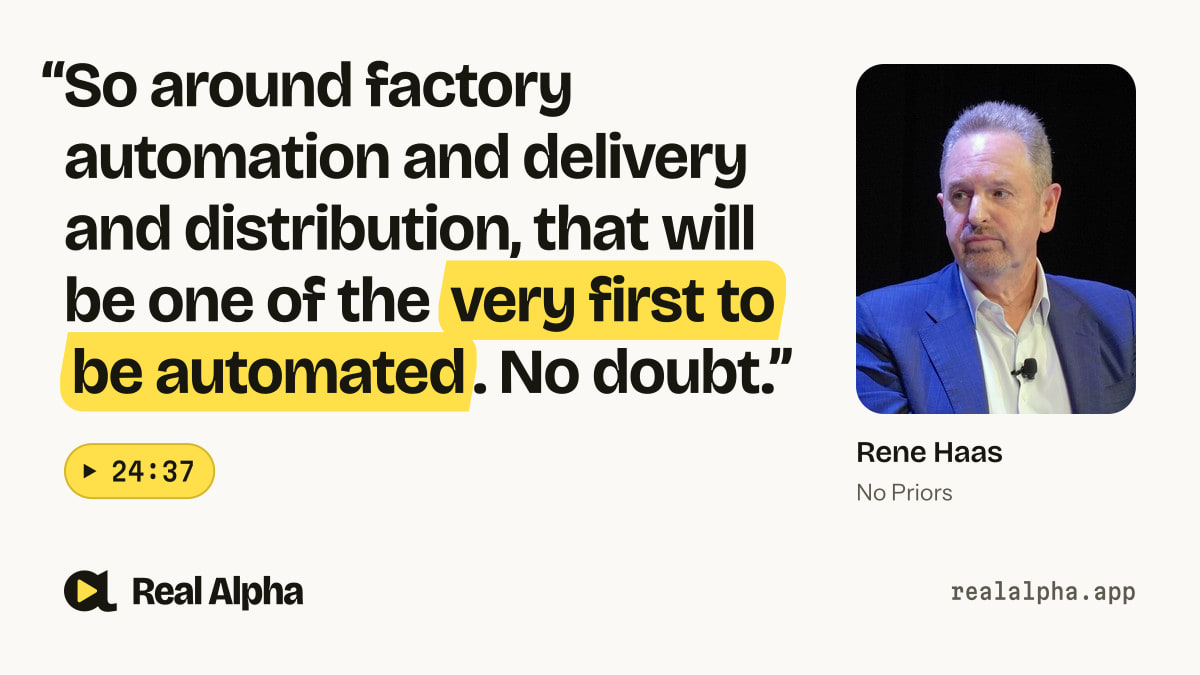
“So around factory automation and delivery and distribution, that will be one of the very first to be automated. No doubt.”
 Rene Haasat 24:37 · No Priors
Takeaways
- General-purpose robots could take on many human labor tasks.
- He expects factories, delivery and distribution to automate early.
- High robot costs and unproven business models remain hurdles.
About this segment
Rene Haas expects robots to take on human labor tasks, with factory automation, delivery and distribution among the first uses. High costs and unproven business models still limit adoption.

Rene Haas is CEO of Arm and SoftBank Group International.
Arm's CEO since 2022, after seven years at NVIDIA. Since April 2026 he has also led SoftBank Group International.


From “Redefining Chip Architecture with Arm CEO Rene Haas”, Sep 3, 2026. Watch the full episode
Answers “When will humanoid robots be useful?” See all 26 answers
Thanks. We'll look at and fix what's off.
Transcript
Transcribed by machine (Whisper) from the episode’s audio, so a word may be off here and there.
- 20:13
We're a couple years into, you know, serious efforts in more generalized robotics at this point, right, if you compare it to like about a decade for LLMs. there's increasingly interesting demo results from companies on generalization of task and environment, more robustness, maybe even in-context learning, but not like wide-scale deployment quite yet. First, would you agree with that characterization? What predictions do you have about the robotics market and any opportunity for ARM there? Oh, well, broadly speaking, uh i think the whether it's humanoids or or dedicated uh machines to do certain level of tasks that can be retrained is going to be enormous right and the the robotics 1.0 which is a purpose-built industry uh you had a piece of mechanics designed to do a certain task and the software that was optimized for that task if you had to a brand new automobile line came up
- 21:18
or some different piece of equipment. If the robots weren't well suited for that, rip up the line, et cetera, et cetera. So as you can imagine, then the barrier was pretty high. Getting to a world where the robots can learn just based upon either being trained or what they see. And then when you then combine that with, can you design something mechanically general purpose enough that can take advantage of being reprogrammed?
- 21:44
And then when you layer on top of that, the cost coming down, you look at it and say, oh, my gosh, what will it not be able to do? So it's almost like something out of the Jetsons, right, where a lot of things will ultimately be done by robots. Construction, infrastructure, service, security. You know, right now you see a lot of stuff on Instagram or TikTok of Olympic races with robots, et cetera, et cetera. I don't think anyone's going to have any interest in watching a sports league of robots. There may be an enthusiast class who might be interested in that. But the broader utility is going to be around a lot of human labor tasks that can ultimately easily be replaced by robots. There's no question. A lot of the hypotheses people have about the form factor of robotics tends to split into two or three camps. One of the camps is that they're going to...
- 22:30
be humanoid or roughly sort of the human footprint because so much of the physical world is already designed that way and the tooling is designed that way and so you can just slot robots right in others view it as there's going to be much more sort of specialized task specific form factors do you have a hypothesis on i think it's both yeah i think it's both there's a lot there are a lot of jobs and work tasks that are optimized around a person being six feet tall and having arms of a certain length etc etc uh but i think it'll be both you know and i think the fact that they're going to have be smart and can learn and to answer your earlier question arm is going to be everywhere uh we are we have a tremendous amount of technology from a real-time sensing standpoint around microprocessors that will be out at the fingers they can do perception and sensing that's
- 23:13
all going to be arm-based uh today whether it's NVIDIA or some of the work that qualcomm does most of the brains the brains that you see in the humanoids those are all all running on arm today. So I think for us, going forward, the robotic industry will be powered by ARM. Are you seeing any early indications? I mean, you have this great seat to your point where given the ubiquity of ARM and a lot of these different types of devices, you can kind of see the future before others in terms of where adoption is happening or where shifts are happening from a technology perspective. Are there specific pockets that you think will be most likely the early adopters of robotics that you're starting to see some signal from? I think it's still a little bit early because the business models have not been
- 23:53
actually figured out. The cost of robots are so high, right? Because the cost of robots are so high, people buying the robots themselves, that's a tough model to sort of get people's heads around. Does it actually replace? So I think costs need to come down and the business model need to be ultimately vetted. Because another robotic footprints tend to be things like automotive or certain surgical robots or distribution centers, right? There's a few very sort of bespoke applications that I think are most of the robotic sales today.
- 24:23
And so that's why I was a little bit curious. Distribution centers for sure. I mean, that can ultimately go completely automated, relative to, and even to the ultimate delivery, right? And you can question, to me, loosely speaking, a truck that has an autonomous, is a robot of sorts. So around factory automation and delivery and distribution, that will be one of the very first to be automated. No doubt.