Free with a sign-in.
The best 13 min of 27
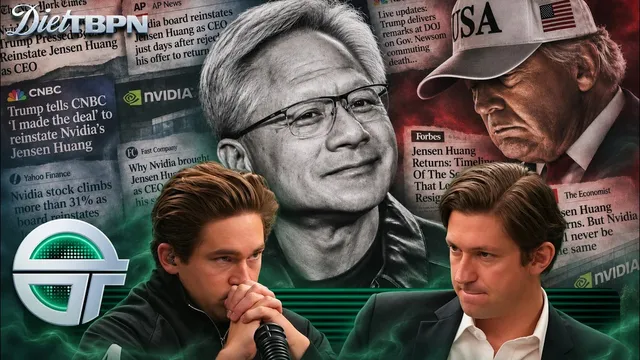
NVIDIA Won’t Be the Same Without Jensen Huang — Tae Kim
Tae Kim says NVIDIA can keep executing after Jensen Huang, but its next CEO must retain key talent and replace his mix of technical vision and dealmaking.
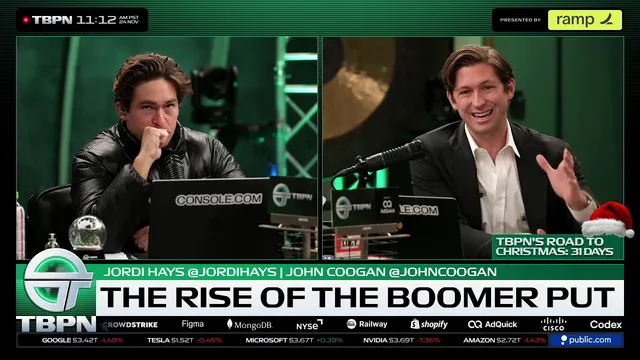
 TBPN · John Coogan & Jordi Hays
- Tae Kim is author of The NVIDIA Way.
The best minutes
- 8:37NVIDIA may need several leaders to replace Jensen6 min
- 20:15Cutting off distillation could widen the AI model gap3 min
- 16:44AI compute demand is strong, but neoclouds face financing pressure4 min
Also worth watching
- 5:20Jensen was a demanding, hands-on CEO, Kim's sources say3 min
- 23:56AI growth is improving IPO sentiment and chip demand2 min
Skip the opening news-cycle discussion of Jensen's departure, the Tim Cook and future-career detour, and the closing book-plans exchange.
Full analysis · 6 min read
Real Alpha · Nov 20
Tae Kim says NVIDIA should lock down about 10 leaders
- Kim says unnamed NVIDIA sources put the retention group at about 10, with the top few most critical.
- The count is approximate, and Kim named only a few people rather than giving a full roster.
- The board must test who owns strategy after the current product pipeline runs out.
Free with an account
Read the rest of the analysis
7 sections, the 8 other voices it tests Kim against, and what it means for you. Every episode we cut gets one.
Check your inbox
We sent a link to your address. Click it to finish signing up. Not there in a minute? Look in spam.
or
Signed up before? The same buttons sign you in. The episode, its moments and the transcript stay free.
The board needs a team, not just a CEO
The most useful number is a rough count, not a CEO candidate. Kim said unnamed NVIDIA sources told him there were about 10 people to lock down.
Kim, author of The NVIDIA Way, said he conducted more than 100 interviews for the book. But the retention count came from unnamed NVIDIA sources, not those interviews as a group.
He first described securing the top two or three, then said sources put the wider group at 10. Kim named only a few individuals, including Colette Kress and Jonah Alpin, rather than supplying a full roster.
The figure is a retention warning, not a vetted org chart or a count of equally critical executives. He did not identify the full group or explain how sources counted them.
Our read
The hiring problem is not simply finding a celebrated chief. NVIDIA needs to secure its technical bench and make authority clear.
Huang combined jobs no successor inherits automatically
Kim's account makes succession larger than replacing one chief executive. He described Huang as chief marketer, business strategist, recruiter, and hands-on manager.
One executive told Kim Huang sent him like 15 or 20 short status emails a day. Kim said Huang spent weekends writing similar updates.
That pattern shows operational attention, not just public dealmaking. But bundling those jobs makes succession harder to evaluate by title alone.
Sarah Fryer, on Bloomberg Surveillance in November, likewise said Huang personally handled many major deals. She also cited 60 direct reports.
That supports the concentration concern, but does not prove every major decision depended on him. A successor's remit may need to be redesigned, not copied.

Our read
Huang's reach explains why a replacement cannot simply inherit a job description. The board must decide which capabilities need one owner and which can be shared.
Kim's succession plan divides Jensen's remit
Kim's proposed answer is to divide responsibilities rather than search for another Jensen. He pictured Renee Haas handling public-facing leadership and business management.
Take Kim's proposed split. Ian Buck would manage data center relationships and contribute technology judgment.
Jonah Alpin would lead GPU engineering. This is a division of strengths, not evidence that those people have accepted roles.
Chamath Palihapitiya, on All-In in November, also favored technical, product-oriented capital allocators and named Ian Buck among candidates. Yet that overlap leaves sales, recruiting, and major dealmaking without an assigned owner.
A team model could cover more of Huang's range than one hire. But named candidates do not establish who will own decisions or work well together.
“The important thing is you need to hire a good CEO that knows his limits, his or her limits”

Our read
The proposed split could distribute Huang's strengths. It only works if the board makes decision rights and handoffs explicit.
Retaining executives won't fix weak governance
Retaining a technical bench may protect product execution, but it cannot by itself repair governance. Kim's prescription focuses on keeping leaders who know NVIDIA's products and technology.
Ed Elson, on Prof G Markets in November, highlighted a different weakness. He cited 60 direct reports, no COO, no board chair, and no succession plan.
Elson also connected limited subordinate pushback with leaders overrating their judgment. That is separate from Kim's reporting, but it identifies a failure a retained team must prevent.
If a new chief delegates engineering but cannot hear bad news, a distributed org chart only spreads responsibility. Board members should ask how dissent reaches the CEO and who can challenge a product or deal decision.

Our read
Retention can protect know-how, but it does not guarantee challenge or accountability. The board needs to design both the leadership bench and the channels for disagreement.
The product runway ends before strategy is settled
Kim put two timelines against each other. He said the next two to three years of product quality are largely baked in.
His bigger uncertainty is strategy and dealmaking three to five years out. A strong launch schedule should not be mistaken for proof that succession is settled.
Kunjan Sabani, on Bloomberg Tech in November, said Huang used relationships and NVIDIA's balance sheet to finance AI infrastructure. Sabani also cited a $500 billion vehicle.
That comparison raises a sharper board question. Can a new CEO preserve strategic financing and customer commitments without routing every large decision through a committee?
For operators and investors, the useful distinction is pipeline versus direction. Existing products may carry the handover, while new partnerships test the next team's judgment.
- KSKunjan Sabani · Bloomberg Tech · Nov 13Nvidia's balance sheet helped finance the wider AI buildout
Our read
The product roadmap buys time, not certainty. The real test is whether the next team can set strategy and make consequential deals after that runway.
Compute demand survives, but financing separates buyers
Kim said aggregate compute demand remains strong, while tighter financing pressures neoclouds more than hyperscalers. He framed that pressure as incremental, not a broad demand shock.
For example, hyperscalers can raise money against free cash flow, while neoclouds face tighter financing and permitting risks. Chip orders alone may conceal how differently those buyers can fund expansion.
Gil Luria, on Prof G Markets in November, preferred 25% more data centers one year and another 25% the next. Paul Kedrosky, on the same show in November, said capital could remain available at a higher price.
Their emphasis is growth pace and financing cost, not an abrupt end to demand. So Kim's outlook is plausible but time-sensitive, especially for marginal infrastructure providers.
- GLGil Luria · Prof G Markets · Nov 18Slower AI infrastructure growth may keep a bubble from forming
 Paul Kedrosky · Prof G Markets · Nov 19AI financing is tightening for marginal compute providers
Our read
A successor will inherit strong demand alongside uneven access to capital. Track hyperscaler and neocloud commitments separately rather than treating chip demand as one market.
Kim predicts distillation curbs widen the model gap
Kim predicts that restrictions on distillation accounts will widen the gap between American and Chinese models over the next six months. He presents distillation as the cause.
His explanation is unusually absolute. He said Chinese models are good only because they distill American models.
Daniel Saedi, on Odd Lots in November, said distillation is not the sole source of Chinese labs' strength. He pointed to compute, talent, and research advances as other factors.
Paul Christiano, on Dwarkesh Podcast in November, described distillation as one route to catch-up. He also said compute and experienced teams still matter.
Those views do not disprove Kim's forecast, but they weaken certainty around its one-cause explanation. NVIDIA's next leaders will need to plan for restricted access and continued Chinese model progress.
- DSDaniel Saedi · Odd Lots · Nov 20Distillation is not the only source of Chinese model progress
 Paul Christiano · Dwarkesh Podcast · Nov 16U.S. progress can also speed China's catch-up
Our read
Kim identifies a strategic risk, not a settled outcome. The board should not build China and compute assumptions around distillation controls alone.
What it means for you
- Map critical roles. Ask which roles NVIDIA must retain, and name the decisions each role owns. Kim's approximate count came from unnamed sources, not a published roster.
- Set decision owners. Separate responsibility for GPU engineering, data center customers, recruiting, and major deals. Test whether the handoffs work before a crisis forces them.
- Track funding by buyer. Measure hyperscaler commitments separately from neocloud financing and orders. Kim's outlook depends on those buyers facing different capital constraints.
- Test distillation exposure. Check model quality alongside access restrictions, compute, and research progress. Kim's forecast rests on one contested cause, while other sources point to additional factors.
What to watch
- Whether the board retains the technical leaders Kim says are central to execution.
- Whether the next CEO divides authority or recreates Huang's concentrated remit.
- Whether tighter financing changes neocloud orders, rather than only raising their costs.
Send this to the board member or executive leading CEO succession.
Watch the minute where Kim says sources flagged about 10 leaders to retain
Written by Real Alpha from the episode's transcript and the other moments it links, then checked against the transcript. Quotes are the speaker's exact words.
Minute by minute
- 1:42Kim says NVIDIA staff were shocked
Kim says NVIDIA employees he spoke with were shocked, disappointed and angry about Huang's departure. He says the China-hawk position and support for open source that Huang championed are now at risk, and calls the end of his tenure disappointing given his contributions to AI and the technology industry.
- 4:34Kim says reports made Huang's position untenable
Kim says reports alleging relationships with a customer and subordinates raised conflicts under NVIDIA's code of conduct, and he viewed a third report as making Huang's position untenable. He says sources for his book did not raise infidelity, but several questioned how quickly Kimberly Powell advanced; the negative behavior they described was Huang berating executives in meetings.
- 6:58Kim rejects the dealmaker-only view
Kim rejects the idea that Huang was mainly a public dealmaker. He cites an executive's account that Huang handled 15 or 20 short emails a day, spent weekends writing updates, and personally drove marketing, business strategy, recruiting and retention.
- 9:38Kim names Haas and Buck as candidates
Kim names Arm CEO Renee Haas, a former NVIDIA employee, and Ian Buck, CUDA's creator and head of NVIDIA's data-center business, as potential successors. He says Haas could lead public-facing business work while Buck brings customer relationships and technology foresight; the board would also need to retain Colette Kress, Jonah Alpin and other key executives.
- 12:29Succession could divide Huang's responsibilities
Kim's best-case model spreads Huang's responsibilities across a CEO, GPU engineering and data-center leaders. He says NVIDIA's culture and mission are ingrained, and that product quality for the next two or three years is largely set; the hard test is dealmaking and strategy three to five years out. He says keeping five to ten key people is essential.
- 15:05Kim says Huang is unlikely to retire
Kim expects Huang to spend six to twelve months dealing with investigations and political and legal matters, rather than retiring. He says Huang has described work as how he has fun and considers NVIDIA his life's work, though Kim is unsure whether Huang would ever compete with the company.
- 16:44China chip rules may affect only the margin
Kim expects Congress to close the data-center loophole that lets Chinese customers access NVIDIA chips through overseas facilities, trimming part of the business but not aggregate AI compute demand. He says hyperscalers can raise funds, while neoclouds may face tougher financing over the next 12 months amid tighter financial conditions and permitting worries.
- 20:15Kim expects the US-China model gap to widen
Kim says China is currently blocking purchases of some NVIDIA GPUs, while the hosts distinguish the government's position from Chinese labs' desire for compute. He argues the bigger force on Chinese models will be US labs cutting off distillation accounts, and predicts the Anthropic and OpenAI lead over Chinese models will widen over the next six months.
- 23:38Kim sees Anthropic IPO sentiment rebounding
Kim says pressure from OpenAI made Anthropic's September results look weaker, then Opus 5.5 and a stronger October growth curve improved investor sentiment. He says an October ARR disclosure flipped sentiment, the IPO was six or seven times oversubscribed, and the lower valuation could help the offering perform well.
- 25:09AI labs still want more chips
Kim argues the RSI cycle would boost AI semiconductor demand because further progress requires more chips. He says AI labs are taking all the compute they can get and reports that agents have accelerated OpenAI's chip-design work; an OpenAI chip architect told him agents were a dramatic multiplier.
Published Nov 13, 2026.
Transcript · 21 min read
TBPN, hosted by John Coogan and Jordi Hays, with Tae Kim.
From the transcript TBPN publishes with the episode.
If you're sick of our coverage of the NVIDIA story, you're gonna hate You're gonna get sicker. Get ready to puke because we got the NVIDIA expert himself. Take him in the TBPN UltraDome. We're bringing him in. Welcome to the show, Tag. How you doing? You so much for joining the show. Week this week. Yeah. I was week indeed. I'm exhausted. How are you doing?
It... It's been rough. It's been rough. Sleep. Yeah. That that that night when the board was meeting, I had to like You were so... Figure out, do I get any sleep or should I stay up all night? Like, I knew a decision was gonna happen.
Yeah. Yeah. Sometimes when you have a week of of like an insane news cycle Mhmm. It's been a different experience just because it's like it's such a... You know, you can't look away but it's also incredibly tragic Mhmm. Right, for the technology industry, for NVIDIA, for Jensen, America. And, you know, I think people are like actually seeming to do a good job of holding two things, which is like people can be flawed and make mistakes and simultaneously be, you know, one of one and incredible in in other domains. And so despite all the chaos of like, you know, insane... Over on Instagram is like crazier. I'm seeing posts with like, you know, half a million likes that are just like...
Read the whole transcript
I'm like, this... You know, the story is not niche at all. No. It's like everyone knows, you know, Jensen and all the... They can recognize all the the other people involved. But overall, I think people have generally been pretty balanced about it Mhmm. Which I I guess is a silver lining.
Yeah. I I've been talking to people on NVIDIA and it's complete shock Yeah. Disappointment. They're angry. Yeah. So many of the causes that Jensen was a proponent of. Now now those things are are in big trouble. Stranded. Yeah. The the China hawk stuff, the open source movement. Yeah. But like all these things that are legitimate positive Yeah. Forces, like, that's all at risk now. And I just wanna say, like, this is just such a sad ending for probably one of the greatest CEOs of American history. Like, to have his tenure end like this, all the stuff that he contributed to society, the technology industry, and pushing AI forward, it's really it's really disappointing and sad.
Yeah. I have a hedge fund manager friend who's... His his... One of his big overarching thesis is that we are coming to the end of the boomer bubble, and this obviously relates to the the handover of generational wealth from the boomers and boomer politicians going... You know, we've had boomer politicians for something like forty years or something like that. And he was he was... I... He was calling out that Jensen was the the final boomer CEO to go. And now we're firmly in, like, the Gen X millennial territory across all the big tech companies, essentially. It's... Yeah. It's a it's a very remarkable time. As you think back on... Which is crazy because Jensen at no point in time have I mentally thought in my head, okay, boomer. Yeah.
No. No. No. He's like so so much vitality, so so much so much energy. I guess like what are you... You know, I would say by Tuesday, I couldn't imagine Jensen staying despite that... Just with all... Everything sort of piling on. Despite that NVIDIA would never be the same and there was gonna be a bad... A bunch of bad downstream implications. It just felt like like just too much in in some sense. Now it's like... I still think you have to believe there's a chance he comes back, but there's a lot of investigations.
I I think it's over. It's like, I I tweeted it out as soon as the the second Yep. Affair report came out with five sources, like Yeah. I I knew then it was completely over because It's a direct report. Direct report. And and direct report is in the NVIDIA terms and conditions, basically, employee handbook. The code of conduct. Code of conduct. Yeah. And it's it's much more cut and dry, which is weird to say because we're talking about allegations of spying with a geopolitical rival, like, the most controversial thing, but there is... That that investigation has not concluded. This one is cut and dry, and so the second one was truly the end.
And the board must have known that if there's two Yep. Two ants in the kitchen, as people say, there's probably more. Then Reuters came out with a third one. Third. Yeah. Yeah. Mean, it was just game over because the code of content says conflict of interest Yep. And the ethics decision tests. Like, if this was in social media or on top of the New York Times, would you wanna do this? And obviously, it did not meet those tests. And, yeah, you can't you can't have an affair with the customer Yeah. That's a conflict of interest. You can't have affair with your subordinates because you have power over these people.
I mean, that's that's just game over. Yeah. Yeah. No. And it makes sense if you're working at a company and you're the one not having the affair, you're like, this is not a level playing field for a company. There's so many reasons why that that I
“I have dozens of firsthand accounts with him. Like, one executive told me, like, I think this is my book, he got, like, 15, 20 emails a day”
He's been able to do this for three decades Mhmm. How is NVIDIA gonna survive Yeah. With him?
“If they're able to retain the top five, 10 people and have a good CEO, the two candidates I mentioned, I think NVIDIA can do well.”
Yeah. What what do you think Jensen does next? Still feels like... It's hard to imagine him going out like this and then just being done. Like, he Yeah. I I mean, I think company? That... Well, I mean, first of all, he needs to go through this investigation process and go before congress and, you know, he's gonna be very busy on the legal, political front the next few months or maybe even a year. Mhmm. I don't think he's retiring because like like he's famously said, work is the way he has fun. So Yeah. I don't I don't think he's done. Like, as soon as all this political stuff and all this legal stuff that he has to go through and he's done, say, you know, six to twelve months from now, he'll do something. Yeah.
I do think he still loves NVIDIA. Like, NVIDIA is his life's work. So I don't know if he'll compete with NVIDIA, but but we'll see.
Yeah. Well, we found the post, the picture of Tim Cook. Retirement side quest update. Can we pull this up? Tim Cook spotted buying rug for $18,000 at the Grand Bazaar in Turkey. Do we have the image? I think we put it in the timeline in the... So this is real. Is this is... Like a real image, but it's from EOIG, entrepreneurs on IG, which is... I don't know if it's Wall Street Journal level coverage. I'm not leaning on it. But it it it is it is a good indication of where Tim... It it's believable even if it's fake news. We'll see.
I mean, after all the work and all the stuff he... He's he's gone through Mhmm. Like, leave the man alone. He's... He did a great job for Apple. Yeah. He doesn't need to be the center of geopolitics Yeah. And running another major technology company.
“Every single data point shows there's massive demand for GPU compute.”
Yeah. Jordy? I have one more. Go for it.
“The only reason these Chinese models are good is because they're just distilling the American models.”
So... Yeah. Yeah. So all of that seems like even with all the turmoil and the chaos in... With NVIDIA, but also the market broadly, It's not the craziest time for Anthropic to go public next week. It feels like they reset the valuation, and it's perfect. Right?
“Six six, seven times oversubscribed. They set the thing low, and now it's gonna go great, and the the the IPO is gonna go bonkers next week.”
I did I did tell people I'm working on a second book. I'm not ready to You're not ready to disclose it? Disclose it.
Yes. I think we might need 10 more books. We need a TPU book. We need a training book, an Intel book, an AMD book, maybe a Broadcom book. I'm I'm not an AI book. I I can only write one book. Get working, Tay. Get working. We need these books faster than you can write them because the the semiconductor race is fully fully on. We are we are potentially leaving the monopoly era.
And they get many interesting stories.... Every week. Every week. Every week. We didn't even talk about the midterms and elections that that much. It's just incredible. Yeah. Every week is like a brand new crazy story.
Yeah. Yeah. We were talking this is exciting. Yeah. Yeah. Yeah. The... Yeah. It'll be interesting to see you. The the the Full employment for take in.
Full employment for anyone with a take. It's a it's a great it's a great time and Great to see you. Business. Hope you can get some rest this weekend. You got some rest. Happy Friday. Next week will be interesting. We'll talk to you soon. Oh, god. Cheers. Goodbye.