The alpha, twice a week
That was 3 min.
Get the best new moments in your inbox every Wednesday and Saturday. It's free.
Check your inbox
We sent a link to your address. Click it to finish signing up. Not there in a minute? Look in spam.
or
Cheeky Pint · 3 min · Oct 29, 2026
Memory makers are cautious because past cycles punished capacity investment
 Sam Altman
 says memory makers endured boom-and-bust cycles with thin returns, so they are cautious despite today's windfall.
In this episode
Full analysis- 11:14Agent teams may improve both capability and alignmentPro pick 3 min
- 16:12AI math breakthroughs put discovery and researchers in tension7 min
- 42:41Personal agents could make business interfaces less important4 min
- 26:56Memory makers are cautious because past cycles punished capacity investment3 min
- 31:38Math-training methods may transfer to AI research3 min
- 0:06AI scans may uncover more serious software vulnerabilities3 min
- 37:42Altman wants five-year gigawatt costs down from $70B to $20B3 min
- 4:33OpenAI favors iterative deployment to keep people in control3 min
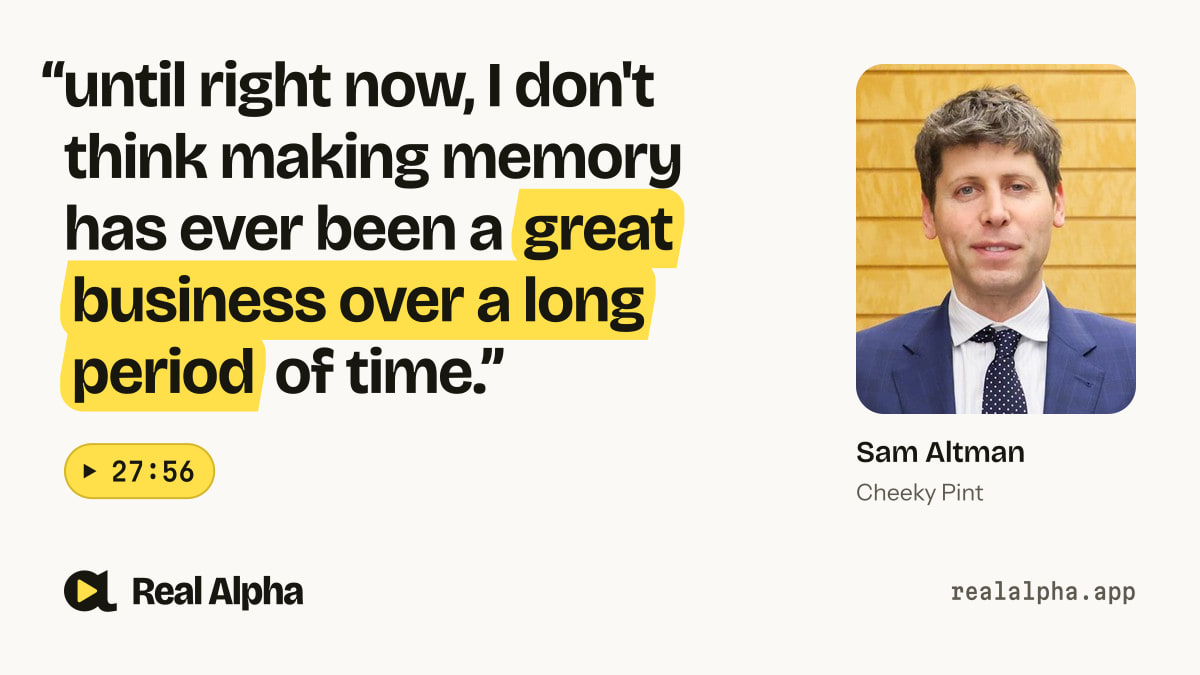
“until right now, I don't think making memory has ever been a great business over a long period of time.”
 Sam Altmanat 27:56 · Cheeky Pint
Takeaways
- Memory makers remember cycles of large investments and thin returns.
- Past near-bankruptcies make suppliers wary of adding fabs.
- Cloud pooling can use scarce memory more fully than local inference.
About this segment
Sam Altman says memory makers endured boom-and-bust cycles with thin returns, so they are cautious despite today's windfall. He also argues local inference leaves scarce memory underused.

Sam Altman is CEO of OpenAI.
Co-founded OpenAI and has led it since 2019, overseeing ChatGPT's launch; formerly president of Y Combinator.

John Collison, Host · Co-founder & president, Stripe
Sold his first startup, Auctomatic, at 17, then co-founded Stripe in 2010.
From “Why Sam Altman is against a single superintelligence”, Oct 29, 2026. Watch the full episode
Thanks. We'll look at and fix what's off.
Transcript
Transcribed by machine (Whisper) from the episode’s audio, so a word may be off here and there.
- 27:02
to high prices is high prices. It's like, okay, step one, we have the high prices for memory and GPUs and everything, and the solutions should be here any moment now. How are we doing on the solutions front? Bad. And I'm not saying this is OpenAI's job. I feel like this is the invisible hand's job, right? Like, memory's gotten really expensive, and so new memory makers are going to flood the market any moment now.
- 27:26
I think the invisible hand is failing right now. I mean, the invisible hand, it has like a checkered track record at best. But I think it's like not quite working here. Why not? like is it just hysteresis or i think it's i i think the like specifics of each area matter here but in the she started with the memory guys like you know for a very long time if you were a producer of d-ram you would invest 20 billion dollars of capex to make 19 billion dollars and and you would go through these like booms and busts like maybe some years you would make 20 $1 billion, some usually would make $18 billion, but like, until right now, I don't think making memory has ever been a great business over a long period of time.
- 28:09
And then all of a sudden, you know, these guys are each going to make like $100 billion of like free cash flow in a year. Unbelievable. But I think they all like remember their history and how many times they almost went bankrupt by making too many fabs and being promised this time it was different. Which leads them to be conservative in their capex. clearly it feels like what you should expect to see is that every part of the supply chain both new startups coming along and maybe more relevantly people with relevant experience getting into so you know intel makes chips they can probably make they can get back into the memory game as is tradition switch back um oh i think there are like all of these ways where the supply chain it's just like super non-obvious um an example of this is people
- 29:11
a lot of people want local inference and somehow they assume that like the problem is solved now because we're gonna have open source models we're gonna be able to run them on our computers and so we're not gonna need all the stuff in the data center but from like a global allocation perspective actually it's quite terrible to have everybody like have a bunch of the world's limited supply of drams sitting in their own computer and being used five percent of the time like you want maximum utilization in the cloud if you're trying to like deal with this very supply constrained environment and somehow everyone's many people's intuition is the opposite of that where else have we seen the market respond to high prices not just in memory but across the supply chain turbines