The alpha, twice a week
That was 3 min.
Get the best new moments in your inbox every Wednesday and Saturday. It's free.
Check your inbox
We sent a link to your address. Click it to finish signing up. Not there in a minute? Look in spam.
or
Cheeky Pint · 3 min · Oct 29, 2026
OpenAI favors iterative deployment to keep people in control
 Sam Altman
 argues the field must explain why AI's risks are worth accepting, then points to iterative deployment as a way for people to shape its use.
In this episode
Full analysis- 11:14Agent teams may improve both capability and alignmentPro pick 3 min
- 16:12AI math breakthroughs put discovery and researchers in tension7 min
- 42:41Personal agents could make business interfaces less important4 min
- 26:56Memory makers are cautious because past cycles punished capacity investment3 min
- 31:38Math-training methods may transfer to AI research3 min
- 0:06AI scans may uncover more serious software vulnerabilities3 min
- 37:42Altman wants five-year gigawatt costs down from $70B to $20B3 min
- 4:33OpenAI favors iterative deployment to keep people in control3 min
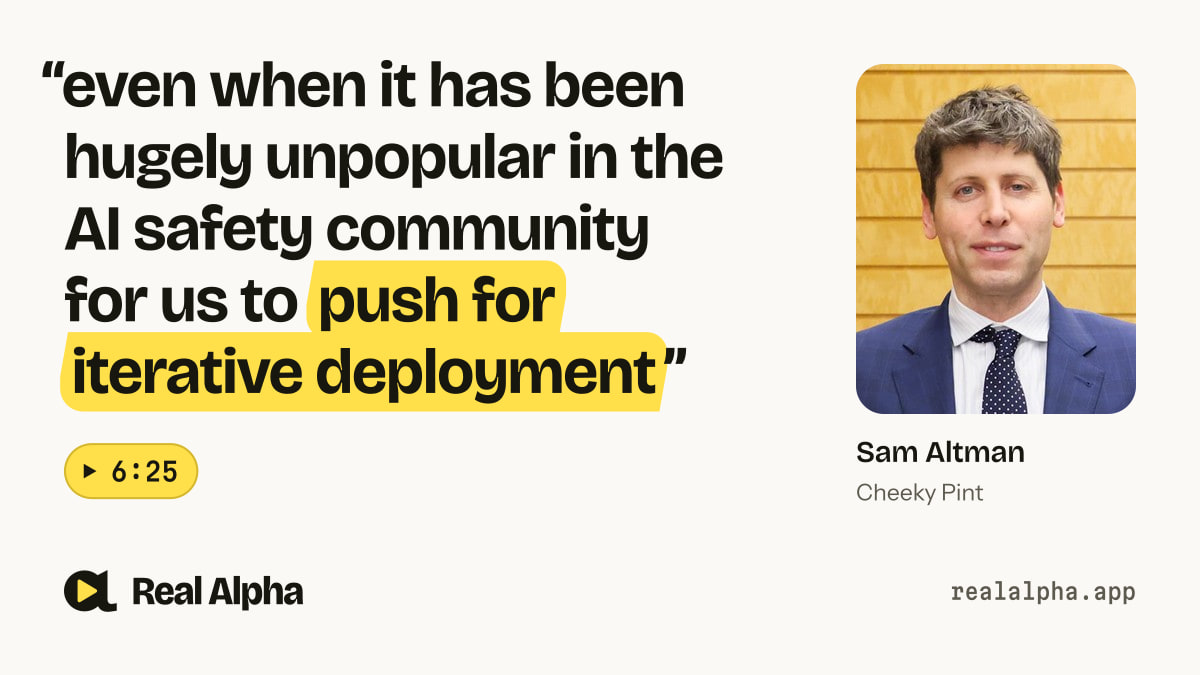
“even when it has been hugely unpopular in the AI safety community for us to push for iterative deployment”
 Sam Altmanat 6:25 · Cheeky Pint
Takeaways
- Altman says the field has not explained the tradeoff well.
- Iterative deployment lets people shape how AI is used.
- He warns against concentrating future decisions in a few firms.
About this segment
Sam Altman argues the field must explain why AI's risks are worth accepting, then points to iterative deployment as a way for people to shape its use. He says capability should reach users, not stay inside companies.

Sam Altman is CEO of OpenAI.
Co-founded OpenAI and has led it since 2019, overseeing ChatGPT's launch; formerly president of Y Combinator.

John Collison, Host · Co-founder & president, Stripe
Sold his first startup, Auctomatic, at 17, then co-founded Stripe in 2010.
From “Why Sam Altman is against a single superintelligence”, Oct 29, 2026. Watch the full episode
Answers “Is AI dangerous?” See all 107 answers
Thanks. We'll look at and fix what's off.
Transcript
Transcribed by machine (Whisper) from the episode’s audio, so a word may be off here and there.
- 4:39
Going back to the cyber side of things, in retrospect, you know, was the cyber RL a mistake or did we just have to go there? It's a little like the SNL thing of, you know, we urge you to urge us to stop. It's like the models are getting very good at cyber capabilities like yeah i mean they are getting very good but not just totally emergently look the reason that snl thing was so funny is because it was so true like humor like that doesn't stick unless there's an element of like it's like clearly pointing out a ridiculous but true thing about society or someone and and the cyber thing there is a point which is like okay you know sure the models are really good at cyber but like who asked for this why are you doing this Like, one of my big disappointments, criticisms of our field or whatever, and I think maybe the cyber, the model's getting good at cyber as an example of this, is I don't think we have done a great job of explaining to people why we think all of the potential downside of this technology is worth it.
- 5:42
Like, the kind of caricature of this is people feel like we're like, all right, you know, fine, you say the model's going to cure cancer someday, maybe it will, and if so, I guess that's good. and you say it's going to like make stuff cheaper and okay maybe i already see that's good and i get access to medical advice or legal advice but but then you paint this picture of the future where it's like a new industrial evolution and maybe the last one wasn't that good and this one sounds worse and i will have no job no ability to like have control or choice or freedom of my future and ai is so dangerous that you're going to have to like have a crazy surveillance state so we don't all die.
- 6:22
I'm with you so far. This is like a terrible sales pitch. Yeah. And one of the things that I am most proud of about OpenAI is even when it has been hugely unpopular in the AI safety community for us to push for iterative deployment and putting these tools in the hands of people, we have really stuck to that principle. And I think this is the only kind of good path. I think people, it's not enough to tell people like, you're going to get the model to do these great things for you.
- 6:52
It's got to be like, we are going to enable you to have a better life that you define for yourself to do useful things. You're not going to just sit and get a basic income and have a bunch of people sitting in a few square miles of San Francisco make all the decisions about the future. Iterative deployment is this idea that you just have to get the advances out there and you can't kind of stopper them up inside the company.
- 7:13
I mean, not all. You still have to make them safe before you put them out there. You can't, like, cause havoc in the world. But that building up a capability overhang is a thing to fight against. That directionally speaking, yes, you want to get this into the world. You want to get this into people's hands. And you want to let people use the technology to figure out all these wonderful things. The exploits get a lot of headlines.
- 7:36
The prevented exploits do not.