Free with a sign-in.
The best 19 min of 123
Market Slides, Math Solved, SpaceX is now GroundX, THE MANSION SECTION
Alex Epstein argues that permitting reform is essential to expanding US energy, housing and data-center construction.
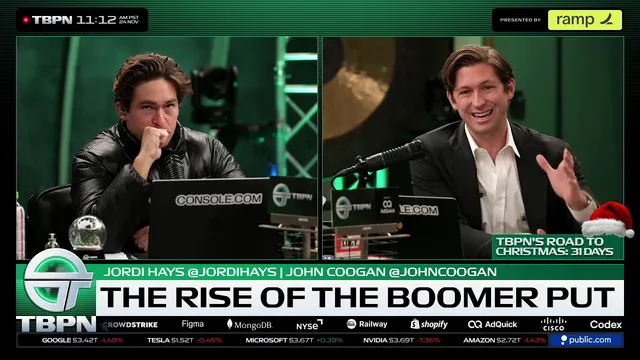
 TBPN · John Coogan & Jordi Hays
- Alex Epstein
- David Chang · Chef and founder, Momofuku
- Zhou Xian
- Eric Wind
The best minutes
- 37:07A House vote can block a popular permitting bill6 min
- 1:42:21Independent watchmakers can raise money before making a watchPro pick 6 min
- 1:12:59Originality is getting harder to find in restaurants6 min
Also worth watching
- 30:46The permitting bill tackles infrastructure delays, not fuel shortages7 min
- 1:23:42Genesis AI is learning dexterity from human hand motion4 min
- 1:48:43Wind Vintage is moving upmarket as modern Rolex gets harder to sell4 min
- 44:21Data centers can reduce delays by making projects better for neighbors3 min
Skip the 29-minute opener of market news, SpaceX financing, timeline reactions and the Mansion Section.
Full analysis · 6 min read
Real Alpha · Nov 20
Alex Epstein says about 15 days could decide permitting reform
- Epstein said about 15 days remained on Congress's calendar, with reform at risk for at least six years.
- His case is that permission, not fuel, constrains supply, but he is advocating for the bill.
- Builders should test approval, grid-cost and community assumptions before committing capacity.
Free with an account
Read the rest of the analysis
6 sections, the 6 other voices it tests Epstein against, and what it means for you. Every episode we cut gets one.
Check your inbox
We sent a link to your address. Click it to finish signing up. Not there in a minute? Look in spam.
or
Signed up before? The same buttons sign you in. The episode, its moments and the transcript stay free.
Epstein says a narrow window could decide reform
Epstein's repeatable number was about 15 days. He said that much time remained on Congress's calendar, and failure could leave reform stalled for at least six years.
That is his forecast about the next legislative opening, not a statutory deadline. The Senate had passed a bipartisan package, but the House still needed to permit a vote.
The distinction matters because the measure can die procedurally before members consider its substance. Epstein advocates permitting reform and is pressing for this bill's passage.
His six-year warning is advocacy, not a measured estimate of projects delayed or costs incurred. Still, his point for operators is that a narrow vote window can matter more than broad abstract support.
“We either pass this or we're screwed on permitting reform for at least six years”
Our read
The urgency is real as a legislative strategy, but the six-year consequence is Epstein's assessment. The immediate number to track is whether House leaders allow a vote.
Permission can constrain energy without exhausting fuel
Epstein's central diagnosis is that the constraint is permission to build and move energy, not a shortage of fuel underground. His examples span housing, gas pipelines, power generation and transmission.
For example, he said gas becomes a constraint when pipelines cannot move it where power plants and data centers need it. That reframes an AI power shortage as an infrastructure and approvals problem, rather than a finite-fuel problem.
The bill, as he described it, shortens environmental review, changes water-permit rules and adjusts transmission approvals. Yet a faster path to permission does not itself supply transformers, generators, capital or a connected grid.
Gil Luria said on Prof G Markets in October that equity and debt available for AI buildout are finite. His point does not refute Epstein, but limits the diagnosis. Faster approvals address one constraint, not every input needed to deliver capacity.
Our read
Epstein identifies a plausible physical bottleneck, not a complete explanation of project delivery. Capital, equipment and power availability still shape what gets built.
House rules can stop a bill before members vote
Epstein explained that members need a House rule before they can vote on the bill. Leadership can block that step, even if a majority might support the bill itself.
He said House leaders have used rules as partisan controls since the 1980s. In his account, the narrow Republican majority makes absences or a small group of holdouts consequential.
Epstein focused on Speaker Hakeem Jeffries not whipping Democrats against the rule. He said at most four Democrats might support introducing the bill if Jeffries opposed it.
For example, a representative could oppose the rule or simply be absent, preventing a vote without publicly rejecting the bill's policy. That is Epstein's political account, not a published tally of lawmakers' positions.
But the procedural distinction matters to companies watching the bill. A favorable Senate vote and broad support in principle do not guarantee that the House will consider the text.
Our read
A Senate vote does not establish that a House majority will get a chance to decide. The immediate test is access to a vote, not just public support.
Grid-cost rules complicate the bill's supply pitch
Epstein called the data-center provisions the bill's worst part. He said data centers would have to pay the full cost of grid work they necessitate, even when other users may benefit.
He acknowledged that the rule could make data centers overpay their share. In the exchange, he and the hosts treated speed to power as more important than the raw electricity bill, but gave no project-level calculation.
That admission complicates the bill's supply pitch. Faster permits could help projects move, while stricter cost allocation could raise expenses for some builders.
The episode does not specify how the rule would divide costs across individual projects and other grid users. Operators should read the actual allocation language rather than assume permitting reform simply lowers project costs.
Our read
The bill trades faster approvals for a tougher principle about who pays for grid expansion. Builders need to model both sides before treating it as a net gain.
Local benefits can cost less than community delay
Epstein argued that data centers should make projects pleasant for neighbors, fund schools and ease local tax pressure. He said those costs can be small beside delays caused by community opposition.
Take the Meta Louisiana example discussed on All-In in September with Dina Powell McCormick. A local superintendent described sales-tax collections rising as high as 260 percent, helping fund teacher checks.
Matt Garman said on Sources in November that AWS pays for the power its data centers bring to the grid. Bing Gordon said on The Information's TITV in November that companies should share benefits with nearby communities.
Those examples support the case for visible local benefits, but they do not prove every project wins approval. Epstein offered no cost comparison, and each site has its own tax base and impact.
 Dina Powell McCormick · All-In · Sep 17Meta's Louisiana data center sharply increased local school revenue
 Matt Garman · Sources · Nov 10AWS says local benefits are key to data center support
 Bing Gordon · The Information's TITV · Nov 9AI data centers need to make nearby communities partners
Our read
Community commitments belong in project economics, not just public relations. The useful test is whether specific benefits reduce opposition and schedule risk at a given site.
National reform cannot guarantee a fast build
Epstein's community argument faces a practical test. Even a supportive site plan cannot by itself erase permitting timelines, construction lead times or state-level rules.
Andrew Feldman, Cerebras's CEO, said on TBPN in November that about 75 percent of its 2027 data centers would be abroad. He said data centers take 15 to 18 months to build, and Cerebras contracted capacity outside the United States.
Use Feldman's 15 to 18 months as a construction-time reference, not an end-to-end delivery estimate. For your own projects, map permitting and construction separately rather than treating his figure as a universal schedule.
Rick Davis said on Balance of Power in November that he expected most states to regulate, not stop, data-center projects. National permitting reform could therefore coexist with a patchwork of local requirements.
That leaves companies with a specific planning problem. A faster federal process may improve the odds of building, but the episode offers no guarantee of a shovel-ready site or a delivery date.
 Andrew Feldman · TBPN · Nov 17Permitting delays push most Cerebras data centers abroad
- RDRick Davis · Balance of Power · Nov 5Data-center growth is more likely to face new rules than bans
Our read
Permitting reform could improve the conditions for building, not guarantee a shovel-ready project. Site selection still needs to account for local rules, grid access and realistic delivery dates.
What it means for you
- Map approval gates. For each proposed site, track environmental review, water permits, transmission access and who can reopen an approval. Epstein's point is that fuel at the source does not move itself.
- Stress-test the schedule. Feldman said data centers take 15 to 18 months to build, and Cerebras contracted capacity abroad. Treat that as his construction-time figure, then map permitting and construction separately for your own projects.
- Price local commitments. Estimate what school funding, property-tax relief and site design would cost beside delay risk. Epstein called these measures inexpensive relative to delay, but offered no calculation.
- Review grid allocation. Check which upgrades a project must fund under the proposed rules, and separate site-specific costs from wider grid benefits. Epstein said data centers could pay more than their share.
What to watch
- Whether House leaders allow the bill's rule to reach a vote within Epstein's stated roughly 15-day calendar window.
- Whether the data-center grid-cost provision survives and how it assigns upgrade costs.
- Whether developers publish local benefits alongside project schedules.
Send this to the infrastructure, policy and site-selection leaders planning US capacity.
Watch the minute where Epstein says about 15 days remain
Written by Real Alpha from the episode's transcript and the other moments it links, then checked against the transcript. Quotes are the speaker's exact words.
Minute by minute
A Pro write-up, open to you here. Try Pro free for 7 days
A Pro write-up. The minute by minute is in Real Alpha Pro; the episode, its moments and the transcript stay free.
Read it with Pro, 7 days free- 0:52An unverified proof met a market selloff
The hosts said Anthropic shares were at $87, above the $83 IPO price but down 10 that day, with an active market cap of $1,140,000,000,000. They discussed an Anthropic employee's claimed Riemann-hypothesis proof, which still needed expert review and was reportedly 250,000 pages in raw form. They said investors were focused on market weakness and revenue prospects, not the math result.
- 7:15Tech stocks lagged Treasury bills
The hosts noted that the Nasdaq was up only 5% year over year and had underperformed T-bills year to date, despite strength in energy infrastructure, data centers and chips. They linked the selloff to broad market weakness and uncertainty about whether AI spending would translate into revenue and profit.
- 10:00SpaceX's financing depends on recoverable collateral
The hosts discussed a proposed $40,000,000,000 financing deal in which an Apollo-managed entity buys NVIDIA GPUs and leases them to SpaceX for five years. Lenders are concerned they could not reclaim the chips if SpaceX sends them into orbit for planned data centers and defaults. The discussion also touched on how data-center sites, power rights and equipment can be reallocated between companies.
- 30:08Permitting reform could expand supply
Epstein described the Bipartisan American Affordability and Jobs Act as freedom-to-build legislation. He argued that permitting delays constrain housing and energy supply, and said reforms to NEPA, Clean Water Act rules, permit certainty and transmission could help unlock infrastructure, including gas pipelines and power generation for AI.
- 37:07House procedure puts the bill at risk
Epstein said the bill still needed to pass the House, where a vote on the rule for introducing it could block passage even if a majority supported the bill itself. He urged the House Freedom Caucus not to oppose the rule and asked Hakeem Jeffries not to whip Democrats against it. Epstein warned that the congressional calendar left little time and that failure could delay permitting reform for at least six years.
- 43:13Data centers can benefit local communities
Epstein said the bill would require data centers to cover the full cost of grid needs they create, which he considered an unfair overpayment because other users also benefit. He argued that developers could reduce local opposition by building facilities that are pleasant to live near and generate tax revenue for schools and property-tax relief, avoiding delays.
- 52:59Epstein backs building compute abroad
Epstein opposed taxing companies that build data centers abroad, arguing that the world needs more compute and AI can help with work such as medical care and everyday tasks. He said the US should build at home while allowing construction elsewhere, and urged states to compete for projects with stable rules.
- 59:15Chang looks for restaurants beyond algorithms
Chang said The Detour sought out restaurants the way people did before algorithms steered them, and described the show's ideas as developing organically. He named Pittsburgh as a surprise favorite, highlighting Primanti's and Apteka, a vegan Polish restaurant. For the Las Vegas Grand Prix, he and Mario Carbone were making a Korean-Italian deli sandwich pop-up.
- 1:06:34Momofuku seeks domestic production
Chang said he wanted tariffs to disappear and called logistics since 2020 a nightmare. Momofuku was looking for more domestic production for its grocery products. He described the noodles and sauces as an attempt to replace boxed mac and cheese in his own home.
- 1:10:16Chang says restaurants need original ideas
Chang said Bay Area wealth could support high-end dining, while a new operator might start in a place like Pittsburgh. He urged restaurateurs to be good at their craft and bring an original point of view, citing Barb's Barbecue in Lockhart, Texas, where chef Chuck put her Mexican American perspective on Central Texas barbecue. Chang and the hosts compared that kind of product originality to innovation in tech.
- 1:22:15Genesis AI targets demanding robotics jobs
Zhou said Genesis AI builds a robot's brain and body together, using raw human hand motion rather than remote operation to train its systems. The company designs a hand around human morphology and contact physics, and is targeting manufacturing, logistics and laboratory experiments, including wire-harness assembly. Zhou said consumer home robots may need another three or four years, and confirmed the company raised $500,000,000.
- 1:30:01Wind Vintage grew from watch writing
Wind said he studied international politics at Georgetown, worked in consulting and earned an MBA at Oxford while writing for Hodinkee. He said his writing audience brought clients to Christie's, where he worked full time from 2015. After starting Wind Vintage with his wife in 2017, he made as much in its first two months as he had in the previous year at Christie's.
- 1:35:40Quartz changed watchmakers' value proposition
Wind said quartz watches undermined accuracy as the watch industry's main selling point: the 1969 Seiko Astron was accurate to one second per month, compared with four seconds per day. He said watchmakers shifted toward emphasizing craftsmanship and luxury. Wind credited Nicholas Hayek and Swatch with buying distressed brands including Omega and Breguet and helping preserve high-end Swiss watchmaking.
- 1:40:40Independent watches draw early deposits
Wind said independent watchmakers have become major draws for collectors. He cited a tourbillon from a run of 20 that sold in France for $11,000,000 after he had sold one for $950,000 in 2021. He said some new makers sell allocations years ahead and take a third down, and agreed that the market could be a bubble, with some brands unlikely to last.
- 1:47:23Wind Vintage shifts toward higher-value watches
Wind said a client was waiting for equity markets to rise before buying a watch, and warned that modern Rolex super-fakes can be difficult to spot on someone's wrist. Wind Vintage was focusing on watches priced at $20,000 and up, which he said left it relatively insulated because high-quality fakes concentrate on modern Rolex. He said his book sold about 9,000 copies in its first week.
Published Nov 20, 2026.
Transcript · 1 h 36 m read
TBPN, hosted by John Coogan and Jordi Hays, with Alex Epstein, David Chang, Zhou Xian and Eric Wind.
From the transcript TBPN publishes with the episode.
You're watching TBPN. It's Friday, 11/20/2026. We are live from the TBPN UltraDome. The temple of technology, the fortress of finance, the capital of capital. Let me tell you about ramp.com. Time is money. Save both. He's used corporate cards, bill pay, accounting, and a whole lot more all in one place. And let me also tell you how many days there are until Christmas because we're so close now. Time to do your shopping. I hope you didn't get any... Hundred and twenty eight hours. I hope you didn't get anyone any stock for Christmas because it's gonna be worth a lot less by the time they unwrap that under the tree. But if you bought I don't know.
Puts, they could be looking really good. Puts under the tree. Putting puts and puts under the tree if you're bearish this holiday season. It's over. It's over. The market is nuking.
Pure red nuking. Anthropic... So we gotta add Anthropic to the ticker. Yeah. Ant. Ant. At the bottom there. Throw it in there. But it's a whole...
Read the whole transcript
It's still a big company and they got a lot of cash. Doing well. But people are frustrated. Market cap's 1,140,000,000,000. That's of course the active, not the fully diluted. Stock's at 87, which is still above the 83 that the IPO ed at, so there's a little bit of a bump since an hour ago, but down 10 today. And, of course, everyone who loves to read into the accelerationism that comes from math accomplishments is confused because it appears that there is a solution to the Riemann hypothesis of proof, which is extremely consequential in the math community. Wall Street doesn't really care apparently.
Chang is saying sell the dip. Sell the dip. Levant over at Anthropic posted that he believes he found a proof with Claude's help, but Scientific American reports it as unverified and still needing expert review. That could take years. It's 250,000 pages. Is that right? Yeah. I think that was the raw pad. I mean, you can definitely trim these things down. That's crazy. I mean, we're having vintage on the show today. His book is substantial, only 350 pages. Imagine 1,000 of these books. Maybe one day. With AI, it might be possible. And so the Clay Institute still lists Riemann hypothesis as an unsolved millennium prize problem. So all we're hearing is the claim. People are going back and forth on it. Terence Tao was on Tyler Cowen talking about the importance of the Riemann hypothesis. Also, he went on a show called Numberphile and he says he believes that he said he believed with the help of AI we could solve the Riemann hypothesis before 2050.
And it took thirty five days, if this is true. But he gives some good context here on why Riemann is important to the math community. It's sort of the the thing that everything else is built on. So let's play this clip of Tyler Cowen talking to...
Did not accept what the math was telling them. And the Riemann hypothesis, what do you feel?
Oh, yeah. That that is that is a really big prize in mathematics. And actually, recently, we're getting some progress on that. That's another story. Pause.
This is funny Yeah. So because Tyler's original question was, you don't need to tell me about the individual math problems. I'm gonna hit you with a sequence, a lightning round of math problems. I want you to tell me how you feel about them. What emotion does it conjure? Now, let's listen to Terrence Tough's answer.
It's... It concerns one of the most basic objects in mathematics, the prime numbers, which we now use prime numbers all over the place, like in cryptography, for just a lot of cryptographic protocols that we use to encrypt our finances and whatever rely on properties of the prime numbers. We look at the prime numbers and they they behave very randomly. Sometimes they're close together, sometimes they're far apart. And the Riemann hypothesis is a very precise way of of quantifying this random looking nature of the primes. And it has many many consequences that any part of mathematics that touches the primes, if you know the Weibman hypothesis, normally your results get stronger. So there's a large chunk of results in number theory which are conditional. Like, if you have the Weibman hypothesis, you get this good result. Otherwise, we can't say anything.
So not exactly an emotion, not exactly a feeling. Sort of dodged the question there. But but very, very informative answer nonetheless about why this is important. Basically, post Riemann hypothesis, not proof, a whole bunch of mathematicians did a lot of work that said, okay, we're going to assume that the Riemann hypothesis is true and that the prime numbers do exhibit this behavior and then we're going to go do other math that assumes that this is true. And we're going to hope that in fifty years, one hundred years, it's not proven false. And today, potentially, this could be serious history. It is proven true and therefore everything else holds and everything else becomes true. So if you've been doing work in math that assumes Riemann was going to be true, it's a huge day for you because Big day.
You didn't get disproven. You can build on top of that successfully. So very, very good. Anyway, AI capability, it's obviously getting better at a steady pace. You feel this with all the new models, all the new capabilities, all the different benchmarks, even the vibe check benchmarks, the three d modeling, the video game building, the AI video editing, everything that you see, you can see the progress month to month. But the market doesn't care. The market does not like it. Anthropic is down 10%. The NASDAQ and S and P are way down as well. Nimchimsky says the Riemann hypothesis is worth approximately negative $121,000,000,000 because it...
That is, of course, the drop, the pre market drop on Anthropic. But these things are obviously unrelated. People are not trading public market stocks based on math progress. But there is a question of like when and when or will the market digest like the RSI narrative. Silicon Valley has come around on that idea. People are reading into the meter report, the anthropic model cards around AI development speed up. Is there a compounding advantage here? There's this back and forth between Silicon Valley says AI is fundamentally different. It is different this time. Wall Street team seems to say, you're a SaaS business with high CapEx.
Not sure I like it that much. But obviously, the folks in Silicon Valley say, no, this is wildly different. RSI will create a... If anything, it'll be too permanent of a monopoly. We could risk a singleton. We could risk a takeoff. These are all extremely bullish signals if you believe them and you believe that you can capture value over time in that regime, which is a whole other question. But at the moment, it seems like the market is reacting just to overall weakness in the stock market broadly, NVIDIA chaos, geopolitical chaos, cyberattacks chaos, all things that would stop customers from actually forking over hard earned dollars to move the needle on revenue, on profit, on the things that Wall Street likes. Yeah. And they're not really focused on the math results just yet.
But maybe soon. Yeah. In the last couple weeks, I've been looking at your phone, seeing red, and then seeing that there was another hack. Yep. Then seeing some more red, another hack.
So Derek Thompson summed it up nicely. He says Nasdaq up only 5% year over year. It's all over. And we will see. We'll see where the where the year ends for the for the Nasdaq. Year to date, the Nasdaq has underperformed TBills. If at the start of this year someone said you should just be holding bonds, they would have been correct relative to tech stocks, which is not what any anyone predicted. At the beginning of this year, remember we were talking about the SaaS pocalypse. Would there be a massive reallocation of value and investment from from SaaS companies to AI companies to to bottleneck companies. Everything that's happened with the booming bottleneck stocks, the energy infrastructure, the data centers, the chips, every piece of the stack, they're all in the NASDAQ.
You add all that together, you still underperform the US government and the and the TBill. Seriously. Anyway, let me tell you about says CoreWeave. Once... What... What's the only thing faster than the AI market? Your business on MongoDB. Don't just build AI. Own the data platform that powers it.
Yes. Michael Burry says CoreWeave, Nebius, NVIDIA Semis, I tried to warn you all. I didn't say short, but I provided the information one would need to sell. We should start saying that because we talk about every company. Every time a company goes down, we should say, I didn't say short, but I provided the information on both sides.
But it's funny after this, like, you know, historic, you know, run up then just being like, you know, just people sitting around that did take profits.
So to be clear, Michael Burry, on January 2023 posted just sell with a period. Like 2023. And there are a lot of ways to make money between January 2023 and November 2026. It has been a lot of activity in the market, a lot of gains. And so people are saying I mean, too much. S S and P is close to doubled. Since '23. Wow. Since since that post. It's hard to hard to see. Yeah. Exactly. So... Whether you're long... He might have posted the next day. Bye. Maybe. Yeah. Just didn't get the engagement.
Whether you're long or you're short, do it on public. Invest across all asset classes, automate anything from AI agents, run trading strategies Ideas, object. Risk management, money movements, and monitor markets with AI agents for investing on public. Get your AI agent to sell everything. It's over agent. Sell everything. SpaceX. There's news about SpaceX. SpaceX leaders want to lenders, not the leaders, the lenders, want it to stop want to stop SpaceX from launching $40,000,000,000 worth of AI chips into space, according to the Financial Times. The chips back a roughly $40,000,000,000 financing deal led by Apollo.
An Apollo managed entity buys NVIDIA GPUs and leases them to SpaceX, which pays them back over five years. If SpaceX defaults, the lenders can take back the chips and sell them. That's the problem with space. Lenders worry that if SpaceX sends the chips into orbit for its planned space data centers, they couldn't reclaim them in a default. You just need a space tow truck. This is a new business. You need a repo man for space. Kinda pathetic from Apollo. Yeah. You should just launch your own rocket to go drag it down.
Yeah. Just say you're just say you're not getting into the launch business Yeah. Yourself.
Yeah. Apollo should get into the launch business with a tow truck for space. Yeet all of our collateral Yeah. Into space, please.
No. That actually does change the the economics because, yeah, there's been so much reallocation of of compute. I mean, down to whole projects changing hands from one hyperscaler to another, leases and permit approval. We have Alex Epstein coming on the show from the Center for Industrial Progress at 11:30. And he's going help under... Help us understand some of what's going on in energy around... And permitting. And it's very interesting because the land can change hands three times before something, and then the actual shell can change hands. The power rights and the water rights can change hands a bunch. Then the company that's building it can change hands because someone didn't have the right staff.
And then the actual chips that go in there can be reallocated. Semi Analysis had an interesting post about how some older data centers, the floors just aren't strong enough for new NVIDIA racks. So that's a sort because the new Blackwell racks weigh, I think, three times or five times as much as they used to. And so you have to go and retrofit the building if you actually want to bring in the latest and greatest. Yeah. There's very...
Here's a question. Yeah. So Trump has been talking this morning saying there's gonna... That he's not gonna allow data centers outside of The US. Yeah. So it's kind of interesting. You have one... Some US politicians saying no data centers in The US. Trump saying no data centers outside Mhmm. Of The US. We'll see Mhmm. Where they land. But how do data centers in space fit into that?
Kind of a perfect loophole. I feel like it satisfies both. He's only allowing you to build data centers.
Well, you're building the data center technically in this... In The US and then you're launching it in the space. I that I think that counts. Okay. Well, let me tell you about Codex. Codex is a powerful workspace for getting work done with AI agents whether you're writing code, analyzing data, creating content or automating business workflows. Codex helps you move projects So forward from start to Elon has been a huge fan of Backwards Day for a long time. He has said Anthropic is destined to become misanthropic. OpenAI will become closed AI. Mid journey isn't mid. He's got zingers. But he says, there's... It's impossible to come up with an opposite day zinger, an opposite day epic vulgar roast about SpaceX because what's the opposite of SpaceX? It doesn't make any sense. What's the opposite of X?
Why? That doesn't make any sense. But he's wrong. He forgot about ground X, which is what's happening to SpaceX. Because SpaceX is making more money on the ground than in space now because of the data centers. So it's becoming ground x. And they also added AI. It was SpaceXAI. And then they changed that to SpaceX SI. And we all know that there is an opposite of super intelligence, midwit intelligence. So it could be ground x MI if if if things don't go well. But I think he can I think he can launch these into space? But we'll see. It is it is a very funny opposite day, the zingers. I love an epic vulgar roast.
He's good guy. He's the best. So SpaceX closed the deal in October with leases set to begin in the first half of twenty twenty seven. Musk had said the debt markets have almost entirely shut off access to money for AI companies without other big revenue streams. So, yeah. You have to be able to underwrite your loans, your debt with your cash flow. For a long time, the hyperscalers didn't really have anything to do with their cash flow. They would just build up on the balance sheet. They'd buy back their stock, maybe pay dividends. Now, they're able to use that cash flow to finance big big big debt offerings.
But it only really applies to companies with large cash flows. Meta, Google, Amazon, Apple, although Apple's not really tapping the debt markets just yet. But SpaceX is in that category because they have Starlink that's generating billions of free cash flow. It's not in the hundreds of billions a year of free cash flow like some of the hyperscalers, but it certainly allows him to pull this $40,000,000,000 financing together as long as he keeps What what what data center kind of run rate is is Starlink on? I thought it was like 10,000,000,000. I don't know. Maybe you can go pull it up. I remember when it when SpaceX went public, people were surprised that the business was like a little smaller at the time because launch is such a small category and then Starlink was still ramping and doing very well, but it's just it it was small relative to 2,000,000,000,000. But of course, you're investing against like Elon and the long term vision.
You're not you're not just buying like a telecom. Right? You can pull that up while I Working on it. About console. Console builds AI agents that automate 70% of IT, HR and finance support, giving employees instant resolution for access requests and password resets. So What'd you get?
Starlink's revenue run rate is about 21 About billion a year. That feels Yeah. High or low? That's that's annualized off of q three twenty twenty six.
Yeah. Feels right. I mean, they're in they're in a bunch of planes now. They have big deals with the airlines. Tons of people have Starlinks. I have a Starlink. It's great. And they're starting to direct to sell. But there's some problems with that. It won't fully be able to replace sell because it doesn't work indoors everywhere. Also, there's just this interesting dynamic where the telecom companies have spent decades finding little patches of gaps in the coverage. So if you go to... You used to go to like like a basketball game or a football game and you would lose connectivity because there were just so many cell phones in one area trying to break through, trying to get connectivity. The the networks have figured out how to load balance that and actually installed extra infrastructure and extra backhaul to to make sure that the... That you can maintain connection while you're in a crowded group of people if it's expected.
Sometimes if you're if you're in a place that no one expects there to be a 100,000 people all of a sudden, you can get jammed up still. But that's a lot harder with SpaceX because with the Starlink network, they still have to go and do that work to figure out how can it be reliable. What are you laughing at?
I'm laughing at Strauss' response to my question yesterday. Oh, yeah. Pull this up. Which 82,000 people have appreciated. Oh, yeah. Yesterday, I asked if GTA seven... We were having a conversation about, you know, the the possibilities of of generative AI in in future versions of GTA. Asked if GTA seven could just be set across the entire world, and he said, we just went live with GTA six on November 19. Oh, it's still November 19, and you're asking a question about GTA seven. We we we clearly thought that was much more funny than than he did. But we had a great conversation It's with him also funny because we will make we will use a Gigachad filter on various guests of the show. Yeah. But this is I think just a real picture which is a work of art. Absolute Chad.
Well, Nabil and Good Alexander are going back and forth on Raymond. Claude solved the Raymond hypothesis hypothesis and Ant is down 10%. Seems like the market is not RSI pilled and believes in AI as normal technology. And Good Alexander asked the question, how do you make money off of solving the Riemann hypothesis? Who pays? Well, the Millennium Prize pays a million dollars. So you should add that to the cash flows and it should hit in a couple months. You don't have to discount it back that much. So you've added maybe $800,000. You might even be able to get a financing against that million dollars that's coming in when the money hits.
So that should add to the book value of the company. If you're investing in Anthropic on book value, this is good news for you. But who pays in general? No one's really buying hypotheses these days. Nabil says, Yeah. The steel man of this case would be something like this. This is way faster than anyone expected, even conditional on the fast math progress earlier this year. Something similar will happen for AI research. Having an automated AI researcher ahead of competitors is going to enable various ways to make So still like some leaps there, but that is the RSI trade. I do think people will wake up to this.
And you could even say that they are because it's a high revenue multiple, high earnings multiple for a company. Obviously, it's a young company. It's high growth, but it's a it's a lot of fun. We were digging into the question of was there... Is there more to... Than meets the eye to the fact that Anthropic went public on the day GTA six launched? Like, they trying to tell us something with that? Because... Hidden messages. Yeah. There's no coincidences in this world. And so I dug into it a little bit more and I think there's something going on here. So in 2001, Claude Shannon, the father of information theory, died. That's the namesake for Claude, the model from Anthropic. And that same year, Rockstar introduced Grand Theft Auto three.
And Tyler, can you look up who the main character, who the protagonist is in Grand Theft Auto three. What's his name? Claude. It's just Claude. Interesting. Okay. Twenty five years later, 02/24/2026, exactly the twenty fifth anniversary of Shannon's death, Anthropic released version three of its responsible scaling policy, the company's official framework for preventing catastrophic AI risks. Then on May 26 and everyone knows what May 26 was. That was the original scheduled release date for GTA VI. So we're already seeing more connections to GTA VI. Tyler. So May 26, GTA VI was supposed to launch. 05/26/2026. Tyler, I want you to look up version 3.3 of Anthropic's responsible scaling policy. Pull that PDF up.
The responsible scaling policy, version 3.3 specifically. And this is going to shock you. I want to see the date that that was released. May May twenty sixth. May 26. That's crazy. Rockstar subsequently delayed GTA six how many days? How many days between between May 26 and November 19? I want you to look that up. A hundred and seventy seven. A hundred and seventy seven days. And do you know the value of Anthropic when it went public, the precise value? $1,770,000,000,000. $17.07. The connections don't stop there though. Both companies were founded by siblings, Sam and Dan Houser at Rockstar, Dario and And Daniela Amade at get this, Anthropic priced their IPO at $83 a share.
Guess what year Dario Amade was born? 1983. 1983. Yeah. I'm gonna blow your mind. What? What is that? That's similar... Similarity between two Anthropic things, not even anthropic and GTA. Tyler You're telling me we're seeing patterns that don't exist? Wow. Okay. Okay. You're not crazy.
You're crazy. You want a real connection between GTA and and Anthropic? I'll give it to you. You know Reed Hastings? He's on the board of Anthropic. You know what company he founded? Netflix. You know where you can stream GTA three? Netflix. That's right. Yeah. Yeah. Netflix is a distributor for Grand Theft Auto. So you... So the guy who's who's on the board of Anthropic just happens to be distributing the game through Netflix at another company. Interesting.
Chad is saying Tyler's trying to cover this up. He doesn't want the truth to get out.
Okay. I want you to rearrange the letters anthropic because it's a perfect letter for letter anagram of hip cop ran. Coincidence? I I think not. We're to pull up that image. Let me let me send this in. Let me guess. Yeah. There you go. There's more. It goes deeper. Where does GTA five take place? San Andreas? No. Oh, San Francisco City. Los Santos. And the anthropic ticker is hiding right in the middle. S A N T O S. Los Santos. What a coincidence. I think that's it. I tried to find as many.
There's definitely more. There's definitely more. Jack Clark is also an anagram for car jack if you leave out the element. Coincidence? I think not. I think not. Symbolism will be their downfall. Let me tell you about Figma. Agents meet the canvas. Your AI agents can now create and modify Figma files with design system context. Let me also tell you about the New York Stock Exchange. Wanna raise... Wanna change the world? Raise capital at the New York Stock Exchange. Good. Let's go over to the mansion section. We got to do some tier lists. Jordy, I want your review of this 500 year old mansion. They wanted a bigger house. Ended up with a 500 year old mansion. They bought a 12,100 square foot Tudor.
They meant to... They had to rehome protected bats. There you go. If you move in... Always a good sign. It's a... That's a haunted mansion. Right? If there's bats in there already? Not necessarily. No? You think the previous owner was just keeping pet bats? These are friendly domesticated bats?
I mean, I I... People people are afraid of bats Mhmm. For good reason. Yeah. Rabies. Get a disease from them. But, you know, some people some people actually, you know, train them and and sort of get them to the point where they're on their side. Right? Like witches.
I thought you were talking about Batman. Oh. Yeah. That's too. Can Batman control bats? He's not like Spider Man where he can talk to bats. Right? Can't Spider Man Spider Man can't There's do someone who can... Aquaman. Aquaman can talk to the fish. Yes. Spider Man was bitten by a spider, but Batman was not bitten a bat. Just like the vibes of Batman. He's just like... He's farming. Yeah. 100%. Anyway, Joanne Hughes and Philip Stapp wanted a bigger house large enough for their blended family of seven children with a spacious backyard for their youngest Billy. They ended up with an almost 500 year old Tudor Mansion four times the size of the previous house. On nearly 13 acres in England's Shropshire Hills, The bat filled property had only one shower when they brought it.
Shropshire. 13 acre, 12,000 square feet, one shower. Brutal. They embarked... I went to Shropshire and no one knew you.
Everyone knew you. The couple embarked on a seven finger makeover that is still in process several years later. He's a 64 year old financial adviser.
Was there any... Finger... Finger. You said finger. I I misspoke. You mean... They mean like an AI makeover? Yeah. Probably started there.
He's a 64 year old financial adviser and he admits they may have gone overboard after falling in love with the property which now has eight bedrooms. It doesn't make economic sense. We have over capitalized on the house. We have to sell everything. But when you are living somewhere, you want it to be done right. Before the move, they were living in a 3,000 square foot five bedroom house in the city of Wolverhampton, some 130 miles Northwest of of London accommodating their children, now aged between 10 and 39 at the time was a squeeze. Billy was a toddler at the time, so the backyard was also a problem. And look at what they did...
Wait. Their children have a 29 year age? Well, it's a blended family. So they I I think they both had Okay.
They both had kids and maybe had more kids together. They've they've So had a lot of kids across the the two of them. Step always admired Shropshire Hills, a 400 plus square mile swath of protected countryside around 400 around 440 miles west of Wolverhampton. He was the one who spotted the I swear they're just making names. They're just messing with us.
Listing for it's called Plaisch Hall, P L A I S H. The 12,000 square foot home was asking $2,690,000. I feel like turn this into a hacker house, get 50 people in there, split it up, you're living pretty pretty nicely. Yeah. You're gonna make it all back. You make it all back. The hall was built between 1540 when King Henry the eighth was in the latter days of his reign in 1580 by the wealthy... They don't even know. They have a forty year range for when this house was built. They're just like, when was your house built? Was was built in decades.... Sixteenth century. That's all they got. By a wealthy judge and politician, sir William Layton, according to a conservation group, Historic England. The h shaped house was built with red brick and unusual and very modern This built is material at the one of the best homes we've ever had in the mansion section.
You get this s tier? This is... Yeah. I'm giving this s tier. Is it... Are they going on the nice list for this? So much characters. Yeah. Definitely on the nice list. But like look at like the fireplace You love kitchen. It? Everything is done. They did a really good... Nicely. Yeah. It feels like it would constantly be cold in there is the only thing... Is my only knock on it. But they've added... Imagine being the 10 year old just like, you know, trying to figure out who you are, pacing around Yeah. Aura farming.
Aura farming. They're just... Yeah. Born in the Aura Farm for sure. Yeah. A 130 acres too. That's a lot of room. Anyway, let me tell you about Shopify. Shopify is the commerce platform that grows with your business, lets you sell in seconds online, in store, on mobile, on social, on marketplaces and now with AI agents. And we have Alex Epstein back in the TBPN Ultra Dome. We love that Alex is always able to come on down to the TBPN Ultra Dome and catch us up on what's going on in the world of energy, AI, DC, politics, everything in the world.
Just remember, because of Jeffrey, we have to specify it's Epstein. Epstein. Epstein. Yeah. Yeah. That became important.
Epstein. Sorry about that. Well, Alex Epstein. Welcome. Wait. Thank you. Is his was...
He's Epstein. He's Epstein? Yeah. Yeah. People with that e p s t e I n, like a quarter of us have been Epstein's and the rest have been Epstein's and they're kind like the naughty branch. They end up...
Well, I wouldn't say that but they they they're particularly upset about him. It makes sense. I'm sure. I'm sure. Anyway, what's new in your world? So I think I've been on the show three four five times or something like that. Not enough. Oh, well that that's very nice. So every time I've come on the show Yes. I've said at some point we need to talk about permitting reform. Yes. And it's never been the topic because nobody outside a small little group of people care about permitting reform. Yes. But now it's actually made the front page in New York Times. It's actually the topic. No. Care. It's... The amount of time I've spent on this is just... Don't know if it's embarrassing, but it's a lot, and so we're now at a very crucial point. So I thought I'd update the world and the tech world.
So what was... What what did make the cover of the New York Times? Like what is that core story and then we'll go back to...
“there is a shortage of the freedom to build the infrastructure necessary.”
“You need something called a rule to introduce the bill to be voted on.”
step back is like... I mean, all the the negative implications of not having this kind of legislation mean that, like, they all compound on each other and it just gets worse and worse and worse?
I mean, it's just so bad. We're already so far behind because it's so hard to build. I mean, you think think China has this issue? Yeah. No way. No. They have way more freedom to... Ironically, to... People don't realize China has way more industrial freedom than The United States has.
How is this bill being framed to the public, to constituents? Is it mostly about housing? Is it Affordability. Energy infrastructure?
It's it's being framed as affordability, which is a reasonable framing if you look at the last affordability or housing affordability? Well, it's everything affordability. I mean, the energy gets the most emphasis, but Yeah. So it's called the bipartisan American affordability Mhmm. And then then there's the jobs component. Yeah. And for once both of those are accurate. Usually these things are just all Orwellian and they they do the exact opposite of what the name says. Sure. But the root of affordability is supply Mhmm. And so you make it easier to build Yep. You make it easier to have supply of of everything Yeah.
“It's in the data center's interest to build a luxury data center that's incredibly pleasant to live around”
Yes.
In these bodies, and being the head of those bodies... Makes sense. And... So fifteen days left? On the on the... More or less on the congressional calendar. Yeah. So... Because, you know, they're about to take off for Thanksgiving. Lots of holidays in congress. Yeah. Now now there's always somebody who says, like, Rick Scott brought this up, but why don't we work every day? And I'm like, great. But that that works on Twitter. It doesn't work Yeah. Actually. Yeah. So, yeah, we don't have much time here, and this is why... Like, if the house tries to modify it and send it back to the senate, then it could quite easily kill it. So that... That's why... I'm not usually a guy who says pass it as is, but it's as is or nothing.
And is that what would happen in March of next year at the... Or just next year generally, the democratic house would modify it? No. No. No. No. No. No. Let let's be clear on this. Yeah. It is now or never. Why why six years if it's a bipartisan bill? I... Like, my my my my a priori would be, okay. In in January, it gets rewritten to be slightly more Democrat leaning, and then it can still go through, which is probably still a step forward. Yes. That a possibility?
That is not a possibility. Why? In order for this thing to happen, so it can't change much because you need to get Trump's support and this barely got Trump's support. Oh, yeah. So this is a bill that limits executive power Yep. And miraculously a bunch of people whom I respect a lot were able to convince Donald Trump to limit his executive power Sure. In the name of what's good for the country.
That was... Affordability, which is huge. Yeah. An industry and so that was great. Yeah.
But the the... So it's not gonna be able to change much. You need Republican and Democrat support. But in particular what you need is committee leadership, because this is all determined, you know, there's the speaker and the leader, and then there's committee leaders, you know, what's called the... There's the chairman and then what's called the ranking member on the opposite side. Mhmm. You need a chairman, particularly a chairman, and then also ranking member who are friendly. This time we had a miracle because we had Mike Lee and Shelley Capito on the Republican side, and of course they're pro permitting. Mhmm. Republicans are typically pro permitting reform, I should say.
Sure. But on the Democrat side, you had Sheldon White House who's one of the senators I disagree with most in life, and Martin Yeah. Cool name. Always confusing because you talk about White House and you mean him or the White House. But to his credit, he is very for pro freedom permitting reform he believe in part he believes that solar and wind are so good and so competitive that on a freer market they will just dominate fossil Oh, that's cool. And I believe that people should act on those kinds of convictions, so that's good.
Totally. Yeah. That's the right...... Win. Yeah. Yeah. So he's he's... And he's really been willing to do that, and he's recognized politically you need to liberate all forms of energy. You can't just reward solar and wind and punish oil and gas or even just free solar and wind. No. You're not gonna get bipartisan. Obviously, you're not gonna get Trump. So White House and Heinrich, Sheldon White House and Martin Heinrich got this, as did the people in the house. Mhmm. So... But the house the house leader, the house committee leader on house natural resources, a guy named Bruce Westermann, great guy, super pro permanent. Now we have a Democrat Congress. So the problem is on the... And I'm not casting aspersions on these people.
These are their positions. The two biggest opponents of Baja who will not support anything remotely like Baja are the chairman of the the new chairman of the House Natural Resources Committee, Jared Hoffman, and the new chairman, like potential chairman of the Environment and Public Works Committee, Jeff Merkley. I mentioned there were two senators Mhmm. Who are willing to piss off all their Democrat colleagues to block Baja, to block the amendment to try to kill Baja. Mhmm. One of those men and the most committed is named Jeff Merkley. Mhmm. So he only wants a bill that makes it easier to build solar and wind and transmission for them and incredibly hard to build oil and gas.
Yeah. What is the probability that senate Republicans agree to that? What is the probability that Donald John Donald John Trump... So Sure. The... When they say they want a better bill, what they mean is they want a bill that makes it at most easy to permit solar and wind, and even there, they'll probably object in the name of some endangered species or something like that. So the the key point is the committee leadership of the next congress is unwilling to negotiate anything remotely like this. This was a bipartisan bill. It had to get support of Sheldon White house, Martin Heinrich. Like, this was a brilliantly negotiated bipartisan bill. Everyone who wants this to pass knows this.
Yeah. None of us disagree on this. Whatever we disagree on, we all agree it's now or never. The best stuff. So that's it.
So after Thanksgiving, are you going to DC? I mean, I'm... I go to DC a bunch. I mean, I'm I'm I'm... I announced yesterday I'm hosting a permitting party once we get this thing done. I'll go to DC if I need to. I mean, I have most people's cell numbers and so... But we're on it.
Has jujitsu taught you about getting things done in Washington? My god. People are always asking for lessons about, like, what jujitsu teaches you. Because the jujitsu people are always like, jujitsu teaches It's you push and a pull. I know. They're using their momentum against them, right?
Know. I've done jujitsu a long time. I really like it. I feel like the benefit is I've learned how to deal in DC. The skill in dealing with DC, I would say.
What about mud wrestling? Any application? I haven't done... Have you wrestled with pigs? No. I haven't done that one. But the...
You wrestle with pigs, you get dirty and the pig likes it. The the number one thing in DC, by way, just so people know, I want to encourage high integrity advocacy is like the two things that really help me are one is people know that nobody has bought me. They know that I have an independent opinion and that's very rare that that... And so that ironically, and I never give anyone money or any support, and ironically, get like huge amounts of trust because it's so unusual to have somebody there. The other thing is you need a team with the capability to actually do a lot of the work. Like, you need to be able to write legislation, do messaging, etcetera, because all the people in congress are overwhelmed.
So if you come to them with, a high level set of ideas, it's just completely useless. You just gave them homework. So if you have an idea, you want to be able to really specify Yep. That idea. But no no jiu jitsu. Will you be serving Mountain Dew? Will you be serving Baja Blast or Code Red? So so I I asked on on Twitter. So You can serve Mountain Dew no matter what. It's a code red if it doesn't pass, it's a blast if it does.
No party if it doesn't pass. Don't believe in moral victorious. The president this morning says we're not going to allow our companies to build data centres outside of our country. We're not going to allow that to happen. They allowed with chips and everything else and it's very destructive to our country. We're not going to allow companies to build data centers in other countries. If they can do that, they can, but we're going put a tremendous tax on it.
Do I think of that insanely bad idea? I think it's insanely bad idea. I mean, what do I think of just taxing everything through tariffs? I mean, has just been a total disaster. So, yeah. I mean, I'm against... This is part of, by the way, you get... Like, independent means you have to tell people honestly when they're doing the right thing. So Trump's doing great on permitting and terribly on taxing imports, which just makes American industry hard. So, yeah, I mean, what we need to be doing and what he's helping do is we need to make it easier to have industry here. But leaving aside, if you're identifying a country as an adversary, yeah, I mean, we should be building these things all over the place, and we should... That's great. I mean, the world needs so much more compute. Sam Altman a while back said something on it. I think this is when GPT-five was coming up.
He's just like, people have no idea how much compute they could benefit from, and if you're like... They have no idea. In my view, everyone... It is insane to me that everyone is not just spending every waking moment of their life talking about the fact that we have dot and duet Mhmm. Right now. Yeah. Like, it's just how much do most people make in their lives? Like, maybe a million dollars? Maybe a little more than a million dollars? I mean, conservatively, those things are worth $250,000 a year, and you're basically... In terms of what they can do for you. Yeah. Go ahead. I have a friend. I need to anonymize him a bit, but works for one of the leading medical clinics in the world that's like 6 figures. Mhmm. And he told me straightforwardly that if right now you had to choose between me and Claude, you should choose Claude.
Woah. Okay. So wait a second. This is hundreds of thousands of dollars. Yeah. People over ten years have paid well over $1,000,000. Right? We now have this basically free. Yeah. What what are... Why are we talking about anything else I know. Besides this? And then we're saying, oh, let's let's not build these air conditioned buildings to have them in.
Yeah. So so... It's always been like this. You know, you get the car, people don't...
No. But people... But you need you need... The industry needs to be... Plumbing. No. No. No. We we never rest on our laurels in this country. We're Americans.
But but but the companies need to be really connected. Goalposts? Because we move the goalposts all the time.
Gotta remove the goalposts. Yeah. I know. I mean, this is why they always talk about curing cancer because no one cares the the the magical ask anything machine No. Because that was three years ago. I don't think That's old news. Think actually the curing cancer thing is too remote for most people. I I think I think like what... The most obvious thing is just everyone needs to be documenting just all the day to day things. You just ask normal people like, hey, how are you using AI? And you know, my trainer loves it, like Uber driver. Yeah. And we we need to we need to be aware of that culturally because the naysayers are just getting so much attention. But you just have this friendly super assistant that's just helping you more and more all the time. It's it's amazing.
And look, know, we're here, you guys more than I, but we're, like, we're relatively prosperous people. Yeah. Like, this is just democratizing access to intelligence in a way that was physically impossible Yeah. Until a few years ago. Like it was literally impossible to have high levels of intelligence applied to a lot of your problems because it was so scarce, and now we now we have it. And of course there's all these fears we could talk about, but just it's... How can you not be so excited about this? And yeah, so everyone in the world should have this, and it's great, and it's same with energy, like everyone in the world should have a lot of energy, and we should be leading that.
We have the... We're the world leaders in both energy and compute, and let's... The idea of keep it all here, let's just say, those poor Africans, why should they have a good education? Why should they have a good custom tutor? Why should they have a good doctor? I mean, are we doing?
To be clear, like, the the intelligence is cross border, and what I think what I I do think right now a lot of data center developers like had projects that they were trying to push forward in America. The midterms happen. They're starting to like seriously think about we should be investing a lot more outside of the country. Yeah. Maybe this... Canada sees it as an opportunity. So I think the president is basically saying, like, realizing that Canada is, like, very excited about the the midterm shift because they see it as an opportunity to get more investment in the country. And so I would I would say, like, your stance is, like, let's do both.
Yeah. Let's let's do both. And, yeah, guess what, states? We're gonna have a lot of FOMO soon because people are gonna... I call this data center center. Right? Like, you're gonna have more and more of that, and people are gonna realize, holy shit. I just... Like, I traded a pretty friendly building that was just a money just a money machine that's making the... Everyone's life better. Like, I traded that because somebody told me a lie about water. Yeah. Like, that... That's... So, yeah, the states need to... Mean, look at what Texas is doing in terms of being antagonistic. Like, there's a whole bunch of states waiting in the wings who need to say, like, hey.
Here's our policy. Here's how we can guarantee enduring protection Mhmm. For you to build these data centers in the right way. Like, who knows? Is it is it gonna be Wyoming? Is it gonna be Louisiana? Is it gonna be Tennessee? Like... And then, yeah, Republicans, by the way, like, get your act together. Like, be more appealing. Hey. Stop, though. By the way, my Twitter following has been fall... Been falling so at Alex Epstein because I've been criticizing white nationalism, because I've been praising AI, because I've been talking about permanent reform. So nobody seems to like any of those things, but those are three of the most important things right now. So so...
Well, Alex Epstein, thank you so much for We having the got to hop on to the next guest. Hey. Alright. Thank you for coming on the show. We have David Chang coming back to the show, the founder of Momofuku, live from Las Vegas for f one where we will get the lay of the land live from Las Vegas with David Chang. Back on the show a year ago today, I think. I think it's been exactly one year since he was on the show. I think it was 11/20/2025. David, good to see you. Thank you so much for coming back to the show. What's up, guys? How are you doing? Thanks for having me. I'm doing great. You're in Las Vegas now. Take us through it. How's it going? What's the occasion of the plan?
It's not actually... That backdrop right now is Zoom background? Yeah. Zoom background of f one. This is, I think the fourth year of Yeah. Of f one. So And what... Yeah. What is the plan for you at f How many p... How many guests are you trying to cater to? What do you plan to print. Is that the plan? Is it pure financials? You're there for the money?
You know, I'm here for the love of the game. Right? Okay. No. There we go. The love of making money. That's right. That's right. The game of making money. There you go. No. We we were... We're doing a a big pop up on the Bellagio Fountains. Yeah. So this year, my good buddy Mario Carbone and I are doing a little little pop up. So we're we're merging forces making a giant Korean Italian deli style sandwich. Yeah. And we'll see we'll see what happens after that.
Are are you trying to set records? I mean, wasn't it last year you did a 60 foot maki roll? Was that right? Yes. That was a... That happened. That happened. Yeah. What what is it like to play in like the world's largest food food food want you to make an edible... I I want Edible. Of a car to be made of cut rolls. So you can just go and you know Scoop. Scoop it out. Yeah.
Next year, I'll I'll work on that for you guys for sure. But Yeah. The vibe here is fun, at least for the chefs. See, lot of times these events are are a little, quite frankly, soul sucking. But Yeah. This is fun because you get to hang with your your your, you know, your peers and your friends, and you're not working too hard. There are a lot of people here clearly, but Yeah. It's a good hang.
Well, switching gears a little bit, take me through the latest with the Detour, the CNN show. It it... It's live. What was the original plan, thesis? How did things play out? What changed in the process of making that show?
I mean, it was on CNN. You're gonna be able to watch it on HBO Max soon. Yeah. So the idea basically was I wanted to find restaurants the way it used to be Yeah. Before an algorithm told you where to go. Yeah. And you know, I have a joke with one of my good chef buddies. When when he comes to town, he's in Europe, he's European. We try to find the best forest restaurant. Mhmm. Right? A restaurant that is not busy. Yeah. That has one one, two, three dishes that are extraordinarily good. Yeah. And nobody's ever gonna make it cool. Yeah. And... So you guys going... Yeah. Yeah. Aren't you gonna be the problem?...
Take it viral and turn it into... You're go viral and you're the last person to you're the last person to enjoy the last The whole idea. Let me ruin let me ruin the the the hidden gem.
Yeah. Well, you guys aren't supposed to tell the entire audience the logical flaw of the show. Okay? That's great.
No. I think it I think it will it will end up transforming their business. Yeah. They'll be able to No. No. It's such a positive dedication. Underrated joke.
Yeah. But I mean, what a what a what a good idea, basically. I I I I was like, let's get a celebrity. Yeah. Let's drive around and let's eat a bunch of delicious shit. Yeah. Sounds great. That's what the show is. Yeah.
Yeah. How long were you on the road? What were the craziest, like, hijinks or unexpected moments from production?
The city that I actually fell in love with was actually Pittsburgh. I was not prepared to fall in love with Pittsburgh. That's amazing. That was that was crazy to me. I I for sure thought it was gonna be a city that we would just drive through, but we went there with actors, Gillian Jacobs, who was born and raised there, and I just thought it was a amazing city with great food and just a lot of a lot of stuff happening.
Yeah. What what... What's the best in Pittsburgh? Take me through the high level of how to how to... And have the same experience that you had in Pittsburgh if I can't be accompanied by a celebrity who lived there?
I mean, clearly the the sandwich of choice is Primanti, and it's one of those places that everybody goes, the tourist, but it is that that kind of spot and it's fantastic. And it's a really young town. There's like 17 colleges and universities there, so you have all kinds of foods from all over the world. But the restaurant that we featured called Apotec Mhmm. It's a a vegan Polish restaurant, which on paper, I don't know if I would have visited, but it was spectacular.
It was good. Okay. Underrated. Very good. As you think about growing just content broadly, even if it's not a next season of this, are you more interested in a really deep dive on a single country where you go to multiple cities within that country or more of a world tour touching a whole bunch of different countries' locations? How do you think about clustering the attention that you bring to a particular area or how you investigate a certain food culture? Honestly, it's whatever Whatever. Is gonna be good. Just whatever You know, like, that's that's actually the the funniest thing. I I never think about food. What we're gonna do media wise Yeah.
Like that at all. It just kinda comes to you. It just is like whatever sort of making sense to us. Right? Like, we decided, hey, let's just make a live TV show based on cooking, and and it just sort of happened. So I would say we are the the poster child for organic growth and ideas, which basically means you don't know what the fuck you're doing. Yeah. That's often the Who's the biggest food like cooking live streamer? Oh.
Oh. See, don't know. I'm too old to to know that stuff. I But no like maybe there is there isn't there isn't one that's like at least broken...
No. I'm sure there are on Twitch or something like that and on YouTube, but you know, I'm turning 50 this year. That's that's out of my wheelhouse. Yeah. I I I think... Respectful. I mean, there's there... Yeah. There there's fertile ground for all this stuff, but when you can go straight to CNN and HBO, there's you know...
No. We always laugh because we like... We were doing some interview last year and and people... And and the question was like where do you see white space around this sort of highly produced livestream? Cause we're livestreamers but it's really more of like a show and ends up looking more like television. We thought like somebody should do a TBPN style show for cooking where every single day the show is happening in a kitchen, they're making food, they're having guests on. And somebody in tech listened to that and they just launched TBPN but with cooking, but they were just talking about tech stuff. And we were like, you know, come on.
Alright. So you asked how and why like now now I got my competitive juices flowing and we got to look into this.
Do it. Do it. No. I know. I think I think it'd be I think it would rip. The answer you might be looking for is the stern wall.... The menu you announce the menu way ahead of time so people can have all the ingredients and they can cook along with you at home. And I think that would just be a cool little flow and I'm sure you could get a DoorDash to give you a bunch of money for that. And I know you love money, so there's could be something... Well, that's sort of the genesis of doing a lot of live TV was how do you make this almost like a a food sports center? Like Mhmm. You you guys to me feels like a a tech oriented sports center too. So... That was the goal.
You know? Yeah. What's going on what's going on with your supply chain? You know, I I I want the tariffs to to disappear forever. Mhmm. That would be great. Yeah. And hopefully, if that gets rescinded sooner rather than later, but...
Well, didn't some of them get rolled back? So you should be getting some level of refund for something? Yes. We certainly did, but Yeah. I would say logistics as a whole since 2020 has been a real real nightmare. Yeah. Much of COVID. Again, I I think we're we're certainly looking for more domestic production for our consumer product goods business, you know, the stuff that you see in the grocery stores.
Yeah. Yeah. Yeah. What what's the secret to winning in grocery stores? Are you calling directly? Do you have a team that's on the ground? Are you going to trade shows? Like, how are you actually driving demand? And do you do you have that... A lot of new brands adopt the model of, like, go upmarket, get into like an era one first and then use that to ride down to the next one. Do you have a thesis for how to roll out a retail footprint now?
Honestly, like, we're a bit different than most brands because we're like a twenty five year old brand. Yeah. Right? We're not even in Erewhon. Yeah. Not to say that we wouldn't be, but Sure. I feel like we were just trying to be an extension of what we've done since 2004, which is make delicious food hopefully of value. Yeah. You know, maybe introduce people to different flavors they might not have had before, and Sure. And become like a a shelf stable. Like my dream is how do we make our noodles and our sauces and stuff like that the replacement for boxed mac and cheese. Right? Yeah. Like, I have that internally in my own house because my kids love boxed mac and cheese and I I listen, who doesn't? But we're we're we're gonna we're gonna sneak up on them soon enough.
I think we're gonna act the number three in Whole Foods Okay. Within that category, which is great. That's very good. Do you keep any food in a bunkie? You a prepper guy? Like I want like ideally if if anything were to go down, I'd I'd jet to you. I'd bring whatever food I I had just so I know you'd you'd be making the most of of our our ingredients. Yep. But it's been on my mind lately, so I thought I'd ask.
You know, all I can say is I think it was a good time during... When everyone had a shelter in place to be locked down with the chef. Yep. Totally. It was was good living for some people. Yeah. Not for me, but for everyone else. For everyone else.
Yeah. Last time we were on, it felt like drinking was hitting rock bottom. Mhmm. The as has an activity. You seeing are you seeing an upswing? Are there any are there any sort of green shoots? Green shoots, signs of life in the drinking community? I mean, I've read reports that younger people are are like drinking again Okay. And they're smoking cigarettes again. Okay. I I I don't know if that's widespread. Yeah. So, you know, it remains to be seen. Actually, last time I was on your show Yeah. You know what's crazy is everybody that I know, and I have a lot of friends that are in the the the Silicon Valley SF area, they were like, holy hell. I can't believe you're on that show. I was finally cool to them.
That's amazing. Well That's great. Yeah. You know, a lot of the AI researchers, apparently they're smoking cigarettes because they think AI will cure cancer. And so... But they haven't really said that much about liver psoriasis, liver disease, but maybe if it cures that, then the drinking culture comes back. We'll see. Not... May maybe more reason to drink with the market down, but also you drink champagne when the market's up. Who knows? It's chaos.
I mean, if smoking can come back, anything can come back. Anything can come That's for sure. Yeah.
Where... If you were starting over today, where would you open your first restaurant?
Well, depends. Like right now, I would say the future of high end dining is is going to be in the Bay Area. I mean, there's no question about that. And simply because of, you know, clearly all the exits and all the Yeah. All the wealth that that generated. That's gonna be good for some restaurants, but not for everybody, and and then for everyone's sort of income level. But if you're interested in doing high end dining, I think that it's only gonna be better, and in some ways worse. But if you want that kind, I think SF is going to just crush in the Napa area as well. But if I was just going to start out, honestly, I'd be in a place like Pittsburgh.
Sure. Something like that. Yeah. Yeah. For the future entrepreneur who's thinking about starting a high end restaurant to cater to newly liquid AI wealth in San Francisco, what would the first step be? What what what should they be thinking through? How would they actually win because a lot of people are going to be trying. Some of them win, many of them will lose. How how can they get it right?
I think the first thing to do is make sure you know what you're doing and you're actually fucking good. Yeah. And you have something original to say. Sure. Right? That that's just harder and harder to come by right now. Sure. Is going, you know, like that feeling that you've washed or consumed something that you've not had before. Like that feeling when I saw You Can See Everything. Was like, ugh. Why isn't this happening in food?
Yeah. Yeah. Yeah. That was the perfect perfect feeling coming out of You Can See Everything. It was just a new type of movie. It just had never seen anything like that. It was great, but it was also just so so new. Whereas a lot of other movies of the year that have been really good, they're in contention for Best Picture. I'm like, that's a really good execution of a sword and sandals or whatever this... Whatever the...
I mean, there are really talented younger Yeah. I don't want to hate on younger people, but there are really talented younger chefs and something like SF with all the wealth generated as of late, I think they should, instead of going for another sort of Italian style restaurant, take a chance to do something innovative bring in Pittsburgh cuisine to San Francisco. I got the playbook. I I understand what you're saying. What was the place in Pittsburgh again? Vegan something? Pols. Apatek. Vegan Polish. That might work in San Francisco. There's a lot of vegans. Could work. You never know.
There's a lot of AI in Pittsburgh, by the way. Oh, Carnegie Mellon. Yeah. Carnegie Mellon. So, yeah. A whole through line there. Whole through line.
“Every year it gets a little bit more difficult to find that that original point of view, and it's rarer than rare.”
Are you guys friends with Eric? He's coming on the show in ten minutes. Oh, shit. You're opening for him. Oh, my God. I'm very excited to have followers work for a long time. So I'm excited to Eric hear about is literally the best and very few people in any kind of retail environment ever shoot it to you straight and won't lie. And he's as honest as they come. So I could not vouch for him as a person any higher. But I would say I got into watches simply because when my dad passed, he didn't give me any of his watches. He gave it to my brothers.
Oh, no. Crazy. It's good to build your collection. Yeah. So I was like, you know what? I don't wanna... I don't want that to happen to my boys. Yeah. My two young sons and, you know, like he had the the gold Datejust and the Yeah. A couple other things, and and I was like, oh, I get it. I'm the youngest. But Yeah. That that was... You know, I was always in the watches, but it wasn't something that I I like talking about too much. But Sure. You know, and and getting to to to befriend Eric and and and doing some business with him has been a a real fun thing, and that book is super cool. So definitely check it out. It's a great Christmas present for sure.
Yeah. So if your family asks you like, why do you have so many watches? It's like you wanna make sure you pass plenty down to each child. Because you're thinking about the grandchildren, the great grandchildren. And that's why you have collected dozens of...
One... Plenty is maybe one. Just fucking one. Yeah. But you have to think about the fourth, fifth, sixth generation down. Everyone needs a watch in the family. Be a lot of fun. Thank you so much for coming on the show.
Hopefully, we see you this weekend. Yeah. We'll be we'll be out there. So hopefully, we'll end up Vegas around three, I think.
Where where where where... Which casino? You were at The Wind. I think Uh-huh. You were staying there. Okay. But we'll hang over to ball as you stepping. You guys are are really going up places. Yeah. That's that's that's fancy stuff.
We're visiting the good folks over at CrowdStrike. If you'd like, I can read the ad read to you if you want to hear about Do it. I want to hear it. I want to hear business is AI. Their business is securing it. CrowdStrike secures AI and stops breaches. They're also partnered with Mercedes AMG f one. We're very excited to be over there with George Kurtz.
He's not entertained. But I'm gonna come by I'm gonna come by the restaurant. I'm gonna say, hey, was hanging out with David. I was hanging out with David yet earlier. Yeah. He said you guys have these amazing mini hamburgers. Hamburgers. Mini hamburgers.
Can I can I just tell you one thing before I go? We have a internal sort of memo. Yeah. Anybody that name drops anything at our restaurants gets immediately put at the bottom of the list. Dang. So... We'll say like, hey, I got this huge argument with David earlier. Think he's I think he's a bozo. Yeah. And he said that you guys... That that my idea was stupid but but here I am. I know you guys have So it I gotta I gotta antagonize if you know, I don't try to be friendly. I gotta antagonize. That's what I'm picking up. So... Yeah.
That's right. Alright guys. See you guys. Thanks for the call, guys. Is great. Talk to you soon. You're the man. Goodbye. Let me tell you about Cisco. Critical infrastructure for the AI era. Unlock seamless value and real time experiences and new value with Cisco. And we have our next guest from Genesis AI, the co founder and CEO with the first appearance on the show. Xian, welcome to the show. How are you doing? Nice to meet you guys. I'm so excited to be here. First Gong hit of the day. Tell us about yourself. Tell us about the company, and then I want to hear about the round.
Sure. It's 04:30AM here. I'm gonna try my best. Woah. I'm Zhou Xian. So... Yeah. I... I'm the CEO and and cofounder of Genesis AI. We are a... We're a pretty young full robotic for full stack robotics company. Okay. We're trying to build, hopefully, very capable general purpose robot and give it what we call human level capability and intelligence Mhmm. And try to deploy it everywhere.
Are you calling in from? Where are you building this? Oh, we're building a... We we have a globally distributed team. Okay. I'm currently traveling in China. Sure. Sure. Sorry. Sorry. I don't have a fancy background. Yeah. No. Our our headquarters is in is in Oh, We have a pretty big team in the Bay. Yeah. And also a office in London. Sure. And we're gonna have a new office in Singapore soon.
Cool. Cool. Great. How is the approach different? Are you are you... Would you say that the company is like more ambitious about crossing the SIM to real gap or more ambitious about puppeteering and remote operation being a key stepping point? Are you more of a Waymo approach or a Tesla approach? How are you positioning your strategy as different from other robotics manufacturers?
“Our philosophy was really trying to directly learn from raw human hand motion.”
Amazing.
Yeah. I've always... I mean, I've always felt that way. It's like you asked, like, the the the, you know, the the cost will decline dramatically I'm sure for these form factors. But if you ask like an average household like pay as much as you would pay for a model three for this robot that does a bad job at a bunch of stuff around your house. And it's like and it's also gonna depreciate $70.80 percent in the first year. It's like the worst Yeah. Value proposition I've ever heard in my life. If you...
There's a bunch of cool company working on this. Yeah. Yeah. So... Shots... I'm fired.... For that.
I... You know, it's you go to a business and you're like, hey, you know that you know that robotics and automation are gonna be a big part of your business. Yeah. Should buy 20 of these Yeah. And they're gonna be at at the very least speed up a part of your process. Yeah. And with humans involved probably get a far... And then you get that sort of revenue and learning and and I and I and I can see this being a much smarter way to attack this opportunity.
Yeah. Tell us about the round. How much did you raise? I wanna hit the gong. We hit the gong meter? Oh, we raised 500,000,000. Thank you. Bang. Pretty good hit, John. Getting up into that 109.9 good. To come back on when you raise your next round. Yeah. We gotta beat that. $99.05. Yeah. I wanted to do that.
Thank you so much for coming on the show. Awesome. Well, thank you for staying up past 4AM. Yeah. Brutal. Good luck some sleep. Hopefully next time we're Have in a similar time a great day. Congrats to the team.
Goodbye. Up next, we have Eric Wind from Wind Vintage. He is the co founder and owner of Wind Vintage and the author of Vintage Watches. The Modern Guide with a guest essay from David Chang. Let's bring in David or Eric Wind. Eric, thank you so much for coming on TBPN. Welcome. Thank you so much. It's an honor to have you. It's an honor to have you. I've been following you No. It's an honor to be on this show.
Yeah. We're so excited. Where should we start? Since it's your first time on the show, can you just give us some background on your career and how you you got to where you are today running Wind Vintage, author of this book. I'd love I'd love to kind of tell the quick story of your journey.
Yeah. So I grew up in Wisconsin. I went to Georgetown, studied international politics in the School of Foreign Service. I never thought that I would be selling watches as a profession. Yeah. I thought I'd be in government or something like that. I worked for a few years for a small consulting firm in DC. Then I went to Oxford for an MBA. But during that time, right out of college, I began writing for a site called Hodinkee that was in its infancy. That's right. And Hodinkee took off by 2015, what was basically an evening and weekend passion for me, became a full time job with Christie's New York, and then I started Wind Vintage with my wife in 2017. So we're coming up on a decade. New book Overcoming success.
Only took nine years. Using simple apps. Yeah. Takes a while. But very fortunate to have wonderful friends like David Chang. He texted me saying he was the warm up act. Yeah. Opener. Yeah. The opener.
So tell me about the the the first launch of Wind Vintage, the go to market. Like, what drove the first sale? Was it connections and text messages? Were you running ads? Did you get lucky? Were there was there flow over from the audience from Hodinki? What was the actual first first flywheel that started things going and made you say, okay. I'm gonna keep building this for years.
Yeah. So we had about 30,000 kind of dedicated fans for my Friday column on Hodinkee. You know, I was getting paid $300 a column. It took about 30... Thirty hours to write the columns. It was like $10 per hour. Yeah. But it was it was fun. Yeah. And those 30,000 kind of followers and fans continued with me to Christie's, most of them. Mhmm. And then many of them became great clients because I was pivoting into watches full time and then selling watches, obviously Mhmm. When I was at Christie's from just writing about them. And I had a good group of clients at Christie's, but I could not serve them because Christie's was really about just sourcing property and then selling it.
Mhmm. And I had clients who said, wanna find these five or 10 watches for my collection. Oh. And you couldn't really spend time going out and finding them. Yeah. So I realized it was gonna take a little bit of a leap of faith to go from, you know, a decent salary to no salary every month, but it was, it was well worth it. And about the first two months after leaving Christie's, I made as much as the previous year, and then I was kinda like, everything's gravy after that.
That's amazing. That's amazing. Congratulations. What is the most common, like, path into vintage watches? We were talking to David Chang and he was saying, like, his family had some watches. They got passed down to other family members. He wanted to get into it that way. But what do you see? What are the commonalities between the collectors you interact with?
Yeah. I think one of the first questions is, I guess, if you had a time machine, would you go to the future or the past? And I think for a lot of people that love vintage watches, they would go to the past. Yeah. And I probably would go to the past. And I like older cars Yeah. As But it but it's across so many different domain. I mean, cars are an obvious example like even even It's like it's so it's such a devastating time to be an enthusiast in many domains because you're like, it feels like the present is actually worse. Compromised. It's like, you know, we we had society and humanity has advanced in so many different ways Mhmm. And yet, you know, you wanna go back. Like, we're... You know, the automotive industry is is going through a crisis that the watch industry sort of already went through and they're just Yeah. Now starting to try to recreate the past but we don't even know how to do it anymore.
And and Mhmm. With with new regulations, it's like we probably legally can't do it. Yeah. And it's sort of a very funny point in history where when if if you were to look at like a mood board of of like things like things that you like, it's probably more likely that most of the images are from like forty years ago. That's exactly right. And it's not even like for me, I don't even know. It's like I'm not even that... I'm not even nostalgic, but I'm like I'm not a very nostalgic person, but some of the things that we made as humanity, I'm like I'm just... They're they're more more appealing for for a number of reasons.
Yeah. You I agree. Being nostalgic for a time when you weren't alive? I feel like nostalgia is usually like, I wanna go to the... Like, my childhood when it's like, you wanna go to the sixties for some things or the seventies for some things. Yeah. And that's a completely different question. Yeah. Yeah. We've been we've been talking a lot about the car market being in a quartz crisis moment with the transition to EVs and then hybrids and then now back and all the most valuable new cars are manuals and naturally aspirated. I want to know, like, more about the quartz crisis. I want to know how accurate my basic high level understanding of it is. What do people misunderstand about that era?
Was it as linear? When people tell the story, it's usually like, okay, quartz watches came out, there was this crisis and the high horology brands retreated into what they did best and they kind of made it through. But what else is in that story that might get, you know, mixed when it gets summarized at the highest level?
Yeah. So, I think the first thing is, you know, the history of watchmaking from the very beginnings of time, you know, fifteen hundreds to today was really about accuracy. And that was John Harrison's chronometer, which helped the British conquer the high seas around the world, etcetera. Yeah. And then you have the Japanese come in in 1969 with the Astron, which was the first quartz watch, and that blew everything out of the water where it's like one second per month instead of four seconds per day kind of And and so suddenly, the whole reason why you exist as an industry for accuracy has gone out the window. Yep. And and then you're...
You have to kind of completely revamp, and that's kind of what's happened in the diamond industry with all of the lab grown diamonds because you now they're trying to say they want... It used to be that perfection was what you wanted, but now perfection can be achieved in a lab. So then actually, don't want perfection. It's a complete one eighty. Yeah. And that's what De Beers has had such trouble with and the value of your average diamonds has plummeted. Yeah. And it happened with the watch industry. So you have accuracy and then suddenly you're trying to say, actually it's not accuracy, it's craftsmanship and it's about luxury and whatever that means. And thank God for Swatch because Nicholas Hayek basically created the Swiss equivalent to the Japanese Seiko watches and everything else.
And because everyone wanted to then own a swatch, he cared so much about watchmaking. He bought Omega, he bought Breguet, all these brands that were basically bankrupt or on the verge of bankruptcy and kind of saved Swiss watchmaking on the high end Mhmm. To this day.
When people... When collectors come to you for advice about vintage watches, Where are you starting with them on the various trade offs that might exist with a vintage watch? I I heard one one watch seller explain it just as like, oh, you'll you'll get different looks because it's not a shiny watch. People go, oh, that's just an old watch. And that can be good. That can be bad for some people if they want something really blingy that looks like it's fresh out of the packaging. But as you go a click deeper, how important is timekeeping? Is relevant at all? How important is the scratches or the story, the history, different movements? What are you actually investigating or interrogating as tradeoffs?
Yeah. So the first thing is from a technical aspect Mhmm. Newer watches generally have much longer power reserves. Yeah. That, for me, doesn't really matter if it's a twenty four to thirty hour power reserve. I'm gonna wind it up. Or if I'm wearing it, it will wind as I wear it. I don't need to set my Daytona down and have it running three days from now and care about that because it doesn't even have a date. So I'm happy to just wind it up for thirty seconds and move on. So that is one way where modern watches are superior. Water resistance is the other way, but many watches you see today that are more in the dress line are really not water resistant at all, just like the old ones. I really like vintage Rolex watches like this Daytona for instance which is from '19 This '70 is still water resistant so I could could... You have one on the other wrist so you can pull up?
I know. Oh, it does. I want my design. Get ready. There we go. Back of the truck up for that one. Very cool. Incredible. I'll send you both one of these if you Yeah. Do Oh, that'd be amazing. I love it. So they they can still be water resistant. You can still be in the rain. You can even dive in the pool with vintage Rolex watches, which you can't really do with any other brand. But, you know, like I said, most of the dressy watches even made today are not really water resistant. So they're not exactly tool watches. It's more of a style accessory and it's a timekeeper, but I think all of us have our phones and laptops near us at all times and that's Yeah. Certainly a way to also check the time.
Yeah. How how much are you tracking the sort of horse race between the big brands on the modern stage? The... Who's rising and falling, how AP is changing, how how Vacheron is changing. Feels like there's lots of discourse about different moves, different risks that brands are taking and how the brands could sort of look very different in a decade based on the decisions that are made today? What trends are you following? What how do you expect the watch world to react to the big watch brands differently from today?
Yeah. I think one thing that the big watch brands haven't really come to grips with is the rise of the independent watchmakers. So, Epstein, for instance, there's a tourbillon that just sold yesterday in France. I put in a a pitiful low bid on it just in case it went low, but it was a watch I had sold. There were 20 of them made that were the original tourbillons he made. And I sold one back in 2021 for 950,000. If I had held it only about five months, it would have gone for 2,950,000 back in 2021. But now it just sold yesterday for 11,000,000 in France. Wow. We have another one coming up in a few weeks Yeah.
At auction in New York. So it's crazy With that Pijorn. Values. Feels a lot like Koenigsegg in some ways where one of the values is that Christian von Koenigsegg is alive. You can go and see him in his prime. You can say whatever you want about the cars, maintenance, all these different things, expensive, but it's just a different experience from Ferrari because Enzo isn't around. Are are the watch... Is the watch world as excited about that as the car world is as excited about Koenigsegg?
They are. And and, you know, kind of the next to Jordan is, Recep Recepi, who's in Geneva. He's kind of brought back fine watchmaking into the heart of Geneva and the old city. Yeah. His watch is, you know, 80 or $90,000, and they resell for 4,000,000. Plus. That's incredible. There's not too many things where if you're lucky enough to get an allocation, you can essentially buy a nice house with the profits. Yeah. It's crazy.
“basically set up a website and an Instagram and have a few million dollars wired into your account within a day or two”
I mean, here's a text I just got, two hours ago. He... This gentleman for the last two weeks had been looking for a specific vintage watch. I sent it to him because we we have exactly what he's looking for. I've looked... He wrote back. I've looked closely at that listing. Don't tell my wife, but I check your page every day. First, I'm in no rush as I celebrate higher levels in the equity markets with watch purchases, and we're very far from that. Very patient. I didn't get the sale of the watch. Well done. Unfortunately. About for the equity markets to increase.
“We continually move up market in terms of our average price of what we're trying to carry.”
Yeah. We had a question from a fan of yours and a friend of the show about the Kalatrava reference thirty seven ninety six. Yes. Can you tell us anything about that? Can you tell us whether it's on an upswing, downswing? I don't know. He was just curious your take on it.
Yeah. The thirty seven ninety six is the successor to the original Patek Philippe kind of time only, what they called Calatrava Mhmm. The reference 96. The thirty seven ninety six is from the nineteen eighties. Mhmm. The 96 goes back to the nineteen thirties. Honestly, about five years ago, it was not that easy to sell a 96. It's 30.5 millimeters Mhmm. And that's very, very small. It's always been popular in Japan, but honestly, I find it too small for my own wrist. You know, trends change. You have the big watches and then you have the small watches. I think both are, like, too far out of bounds for what most men should be wearing.
But, you know, sometimes the the... We sold, unfortunately, at 96 earlier this year was not that great of condition for 29,000 for a client who paid 10 or 15,000. The the person who bought it from us put it at auction immediately in an online auction, and it went for a 160,000, basically, two months after we sold it for 29,000. So that was... I felt bad about that one. Mhmm. And I told them he owes me dinner and the guy who bought it, which he obliged. But it's, you know, honestly, it does not look good on most American average corn fed American men like the three of us. What if I It looks too small.
What about if I ice it out with aftermarket diamonds or fake diamonds potentially? If I flood it with that, if I flood the dial, would that help at all? Zero. Zero. For sure. Because maybe the super fake of the j book...
What's the most... Outside of Rolex, what is the most... What is the vintage watch that you'd recommend that's most durable? Mhmm. Because some... The the reason I'm so drawn to like modern sport watches is just durability. Like, love having the confidence to just wear it everywhere Yeah. Wear it wear it and never be kind of worried about it having any kind of issues.
For me, that's vintage Submariners and vintage GMT Masters from Rolex. But I said outside of Rolex. That's why it's trick question. Yeah. Yeah. It's a trick question. You can't then because it's almost impossible to make vintage watches water resistant.
I don't even care about water resistance. I just want... I just want it to fall apart. I don't want it... Yeah. Yeah. Just like general like, I don't want to baby... I don't like babying it. Okay.
Vintage Tudor. That's a trick question because it's made by Rolex. There's vintage Timex. Maybe Timex. As vintage omegas. Yeah.
Yeah. Well, we we we actually got to hop on a plane. We got to go see David Chang in f one... At f one in Vegas. But thank you so much for coming on the show. Let's see what's Back soon. Anytime...
The book is out. Where should people buy the car? Vintage watches the modern guide. Go pick it up. Features two of today's guests. Thank you so much. Okay. Is this a coffee table book? Because I opened it up and I was reading the first the first chapter and the introduction and I was just sucked into the actual writing. And how are you framing this? I mean, it's fantastic. The imagery is amazing. But how do you think about this? Is this a book or a coffee table book? The... It's a quasi coffee table A quasi.
Like plenty of reading. Yeah. And it's a good size where you can actually fit it in your bag when you're getting on a plane or going to the beach or Yeah. Going to Las Vegas to f one. Yep. But, yeah, we're really happy. It kinda that perfect Goldilocks Yeah. Just right size where you can still see the watches beautifully. Yep. We've sold about 9,000 copies so far the first week. Wow. Hoping we get in the New York Times bestseller list next week That's great. For non fiction. But we're we're really happy with it. And the essays are really fun, particularly David Chang's recipe for becoming a watch collector. It's brilliant stuff.
Well, thank you so much. Well, congratulations. Have a great weekend. Let's do it again soon. Talk to you soon, Eric. Yes. Cheers, Eric. Thanks. Have a great one. Goodbye. And that's our show. Thank you for tuning into TBPN today. Sign up for our newsletter Good. At TBPN.com. Good. Leave us five stars Good. On Apple podcasts Good. Buy Eric Wind's new book. Buy Eric Wind's new Make it a New York Times bestseller.
Book a Reservation of Mamafuku and vote for the Baja bill if you're in Congress also. Good. We're sponsored by that now. Good.
Good. John, ID on the shirt. Is that Ralph? I think 2.6 nailed it. I think it's Drake's brown moleskin two pocket shirt. Think... Wow. Good. That's crazy. I think it's actually what it is. Yeah. Well, thank you. Good. Mixed up. Is La Mer. There we go. Good. Good. That's... Have a great weekend everyone. Have the best weekend ever. The market can't... Goodbye.